Car Sort: Color Puzzle Level 219 Solution Walkthrough
Route Reference
Key opening, middle, and finish positions for this route.
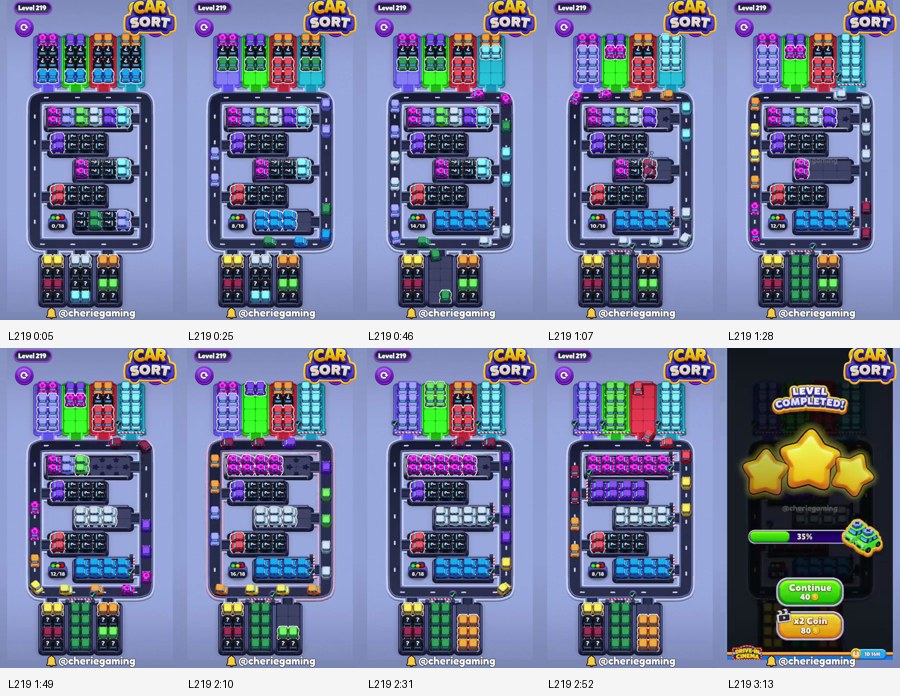
Six Shelves Inside A Tight Perimeter Loop
Car Sort: Color Puzzle Level 219 places six horizontal shelves inside a rectangular road. Four tall towers stand above the loop and four numbered reserve columns sit below it. The internal shelves expose pink, green, purple, white, red, cyan, and dark covered groups. All shelf mouths face the same narrow road, so emptying several rows at once turns the rectangle into a mixed queue.
The route reference shows the upper towers becoming clean pale-purple, green, red, and cyan columns while the inner shelves gradually resolve into full pink, purple, white, red, and blue bands. The lower reserves remain largely closed until the shelves have shortened.
Recommended route:
upper pale purple -> upper green -> upper red -> upper cyan -> top inner pink/green shelf -> purple shelf -> white middle shelf -> red shelf -> blue lower shelf -> bottom green/orange cleanup
Complete one batch before opening the next shelf. The right vertical edge is the main checkpoint: it should never hold two colors.
Establish The Four Upper Garages
Begin with the upper column whose front color has the clearest route, usually pale purple or green on the left. Finish it and wait for the top edge to empty. Red follows from the center-right tower, then cyan on the far right.
Do not start a shelf color while a top car is still rounding the upper-right corner. Every inner row enters beneath that corner and can trap the top batch.
The upper phase is complete when the four towers display strong single-color columns and the perimeter carries no mixed traffic. If a car stalls, complete its tower instead of tapping a covered shelf.
Peel The Internal Shelves From Top To Bottom
The top shelf exposes pink and green closest to the road. Clear the color whose first car already has a free side, then finish the other. Purple becomes the next major band. Keep purple together until the loop is empty.
White occupies a middle shelf and should move after purple. Red follows from the lower-middle row, while blue/cyan is a late bottom shelf. This top-to-bottom order matters because each empty shelf exposes the mouth of the row beneath it.
Use these shelf checks:
- pink/green leaves the top row;
- purple clears without white entering behind it;
- white opens the central lane;
- red moves through an empty lower corner;
- blue waits until the rows above have stopped feeding traffic.
If a shelf counter reveals a different color, pause. Finish the active road batch before reducing the counter again. A new layer can remain parked safely; a new color on the loop cannot.
Leave The Bottom Reserves For The Open-Loop State
The four lower columns show yellow, dark covers, green, cyan, and later orange. They are cleanup reserves. Open one only after the internal shelves have reduced and the lower edge is clear.
Green is a practical first bottom batch because it forms a full column near the center. Orange follows from the far-right reserve after green clears. Yellow or pale-purple layers can use the left side once the loop is empty.
Open one counter, finish its color, and inspect the next layer. Do not make all four counters visible at once. They share the same short lower road.
Final Checkpoints And Recovery
Near completion, the top bank shows pale purple, green, red, and cyan; the inner rows show full pink, purple, white, red, and blue bands; and the bottom has green and orange columns. Choose the complete band closest to an empty road mouth and clear it.
If the right edge blocks, stop every shelf and reserve tap. Finish the color farther around the loop. If the bottom edge blocks, finish the active lower shelf or reserve color before returning to the top.
For a mixed road:
- stop opening counters;
- identify the leading color;
- complete it from its current shelf;
- finish the second color already on the road;
- resume from the highest unfinished shelf.
Avoid starting the long top pink row while cyan still descends the right edge. Pink needs several uninterrupted trips. Likewise, leave bottom orange parked until the blue lower shelf has cleared the bottom corner.
Why The Lowest Blue Row Must Wait
The blue row along the bottom of the inner yard is visible early and looks easier than the partly covered rows above it. It is actually a route lock. Every blue car leaves beside the lower-right corner, then occupies the long bottom edge before climbing toward its garage. If blue starts while the middle white or red shelf is active, it removes the empty stretch those shorter rows need for turning.
Wait until white has cleared the middle and red no longer feeds the lower bend. Then send blue continuously. The row is long enough that pausing halfway to tap a top tower creates a second wave behind it. A completed blue row leaves the whole bottom edge open for the numbered reserves.
If one blue car remains hidden behind a counter, do not open unrelated bottom columns while searching for it. Clear the visible blue batch, let the loop reset, and inspect the same shelf again. If the next layer is a different color, park it and begin the reserve phase from the clear side. This avoids treating a hidden layer as though it were part of the visible blue checkpoint.
The far-left and far-right corners should both be empty after blue. If one still contains a car, finish that road color before touching green or orange below. This single board check prevents most late jams.
Level 219 is solved by shelf depth. The upper towers establish the perimeter, the six inner rows empty from top to bottom, and the bottom reserves wait for an open rectangle. Preserve one-color traffic and every empty shelf becomes real route space instead of a place for another blocked batch.