Car Sort: Color Puzzle Level 253 Solution Walkthrough
Route Reference
Key opening, middle, and finish positions for this route.
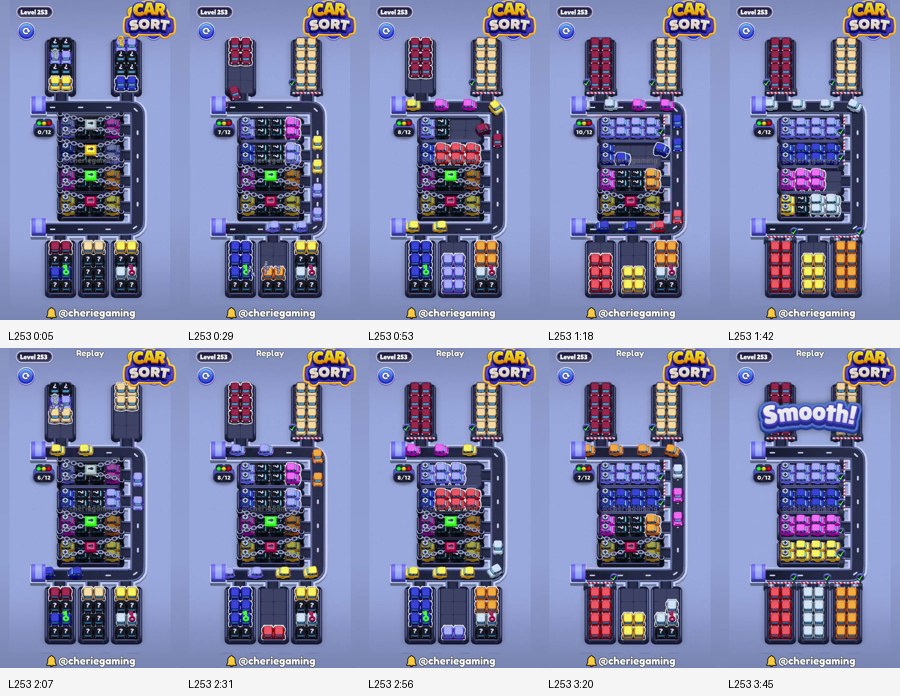
The chained center
The central rectangle contains many dark cars, with colored groups embedded in horizontal bands. Pink, red, orange, blue, purple, yellow, and white become visible as the chains release. Colored screw markers sit across the rows, indicating that normal traffic alone cannot empty the center immediately.
Above the road, the left tower contains blue and later yellow or white, while the right tower contains dark red and beige. Below are four covered columns with red, blue, yellow, orange, and other late colors.
The counter holds twelve cars. Because chain releases can expose several cars at once, keep at least three spaces open near each transition.
Route priority
A reliable order is:
yellow → pink → red → blue → orange → purple → white → beige → remaining dark rows
Yellow appears at accessible road edges and helps advance the first colored screw. Pink then clears a central row. Red connects the center with the upper-right and lower-left sources. Blue uses the upper-left tower and central bands.
Orange, purple, and white belong to the middle and late release stages. Beige is concentrated in the upper-right tower and is easiest when the top road is empty. Dark cars remain behind several bright rows and should be saved for the open-board cleanup.
First screw releases
Begin with reachable yellow cars near the bottom and road edge. Complete the yellow group rather than taking one car from each upper tower. Its removal advances the locks and creates space along the lower perimeter.
When pink becomes available, clear the full pink band. Pink cars occupy a coherent central row in the developed board, making them more valuable than scattered red or blue pieces. Their exit frees the right side of the center.
Red is next when matches from the central band, upper-right tower, and lower-left column are visible. Bring them together in one sequence. A lone red car on the right road can block the beige tower, so do not start red without enough partners.
At the first checkpoint, yellow and pink should be complete and the center should expose a broader red or blue band. Several chains may remain; that is expected.
Coordinating blue and orange
Blue draws cars from the upper-left tower, a central row, and possibly a lower cover. Wait until the central blue band has an exit before pulling the upper tower. Then move the entire blue sequence while the top-left corner is clear.
Orange uses the opposite traffic path. Orange appears in a central group and the lower-right column. Clear blue first if both are active, because its tall tower blocks more of the top route. Orange can then travel through the lower-right bend.
Do not alternate these colors around the ring. They enter from opposite sides and meet at the narrow center exits. Completing one gives the other an empty perimeter.
The replay's middle state shows strong red, yellow, and orange columns outside the center while purple and blue rows remain visible inside. That is a good sign: completed colors should move outward, leaving the chained center progressively simpler.
Purple, white, and beige
Purple is released from a middle band and a lower source. It should be handled after orange clears the lower-right connection. Finish purple as soon as its full row becomes accessible; leaving it half moved can obstruct two chained bands.
White emerges later near the bottom half of the center and can match cars from the upper-left progression. Keep the left vertical road open for it. If beige is also exposed above, leave beige in its tower until white finishes.
Beige is a tall, concentrated group in the upper-right tower. Once the top road is clear, it can leave in a smooth sequence. Taking beige earlier blocks red and orange cars that must pass the same corner.
Each completed bright color should either remove a chain or expose a full dark row. If a move only creates another isolated car, pause and return to the color whose screw marker is closest to release.
Lower covered columns
The four bottom columns are suppliers for missing colors, not the opening targets. Open the column that matches the active group. Red and yellow sources are useful early; blue and orange become useful in the middle.
Keep the road directly above the covers empty. A released car must turn left or right around the rectangle. If a partial purple or white group is parked there, the new car cannot join its match.
When a cover reveals a different color than expected, do not empty the column. Complete the current group using the center or upper towers, then reconsider the new color.
The counter falling from twelve toward zero signals that the board is consolidating. If it remains nearly full across several releases, too many colors are active.
Dark-row cleanup
Dark cars dominate the opening image but are poor early targets. Their rows are split by colored locks and other cars, so they cannot form clean groups at first.
After yellow, pink, red, blue, orange, purple, white, and beige have cleared, the chains no longer divide the center. The remaining dark cars can leave row by row. Use the nearest exposed horizontal band and complete it before moving to the next.
Keep the perimeter flowing in one direction. With few colors left, a head-on traffic conflict is the only remaining way to lose space unnecessarily.
Recovery checkpoints
If the center remains fully chained, finish yellow or pink from exposed positions. Random dark-car taps will not create the required release.
If the top road is blocked, complete blue, red, or beige according to the waiting car's color. Do not pull another tower while one is in transit.
If the bottom covers are all open and traffic is mixed, stop releasing cars. Finish the color with a complete central band, then clear the lower entrance before continuing.
If a screw release exposes multiple colors, use the one that already has partners in an upper or lower column. Leave the other cars in place.
For a restart, use four milestones: yellow begins the release; pink opens the center; red and blue clear the upper connections; orange, purple, white, and beige finish the bright rows before the dark cleanup. This order respects the physical chains rather than guessing hidden cars.
The Level 253 solution is a controlled unlocking sequence. Complete the color tied to the next useful screw, reserve counter space for newly freed cars, and delay the dark mass until the colored rows are gone. Once the final chains release, the intimidating center becomes a straightforward set of horizontal groups.