Car Sort: Color Puzzle Level 269 Solution Walkthrough
Route Reference
Key opening, middle, and finish positions for this route.
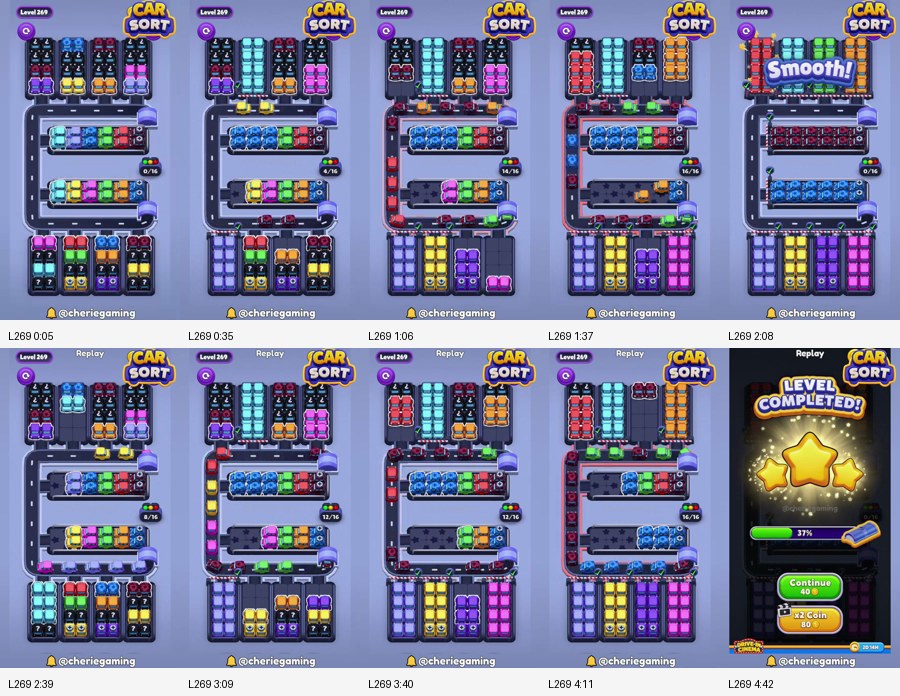
Reading the two decks
The upper shelf contains pale violet, cyan, green, red, blue, and dark cars. The lower shelf contains yellow, pink, green, orange, and covered spaces. Above them are tall stacks with red, cyan, orange, pink, purple, yellow, blue, and dark shades.
Below the road, four columns later supply pale violet, yellow, purple, pink, cyan, red, blue, and other colors. Their entrance connects directly to the lower deck.
The counter holds sixteen cars. It supports long shelf groups, but the shared left spine can still block even when counter space remains.
Recommended route order
Use:
cyan → red → blue → green → yellow → pink → orange → pale violet → purple → remaining dark cars
Cyan clears a strong upper group and opens the top deck. Red and blue then simplify the upper shelf and towers. Green bridges the two decks.
Yellow, pink, and orange clear the lower shelf. Pale violet and purple coordinate with the bottom releases. Dark groups belong to the final open-road phase.
Upper-deck opening
Start with cyan from the upper shelf and matching top tower. Move all cyan cars in one direction around the upper turnaround. Keep the shared left spine free of lower traffic.
Red follows from the upper shelf and top-left progression. Complete bright red before touching a similar dark-red column below.
Blue becomes a strong upper group after red clears. Send the full row through the same deck. Do not pull yellow from the lower shelf during this sequence.
The first checkpoint is an upper shelf with cyan, red, and blue organized or removed, while the lower deck remains mostly untouched.
Green as the deck transition
Green appears in both horizontal shelves and an upper tower. It is the bridge color between phases, but the sources should not enter from opposite directions simultaneously.
Clear the upper green pieces first, let the shared spine empty, then take the lower green source. Complete the group in one destination.
Green's removal opens the left connection for lower traffic. From this point, avoid returning to an upper tower unless it supplies an exact match.
If another green group appears later, treat it separately rather than leaving an opening car active through several phases.
Lower yellow, pink, and orange
Yellow is the best first lower-deck target because its row has a direct turnaround and matching bottom supply. Complete yellow before releasing purple.
Pink follows from the lower shelf and bottom-right column. Keep the lower right bend dedicated to pink until the group finishes.
Orange occupies the remaining lower row and an upper-right tower. Wait until the shared spine is empty, then combine the two sources.
These three clears should leave the lower shelf largely empty and make the bottom covered columns easy to access.
Four lower covered columns
Open one column at a time. Pale violet is often the most useful first late group because it matches cars from the upper progression and the leftmost bottom supply.
Purple follows from the middle-right column and an upper tower. Complete it before activating cyan or red repetitions behind neighboring covers.
If a cover reveals a color that already formed an earlier group, determine whether a full second set is visible. Do not hold a single repeated-color car indefinitely.
Reserve several counter spaces before every release. Bottom columns feed directly onto the lower deck and can trap each other at the entrance.
Top-tower cleanup
After the lower covers resolve, return to any remaining upper towers. Their orange, pink, cyan, or dark cars now have an empty upper deck.
Complete each tower from front to back without sending a different color onto the lower road. The shared spine should carry one direction of traffic.
Dark cars remain behind bright tower sections and are easiest last. Similar shades should be sorted into separate complete rows.
The successful late state shows clean red, cyan, green, and orange towers above; blue or dark rows on the upper shelf; and pale violet, yellow, purple, and pink columns below.
A practical deck handoff check
Before switching from one deck to the other, wait until the shared spine contains no moving car and the previous color has entered a uniform garage. Then inspect the destination deck from its far turnaround back toward the spine. If the far bend is occupied, finish that waiting color first; a newly introduced group would have nowhere to circulate.
This short pause is especially useful after green, because the board visually changes from an upper-shelf puzzle into a lower-shelf puzzle. It is also useful before returning to the top towers near the end. A clean handoff prevents a late orange or cyan car from meeting a pale-violet or purple car released below.
Recovery plan
If the shared left spine is blocked, finish the color currently using it. Stop all entrances from the opposite deck.
If the upper turnaround is jammed, complete cyan, red, blue, or green before moving a bottom column.
If the lower turnaround is blocked, finish yellow, pink, orange, pale violet, or purple. Do not activate an upper tower for an unrelated color.
If several lower covers are open, choose the column whose full color is already visible and leave the others parked.
If repeated colors cause confusion, regard each physical tower as a separate group until enough matching cars are exposed to merge safely.
On restart, use the deck transition: cyan, red, and blue own the top; green changes control; yellow, pink, and orange own the bottom; pale violet, purple, repeated colors, and dark cars finish after the covers.
The Level 269 solution is successful when only one deck uses the central spine at a time. Clear the upper colors, let green bridge the transition, and finish the lower shelf before opening several covered columns. That traffic discipline matters more than the exact garage assigned to each finished group.