Car Sort: Color Puzzle Level 271 Solution Walkthrough
Route Reference
Key opening, middle, and finish positions for this route.
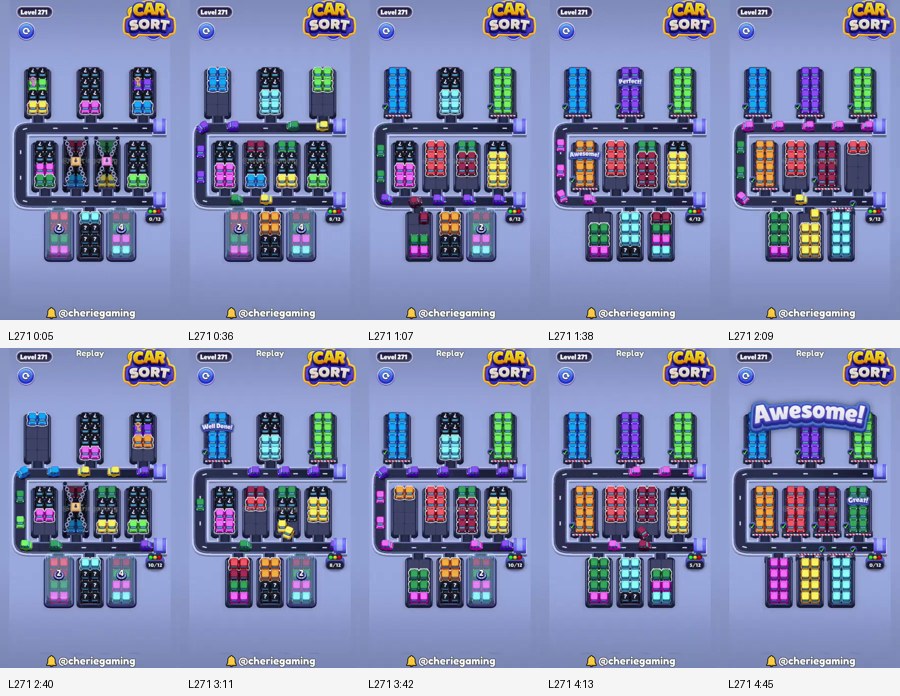
Reading the opening board
The central rectangle contains four vertical bays. The left and right bays show green and yellow cars behind dark blockers, while the two middle bays are tied by chains with colored locks. The upper towers initially mix blue, purple, green, cyan, pink, orange, and dark cars.
Below the road are three covered columns. Pink and green are visible on the outer two, while orange and dark cars emerge from the middle progression. All three lower columns enter through the same bottom road.
The counter holds twelve cars. A newly released central bay can expose several pieces, so keep at least three spaces free near each chain transition.
Recommended route priority
Use:
blue → cyan → green → pink → orange → red → yellow → purple → pale violet → dark cleanup
Blue and cyan clear the upper towers and open the top road. Green advances the central locks and connects to the lower-left supply. Pink removes a strong central or lower group.
Orange and red simplify the left half of the inner block. Yellow clears the right bay. Purple and pale violet become concentrated after the chains release, while dark cars remain for the open-board finish.
Clearing the upper towers
Start with blue from the upper-left progression. Complete one full blue group without pulling purple from the neighboring tower. Blue's removal opens the top-left corner.
Cyan follows from the middle tower and central matches. Move the whole group through the top edge while the road is empty.
Green is the first bridge color. Some green cars sit in the upper-right tower, others appear inside the central block or lower-left column. Wait until enough are visible, then complete the group as one sequence.
The first checkpoint is a clear upper road with blue and cyan organized and the green lock advanced. Do not expect both center chains to be gone yet.
Opening the chained middle bays
When a chain releases, inspect the front color. Take it only if its partners are already available in an upper tower, outer bay, or lower column.
Pink is commonly the first useful released group. Complete the visible central pink cars and use the lower supply as finishing pieces. Keep the bottom road dedicated to pink.
Orange follows from the left-central bay and middle lower progression. It uses the bottom-left corner, so wait until pink has fully cleared.
Never activate both chained bays simultaneously. Two long releases can fill the twelve-space counter and block the inner rectangle before either color completes.
Reserve several spaces whenever a numbered lower cover or chain is close to changing. A second color may become visible immediately behind the first.
Red and yellow side bays
Red becomes concentrated in the middle-left bay after orange leaves. Complete red before starting yellow, because both exit through the lower road.
Yellow occupies the right central bay and receives matches from a lower or upper source. Clear the inner yellow cars first, then use the external column to close the group.
The developed replay shows orange, red, dark red, and yellow as clean central columns. That is the correct structural checkpoint even if the game places colors in different bays.
If red and dark red are both visible, keep their shades separate. Finish the group with the larger exposed central column first.
Purple and pale-violet late phase
Purple appears in the upper-middle progression and behind a central chain. It is safer after yellow clears the right route.
Pale violet comes from another upper tower and a lower release. Complete purple first if both colors are active, because its source is usually more concentrated.
Use the now-empty central bays as destinations for uniform groups. Do not refill them with mixed leftovers from multiple towers.
Dark cars remain behind the colored fronts and chains. With the center open, sort one dark shade at a time and keep the perimeter moving in a single direction.
Upper and lower traffic rules
Before moving an upper tower, check both top corners and the right vertical edge. Before opening a lower column, check the entire bottom road.
Allow one entry zone at a time. A complete upper group can finish safely; an upper pair meeting a lower pair may lock the corner even when counter slots remain.
When a central bay empties, pause before changing color. Confirm that the road contains no lone car and the next group has enough visible partners to complete.
The late board should show clean upper blue, purple, and green towers, organized central orange, red, and yellow bays, and uniform lower pink, yellow, or cyan columns.
Recovery advice
If the top edge is blocked, finish blue, cyan, green, purple, or pale violet according to the waiting car. Do not open a bottom cover.
If the lower road is jammed, finish pink, orange, red, or yellow before touching the upper towers.
If a chain releases an unusable color, leave the car inside the bay and complete a visible tower group.
If the counter contains several pairs, prioritize a complete central column. Empty interior space improves every later route.
If green is split across top, center, and bottom, clear blue or cyan first, then combine all green sources through one open side.
For a restart, use four phases: blue and cyan open the top; green and pink advance the locks; orange, red, and yellow clear the center; purple, pale violet, and dark cars finish with the road empty.
The Level 271 solution is a controlled chain-release route. Prepare a complete color before opening each central bay, separate upper and lower traffic, and reserve counter space for newly exposed cars. Once the red and yellow side bays clear, the final purple and dark groups have an easy path.