Car Sort: Color Puzzle Level 275 Solution Walkthrough
Route Reference
Key opening, middle, and finish positions for this route.
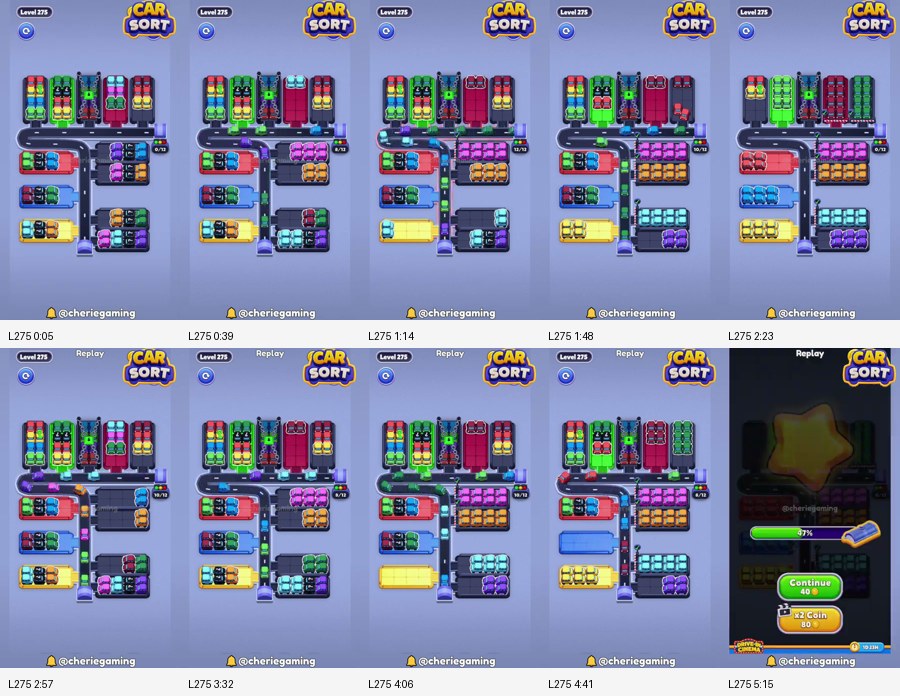
Reading the split shelf layout
Three short garages sit on the left and three on the right. The left rows contain red, cyan, green, yellow, orange, and dark cars. The right rows contain pink, purple, orange, cyan, green, and covered colors. Their exits point toward a single central spine.
The five upper towers supply yellow, green, red, blue, pink, cyan, dark red, and chained colors. A horizontal road beneath them joins the spine, making the upper-right and upper-left corners shared traffic points.
The counter holds twelve cars. A complete shelf row fits, but several cross-board pairs quickly consume every space.
Recommended route priority
Use:
red → blue → yellow → pink → orange → cyan → purple → green → dark red and remaining dark cars
Red clears an exposed left shelf and advances the upper locks. Blue opens another left row. Yellow removes the lowest left shelf and connects to a top tower.
Pink and orange then simplify the right bank. Cyan and purple clear the lower-right shelves. Green becomes easier after the center is open, while dark shades remain behind the bright tower fronts.
Opening the left shelves
Start with red from the upper-left horizontal row and matching top source. Complete red without pulling pink from the opposite bank.
Blue follows from the middle-left row. Move the whole group through the center in one direction and keep the top intersection clear.
Yellow occupies the lowest left shelf and an upper tower. Clear the shelf source first, then use the tower pieces as finishing matches.
The first checkpoint is a left bank with red, blue, and yellow organized or removed, plus an empty lower bend. The right shelves can now use the central spine without opposing traffic.
Upper tower lock timing
Several tower sections begin restricted by colored locks. Let complete left-side groups advance those requirements.
When a tower opens, take its first car only if it matches the active group. Otherwise leave it parked above the road.
Reserve at least three spaces before a lock reaches its final step. A tower may expose two different colors quickly.
Do not empty an unlocked tower automatically. Its purpose is to provide exact matches for the current shelf, not introduce a new sequence.
Pink and orange on the right
Pink becomes the strongest first right-side target. Its upper shelf and tower pieces can form a complete group once the central road clears.
Orange follows from a middle-right row and an upper progression. Wait until pink has left the upper intersection, then complete orange.
If orange also appears in a left shelf behind yellow, merge the sources only when the spine is empty. Do not park orange cars at both ends.
These two colors should create large clean rows on the right and expose cyan or purple beneath them.
Cyan and purple lower-right cleanup
Cyan occupies a broad lower-right shelf and may have matches in a top tower. Move the shelf cars first, then close the group from above.
Purple follows through the same lower bend. Keep cyan and purple separate even when their destinations sit side by side.
The replay's developed state shows pink and orange as upper-right rows, cyan and purple below, while red, blue, and yellow remain clean on the left. That balanced shape is the central Level 275 checkpoint.
If a covered row releases green during this phase, leave it until purple has vacated the road.
Green and final upper colors
Green appears in several upper towers and deeper side shelves. It is widely distributed, so it becomes efficient only after both banks are open.
Collect the exposed green sources in one run. Use the empty central spine and complete the group before returning to dark red.
Dark red and dark cars sit behind brighter tower fronts. Sort each shade independently. A nearly black car and a dark red car may look similar but use different garages.
The final board should contain uniform top towers and clean horizontal side rows. Exact garage positions may differ from the replay as long as every group is complete and the center road is empty.
Central-spine discipline
Before changing colors, trace the road from the top intersection to the bottom exit. Any stationary car must be completed before a new row begins.
Allow one bank to use the spine at a time. Left and right traffic entering together can meet in the middle and immobilize several shelves.
When an upper tower supplies the final match, wait until the tower car reaches its garage before tapping the next shelf end.
Empty shelf space should hold a uniform group. Mixed parking removes the benefit of clearing that side.
Recovery advice
If the center is blocked, finish the color of the car nearest the top intersection or bottom bend. Do not unlock another tower.
If the left bank remains crowded, return to red, blue, or yellow before working on pink and orange.
If pink and orange are both active, finish pink when its full top row is exposed; otherwise complete orange from the concentrated middle shelf.
If cyan and purple meet at the lower bend, finish cyan first because its larger shelf creates more space.
If green is scattered across several towers, clear one visible side-row color to open the spine, then consolidate all green sources.
For a restart, use four milestones: red, blue, and yellow empty the left; locks supply exact matches; pink and orange open the right; cyan, purple, green, and dark shades finish through the clear spine.
The Level 275 solution is a bank-by-bank route. Complete the left shelves before transferring control to the right, use upper towers as finishing supplies, and never let two colors wait in the central spine. That discipline keeps the long five-minute board predictable.