Car Sort: Color Puzzle Level 279 Solution Walkthrough
Route Reference
Key opening, middle, and finish positions for this route.
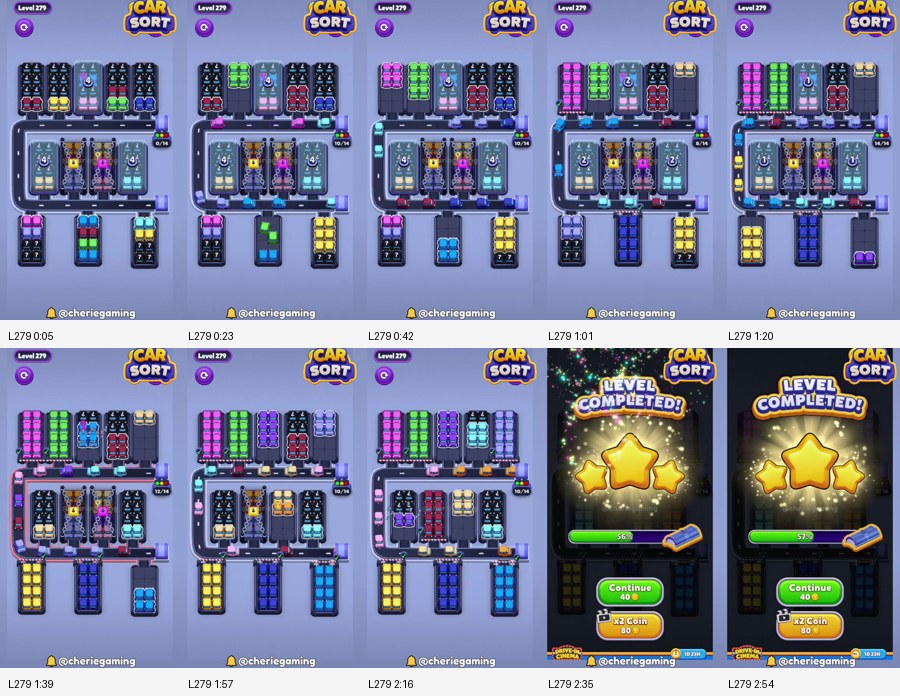
Reading the locked center
The interior rectangle contains four tall bays. The two middle bays are tied by yellow and pink locks. The outer bays hold pale yellow, cyan, and dark cars behind counters. The five upper towers contain pink, green, purple, blue, red, cyan, pale violet, beige, and dark shades.
Below the road, the left and right columns begin covered while the middle column shows red, green, blue, or later dark blue. All lower traffic enters through the same bottom edge.
The counter holds fourteen cars. A chain release can expose a long group, so reserve several spaces and avoid carrying pairs from multiple upper towers.
Recommended route order
Use:
pink → green → red → yellow → blue → cyan → purple → pale violet → beige → dark cleanup
Pink and green clear strong upper towers and advance the middle locks. Red connects an upper source with the lower progression. Yellow becomes the first major central release.
Blue and cyan open the remaining interior and lower columns. Purple, pale violet, and beige are concentrated in the late upper towers. Dark shades remain behind bright fronts and numbered bays.
Opening the upper towers
Start with pink from the upper-left progression. Complete the full visible column before taking green from the neighboring tower.
Green follows through the top road. Some matches may sit behind an interior cover, but use them only when the full group is ready.
Red becomes exposed in the upper-right tower and middle lower column. Wait until the bottom road is clear, then combine the two sources.
The first checkpoint is a clean top edge with pink and green organized, red completed or nearly complete, and enough counter space for a chain transition.
Yellow chain release
The yellow lock in the center advances through the opening groups. Prepare visible yellow cars from the outer bays or lower source before it reaches zero.
When the tower releases, move every yellow car in one sequence. Keep the bottom edge and right side clear until the group finishes.
Do not begin blue while yellow is in transit. Both groups are long and together can exhaust the fourteen slots.
Yellow's removal creates a central bay that should remain empty or receive one complete later color.
Pink lock and second center group
The neighboring lock may release another pink, purple, or dark group. Check the visible front color and its external partners.
If it is pink and the opening pink group has already finished, confirm that a complete second set is visible before moving it. Repeated colors should be treated as separate groups.
If the release is purple or pale violet, leave it until blue and cyan clear the road. The new car can wait safely inside the bay.
Never empty both central towers simultaneously. Complete one released group, clear the perimeter, and then activate the other.
Blue and cyan lower transition
Blue appears in the middle lower column and upper progression. Complete it after yellow, using the open bottom entrance.
Cyan follows from an interior outer bay and a lower or upper tower. Its pale color is easy to distinguish from blue; keep the groups separate.
These clears remove the remaining major central blockers. At the checkpoint, yellow, blue, and cyan should form clean columns while the rectangle has open turning space.
If a numbered bay reveals red again, finish the complete repeated group only when its partners are visible. Do not leave a lone red car circulating.
Purple, pale violet, and beige
Purple becomes concentrated in an upper tower after green or blue leaves. Complete it through the top route.
Pale violet follows from another upper progression and possibly a lower cover. Wait until purple has vacated the road.
Beige appears late in the upper-right tower and central bay. It is most efficient after the bright columns clear because both sources can then connect directly.
Finish each shade independently. Similar purples may use different destination garages, so follow the accepted color rather than visual approximation.
Dark-car cleanup
Dark cars begin behind almost every bright upper tower and central cover. Their sources are too divided for a useful opening group.
Once the colored groups have cleared, complete each dark shade one at a time around the empty rectangle.
The successful late board shows pink, green, purple, red, beige, and pale violet above; yellow, blue, and cyan below; and organized dark columns inside.
Exact garage placement may vary, but every destination should contain one color and no car should remain parked on the road.
Recovery advice
If the top road is blocked, finish pink, green, purple, pale violet, red, or beige according to the waiting car.
If the bottom entrance is jammed, stop opening covers and finish yellow, blue, cyan, or the active lower group.
If both chains release, commit to the color with more visible matching cars and leave the other tower untouched.
If the counter contains repeated colors from different sets, finish the group tied to a complete physical tower first.
If purple shades are mixed, separate them by destination and move one full shade before the other.
For a restart, use four milestones: pink, green, and red prepare the locks; yellow clears the first center tower; blue and cyan open the lower and outer bays; purple, pale violet, beige, repeated groups, and dark cars finish on the empty loop.
The Level 279 solution is a prepared chain route. Use compact upper columns to advance the locks, move each released center group without interruption, and preserve the bottom entrance for blue and cyan. Once the interior is open, the remaining upper shades are straightforward.