Car Sort: Color Puzzle Level 299 Solution Walkthrough
Route Reference
Key opening, middle, and finish positions for this route.
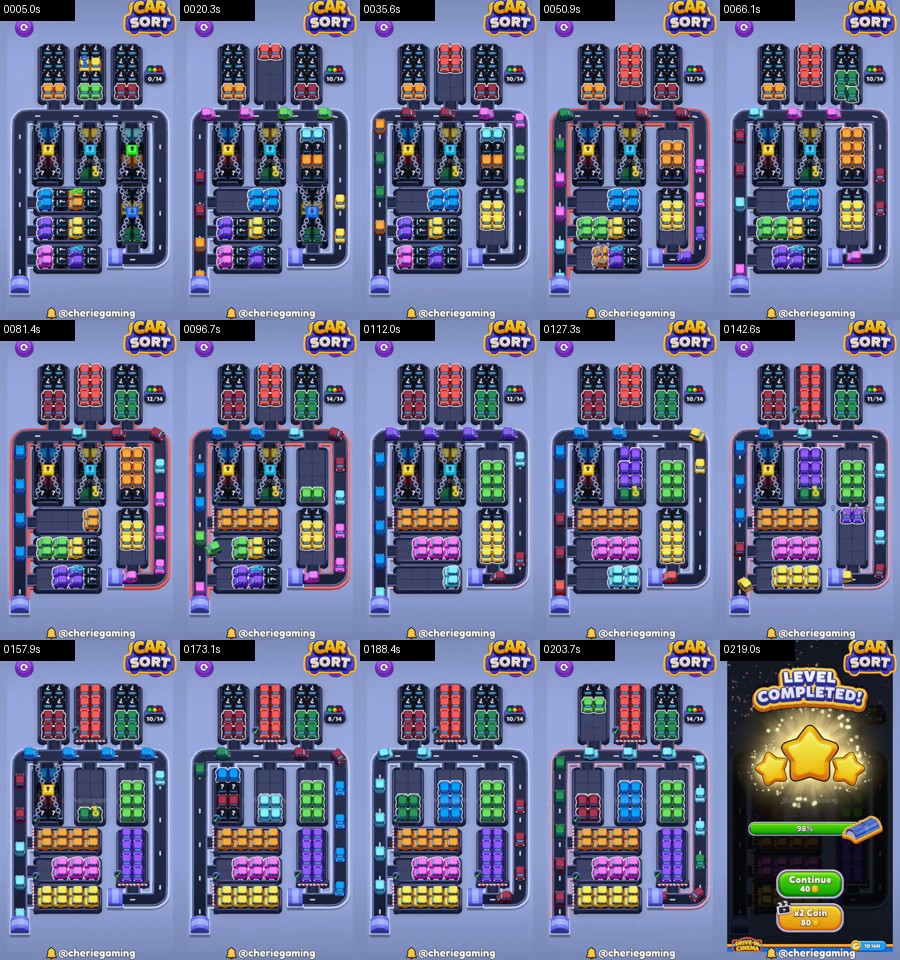
Open one hanging lane at a time
Blue is the first practical center color. Move the exposed blue group and use the upper road until its batch is complete. Orange follows on the right side, reducing the column beside the yellow guard. Green then becomes available through the middle gap.
Use this sequence:
blue center opener → orange right column → green middle → purple lower bars → pink band → pale cyan → yellow → upper red and green finish
The hanging locks make partial batches costly. If blue is still circulating, do not start orange simply because its garage has opened. A car waiting between two locked columns blocks both lanes at once.
After green has created central room, move purple from the lower-left chained bars. Purple clears the deepest horizontal blocker and exposes the pink row beneath it. Finish pink before pale cyan. These two colors share the bottom entrance, but pink has the shorter exit and gives cyan the wider road it needs.
Turn the lower edge into a cleanup lane
Pale cyan is the bridge to the late yellow stack. Clear cyan through the lower road, then release yellow from the right. Yellow should appear as a clean horizontal band near the bottom; if it is mixed with pink or purple, an earlier batch is unfinished.
With the lower edge open, the tall upper garages can drain their remaining red and green columns. Blue may reappear as a final upper batch, but it is safe now because all three hanging lanes have already been opened by the center sequence.
If the road is blocked at the top, complete the active upper garage color. If it is blocked below the hanging columns, finish purple, pink, cyan, or yellow according to the visible batch. When a lock remains closed, return to the color immediately beside it; tapping an unrelated top garage does not create a new center path.
Treat each hanging column as a gate
The three suspended locks divide the center into narrow lanes. Cars can circle the large rectangle, but they still have to pass the openings above or below those columns. A partial batch left under one lock therefore blocks more than its own color; it can remove access to two sections of the road at once.
Blue opens the first useful passage. Complete the visible blue center group and wait until the upper portion of the rectangle is clear. Orange then works the right lane beside the yellow guard. Green uses the middle after those two colors have reduced pressure around the hanging blocks.
The first major checkpoint is reached when blue, orange, and green no longer form short mixed columns beneath the locks. At that point the route through the center is continuous enough for the lower chained bars. Before this checkpoint, purple and pink should remain in place even if their front cars look available.
Open the center, then sweep the bottom
- Move blue from the exposed center and finish its complete garage batch.
- Clear orange beside the right hanging lane. Keep yellow waiting behind its lower-right guard.
- Release green through the middle gap. Green creates the shared passage used by the chained bars.
- Empty purple from the lower-left horizontal blockers. Purple removes the deepest obstruction along the bottom entrance.
- Complete pink from the band uncovered beneath purple. The lower-left corner should now be open.
- Send pale cyan through the bottom road. Cyan is the bridge between the cleared bars and the guarded yellow stack.
- Release yellow on the right and let it form one clean late batch.
- Drain red from the upper garages after the lower edge has cleared.
- Finish the remaining green or blue upper column according to the active garage face.
- Collect any short center remnant before tapping the last tall garage.
This is a two-stage route. The first three colors create lanes between the hanging locks; the next four turn the bottom edge into usable road. The upper towers belong after both stages, not between them.
Use yellow as the late-board checkpoint
Yellow should not appear as mixed traffic scattered through the center. It should leave the lower-right stack after purple, pink, and cyan have vacated the bottom entrance. When yellow forms a clean horizontal group and parks without meeting another color, the level has entered cleanup.
If yellow is blocked by cyan, finish cyan. If it is blocked by pink or purple, return to the first incomplete chained bar. Opening red from above cannot solve congestion below the hanging columns.
Recovery for the three common jams
A jam at the top of the rectangle usually means an upper blue, orange, red, or green batch is unfinished. Finish the color already using the top road and keep the other garages closed. A jam directly between the locks points to blue, orange, or green from the opening sequence. Do not touch the chained lower rows until that center color has parked.
A jam along the bottom edge belongs to purple, pink, cyan, or yellow. Work in that dependency order whenever several are visible. Purple exposes pink, pink makes room for cyan, and cyan clears the approach to yellow. Reversing that sequence causes the right guard to feed cars into a lane that is still occupied on the left.
If a lock remains visibly closed late in the run, identify the matching group immediately beside it rather than searching the outer road. Completing that local color normally releases the cover. Once all three passages are open, the final red and green tower groups can circle the rectangle without competing with center traffic.
The Level 299 walkthrough succeeds by converting three locked lanes into one continuous passage. Blue, orange, and green open the center; purple, pink, cyan, and yellow clear the lower bars; red and green then leave through an uncluttered outer road.