Car Sort: Color Puzzle Level 309 Solution Walkthrough
Route Reference
Key opening, middle, and finish positions for this route.
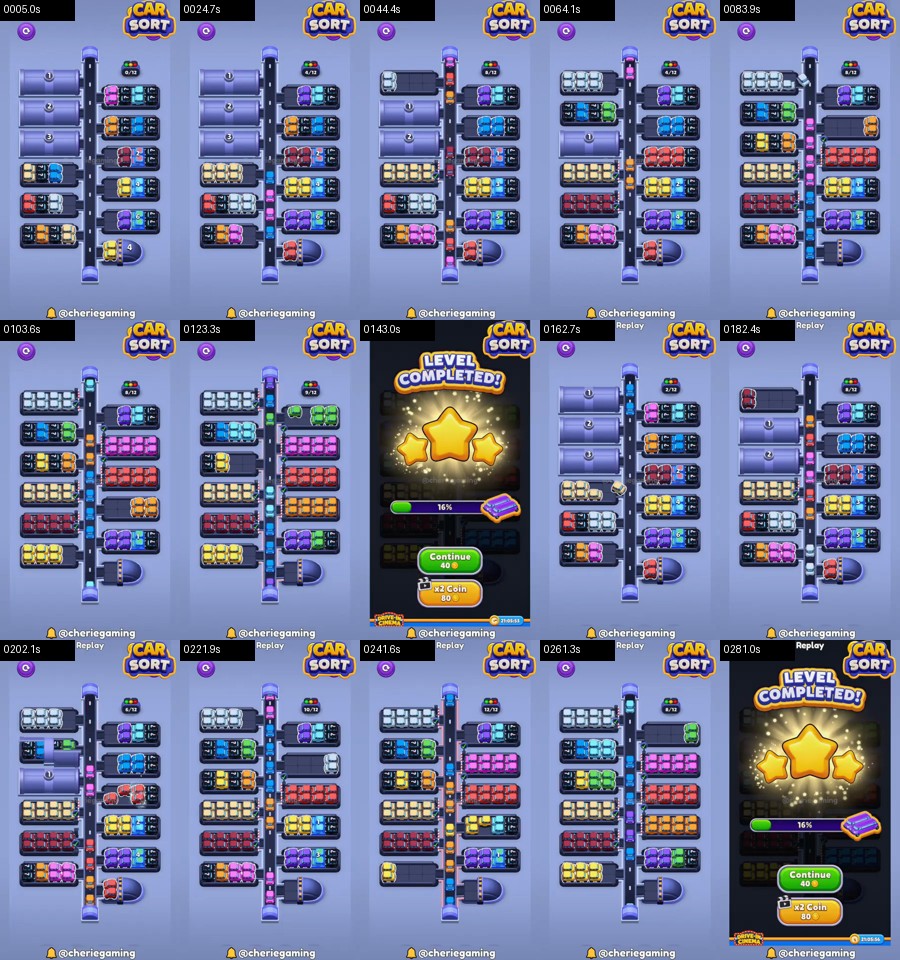
Clear shelf pairs around the spine
Begin with white from the upper-left shelf and purple from the upper-right. Finish white first because it opens the top turn beside Garage 1. Purple then uses that empty turn and exposes the blue shelf below.
Use this shelf order:
white → purple → blue → cyan → red → yellow → orange → pink → green → beige cleanup
Blue and cyan form the next pair. Keep them separate on the vertical spine. Red follows from the middle-right shelf and releases a deeper Garage count. Yellow then moves from the opposite side.
Orange and pink are lower shelf batches. Orange has the cleaner path toward the bottom cylinder, so clear it first. Pink follows after the lower turn is empty. Green is saved for the last substantial shelf because its group spans the road longer than the earlier short batches.
Let the numbered cylinders open naturally
The cylinders marked 1, 2, and 3 do not need to be forced. Completing the shelf pairs exposes their matching columns in sequence. Beige is a late cylinder release and should use the spine only after green has parked.
If traffic stops halfway down the board, complete the color already on the spine. If an upper cylinder stays closed, finish white, purple, blue, or cyan. A lower-cylinder stall points to red, yellow, orange, pink, or green. Opening another shelf while a batch is incomplete creates two opposing queues with no passing space.
Use the shelf numbers as vertical checkpoints
Each right-hand shelf carries a small number, and the left rolled doors open from the top down as those shelf groups finish. Read the board by height. The white row at the upper left and the purple row at the upper right own the first section of road. Below them, blue and cyan form a second pair; red and yellow occupy the middle; orange, pink, and green sit closer to the bottom garage. A lower shelf may be visibly complete while the cylinder above it is still taking up the lane.
Clear white until its entire upper-left face is dark. The cars have only a short approach to the top of the spine, but the last marker still needs time to turn into its destination. Purple follows from the opposite shelf. Do not alternate between the two sides, because all traffic merges into the same one-cell-wide vertical road.
Blue and cyan are the next useful pair. Take the higher exposed row first. When both have finished, the first rolled cylinder should retract and reveal a beige or pale row on the left. Leave that newly revealed group parked until the right-side batch already on the spine has cleared.
Work through the middle without skipping height
Red occupies a long mid-right shelf and should be sent as one uninterrupted group. Yellow follows from the shelf across the spine or immediately below it. These warm colors are a useful midpoint because their departure leaves obvious dark horizontal bays on both sides. If one bay is only partly black, return to that color rather than descending to orange.
Orange is safe when the lower turn beside the round cylinder is empty. Pink comes next and often forms a wider right-hand row than it first appears. Let the whole pink batch pass the bottom junction. Green then has the long uninterrupted road required for its tall shelf.
The replay's late state shows most right shelves as solid, reorganized color rows while one or two left cylinders have opened. That does not change the basic rule: finish the highest complete shelf connected to the spine. The rolled doors are progress gates, not shortcuts around a waiting convoy.
Release beige and the cylinder contents last
Beige appears prominently on the left once the upper cylinders have dropped. It is tempting to clear it immediately because the face is large and uniform. Wait until the active right shelf is dark. Beige enters from the opposite side of the spine and can trap a lower orange or green car if it starts early.
After beige clears, check the remaining cylinder numbers. A door marked one should be resolved by the complete shelf at the same height. A lower door marked four still depends on several finished batches and should remain closed during the roof phase. Never tap a fragment revealed at the edge of a rolling door; wait for the full face and the end of its opening animation.
The final sequence usually leaves short red, yellow, green, or pale rows on alternating sides. Continue from top to bottom even though the board looks mostly open. A high car blocks every lower car on this road, so shelf height remains more important than color preference through the final convoy.
Fix a stalled vertical queue
When cars stop above a shelf entrance, compare the stationary car with the full row at that height. Complete that row. When the queue forms below the middle, inspect orange, pink, green, and the round lower garage. Do not send an upper beige batch down through a lower blockage.
If two colors already occupy the spine, stop tapping. Finish the higher source first, allow those cars to reach their garage, then complete the lower source. A restart is necessary only if the higher destination remains hidden and neither group can move. On the next attempt, wait for a completely empty vertical strip after every shelf.
The dependable rhythm is upper pair, second pair, middle warm rows, lower rows, then the newly exposed cylinder faces. Following the height bands turns Level 309 from a crowded wall of colors into a simple series of one-lane deliveries.
Level 309 is solved shelf by shelf: alternate the upper white/purple and blue/cyan pairs, move through red, yellow, orange, and pink, then let green and the beige Garage release finish an otherwise empty vertical road.