Car Sort: Color Puzzle Level 320 Solution Walkthrough
Route Reference
Key opening, middle, and finish positions for this route.
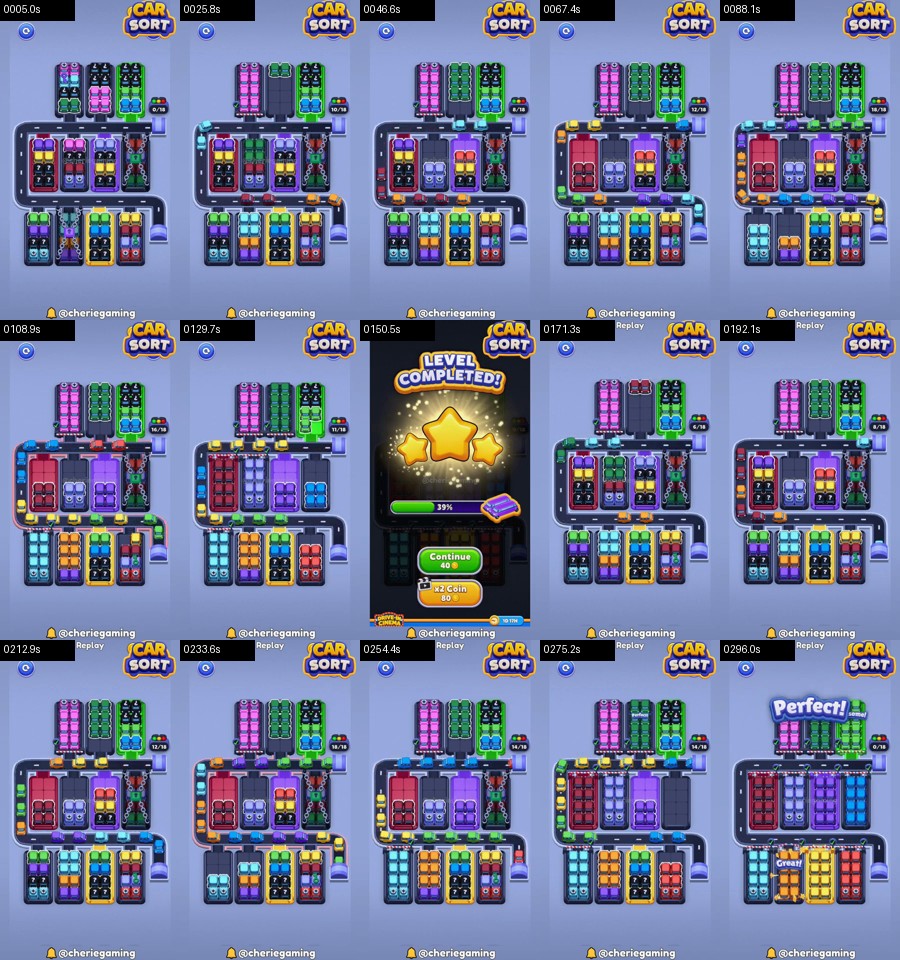
Establish a one-way spine
Begin with the exposed red cars on the left and complete their short shelf. Green follows from the upper-right side. Orange is next, opening the first numbered cylinder and removing pressure from the upper turn.
Use this route order:
red → green → orange → pale violet → pink → blue → cyan → white → dark red → yellow → final green
Pale violet and pink clear the middle shelves. Keep violet together until it parks, then allow pink to use the spine. Blue follows as the first long right-bank row. Cyan uses the same vertical lane after blue has left.
White and dark red are lower transitions. White opens the deepest left cylinder; dark red clears the matching right shelf. Yellow should be held for the late lower turn because its group spans almost an entire row. Green is the final broad cleanup once both shelf banks are fully exposed.
Recover by matching the nearest shelf
If the spine contains mixed cars, complete the color nearest its matching Garage instead of opening another shelf. If a left cylinder remains numbered, finish the row directly opposite it. A right-bank row should never begin while a car is still waiting at the upper or lower turn.
The useful checkpoint is a board with uniform red, violet, blue, cyan, pink, and green bands. When the colors have consolidated into those long rows, the final phases are straightforward.
Level 320 becomes orderly when the central road stays one-way. Clear the short red, green, orange, violet, and pink fronts, then run blue, cyan, white, dark red, yellow, and green through the exposed shelf banks.
Read the two banks as opposing queues
The road is a narrow vertical rectangle separating a tall left bank from a tall right bank. Every shelf points toward the same central spine. The left side begins with mixed red, green, orange, pink, cyan, blue, and white fronts, while the right side contains translucent numbered platforms that later become uniform cream, green, orange, blue, and red rows.
Begin with the exposed dark-red face near the upper-left. Clear it completely. Green follows from the opposing upper shelf after red has left the top bend. Orange then opens the first numbered platform and creates a visible gap across the center.
The opening is safe when the spine is dark and the topmost shelves on both banks have become solid faces. Do not tap a lower pink or blue row merely because it is visible; a partial group entering from below can meet the opening traffic halfway up the spine.
Consolidate the mixed middle shelves
Pale violet is the first useful middle color. Drain its full row and wait for the last marker to leave the lower turn. Pink follows from the neighboring shelf. The two rows should not overlap because both need the same central merge.
Blue becomes the first long right-bank batch. Clear it only when the left side has stopped feeding cars. Cyan follows through the empty lane. These large groups transform the right bank from scattered covered cells into long, readable rows.
At the middle checkpoint, look for distinct horizontal bands: red or violet high on the left, blue and cyan through the right, and pink or green lower down. If the board still contains several short mixed fronts, complete the row touching the spine rather than opening a deeper cylinder.
Unlock the four left cylinders locally
The purple cylinders embedded in the left bank hold deeper faces. A cylinder number drops when the shelf beside it finishes, not when an unrelated matching color moves elsewhere. Work from the highest exposed cylinder downward.
White is an important lower transition. Its row opens one of the deepest cylinders and leaves a clean approach to the bottom bend. Dark red follows from the facing right shelf. Do not combine it with the opening red group; this is a separate late batch with its own source.
When a cylinder reaches zero, clear the full color immediately revealed beside it. That may be orange, green, pale violet, or cyan. Finish that row before moving diagonally to another numbered cylinder.
Run the long right-bank rows
Once the counters have fallen, the right bank displays broad blue, cyan, pink, green, cream, and orange rows. Choose the complete row nearest the open spine. Let it use the entire rectangle, then move down to the next.
Yellow spans a late lower row and should be saved until the bottom turn is empty. Its cars take a long route and can hold the spine while the shelf already appears dark. Wait for the final yellow marker to park before starting green.
Green is often the largest cleanup batch. Drain it continuously from the lower-right or left-facing row. Its departure exposes the final red, cream, or blue face.
The replay's late state shows long uniform rows on both banks rather than numbered cells. At that point, alternate sides only after a complete reset: one left row, dark spine, one right row. This preserves the one-way rhythm that the board requires.
Final bottom-up sweep
Clear the lowest complete face first if it controls the bottom bend. White, yellow, green, or orange may occupy that position. Once the bend is dark, move upward to red, blue, or cyan.
Do not reopen a solved row because the same color appears on the opposite bank. Repeated colors are deeper layers and must be handled independently. Position and access determine the order.
Before the last batch, all four left cylinders should be open, every translucent right platform should be gone, and the spine should contain no parked marker. Release the one remaining solid row and let it complete a full circuit.
Recovery for opposing traffic
If cars stop at the upper turn, finish the active upper red, green, orange, violet, or pink row. A blockage at the bottom points to blue, cyan, white, yellow, green, or the deepest cylinder face.
When a left cylinder refuses to open, complete the shelf directly beside it. When a right platform stays numbered, finish the left row that faces it across the spine. Do not tap another layer as a shortcut.
If two colors meet in the central lane, stop all new moves. Complete the source of the group already closest to its garage, wait for the spine to clear, and then drain the second. Restart only when both sources are hidden behind covers.
Level 320 is lengthy because both banks reveal several generations of rows. Red, green, and orange establish direction; violet and pink clear the middle; blue and cyan consolidate the right bank; white and dark red unlock the deepest cylinders; yellow and green then sweep the bottom. Keep the spine reserved for one complete group and every later row becomes a simple delivery instead of a traffic contest.