Car Sort: Color Puzzle Level 328 Solution Walkthrough
Route Reference
Key opening, middle, and finish positions for this route.
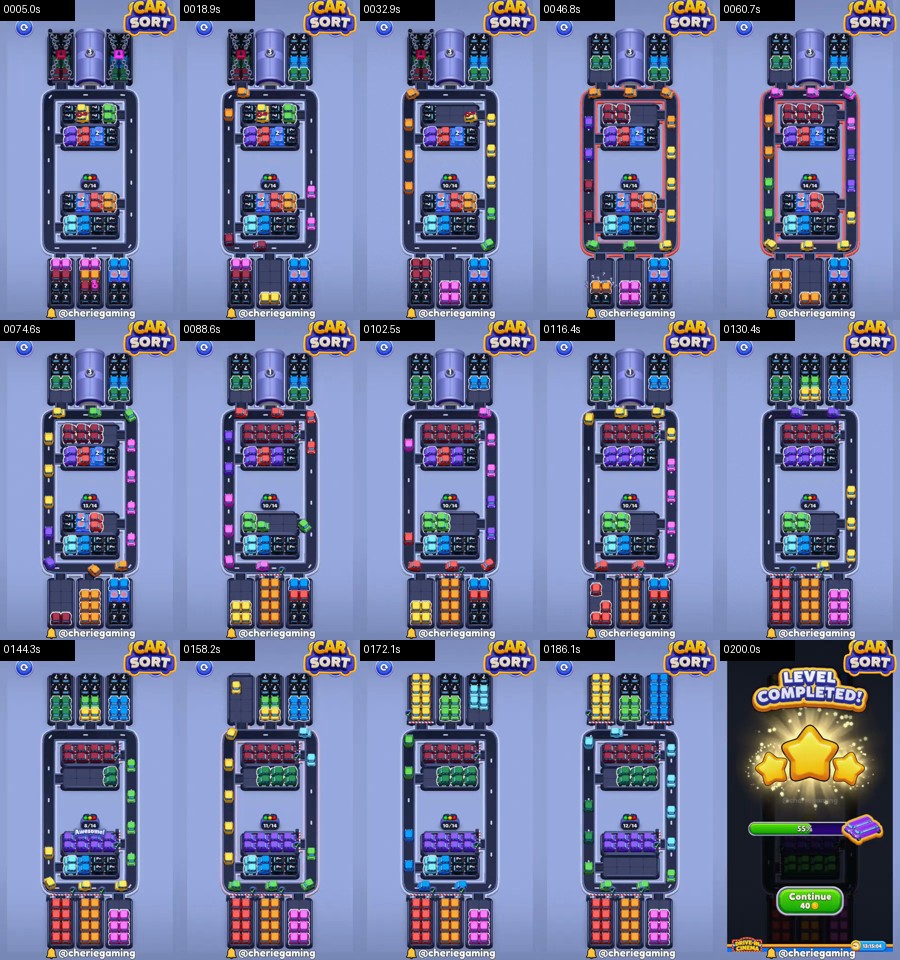
Work from the upper shelf to the lower shelf
The upper block exposes red, purple, and blue around dark covered spaces. Begin with the small red group, then clear purple. Blue is next once the top half of the loop has stopped carrying red traffic. This opens the first counter and exposes deeper red cars.
Use this route reference:
red upper shelf → purple → blue → deeper red → green middle shelf → pale cyan lower shelf → yellow lower reserve → orange reserve → upper dark/green/blue groups → purple and cyan cleanup
Keep the right edge empty while working through the first four colors. That edge is the only clean path between the top gate and the lower reserve row.
Use the loop corners as checkpoints
After the first red batch, the upper-left corner should be free. Purple clears the space immediately below it, and blue opens the lower-left corner. The right side should remain nearly untouched during those moves. If traffic is already stacked on the right before deeper red appears, an upper batch was split and needs to be completed.
The numbered gate at the top is a progress indicator rather than an early target. Let the inner shelves reduce its count naturally. Opening a bottom reserve just because a cover lifts can consume the corner space needed for the next inner color.
Turn the middle block into a buffer
After the deeper red batch leaves, green becomes available in the middle. Move all exposed green before touching cyan below it. Green opens a broad empty shelf that functions as parking space during the gate transition.
Clear pale cyan from the lower internal block next. Cyan must round the bottom-left corner, so it needs green off the road. When cyan completes, the covers below the loop release yellow and orange. Take yellow first, then orange. Do not alternate between those columns: both batches enter through the same bottom connection.
The central counter should now be close to complete and the top gate will begin exposing its late reserves.
Confirm the bottom reset
After yellow and orange, the three spaces below the loop should either be empty or show only covered deeper faces. No yellow marker should remain on the left edge, and no orange marker should remain on the right. This clean reset separates the lower phase from the upper gate phase.
If a purple face becomes visible inside the loop during the reset, leave it until the current reserve completes. Purple belongs to the late shelf wave and is safest when the top gate is no longer feeding another color.
Handle the top gate one column at a time
The upper phase introduces a dark batch alongside green and blue. Clear the dark cars while the top bend is empty, then green, then blue. Yellow may appear again in a neighboring column; finish it only after blue has reached its garage.
Purple returns across the lower internal shelf during cleanup. Move it as a complete band, followed by the last pale-cyan group. At this point the loop should carry only one active color and the final gate counter will fall without another blockage.
How to read the late shelf wave
The inner blocks look sparse after the top columns begin draining, but their remaining faces still determine the order. A complete purple band can use the empty bottom half of the loop; the cyan band should wait because it crosses the same left corner used by the last tower car. When purple vanishes, cyan has a direct route and becomes a reliable final checkpoint.
If yellow reappears in a tower layer, finish it before returning to the inner purple band only when yellow is already on the road. Otherwise preserve the established tower order. The goal is always to remove the active batch, not chase whichever new color has just become visible.
Recovering the rectangular loop
A single stranded car at the top can usually be rescued by completing its tower face. A stranded car at the bottom points to yellow, orange, purple, or cyan in the inner shelves. Follow the location before choosing the source batch. Do not add green as a temporary spacer; green's late column uses the same right edge and can seal the loop.
Restart only if two partial colors occupy opposite corners and the corresponding source faces are still covered. Most other mistakes can be repaired by clearing one complete visible group and returning to the last empty-corner checkpoint.
If the upper road jams, finish the color currently descending from the top reserve. If the lower-left corner is occupied, return to cyan, yellow, or orange. When a numbered gate refuses to open, inspect both internal shelf blocks for a covered car of the matching visible color; starting a new reserve will not reduce that counter.
The Level 328 solution succeeds by clearing the two inner shelf blocks before asking the top and bottom reserves to share the loop. Red, purple, and blue open the board, green and cyan create the central buffer, yellow and orange vacate the bottom, and the upper columns then drain into a road with both corners available.
The safest final check is the shape of the road itself: both left corners should be empty, the right edge should show only the active cleanup color, and no covered reserve should remain below. When all three conditions are true, the last cyan group can be completed without another detour.