Car Sort: Color Puzzle Level 354 Solution Walkthrough
Route Reference
Key opening, middle, and finish positions for this route.
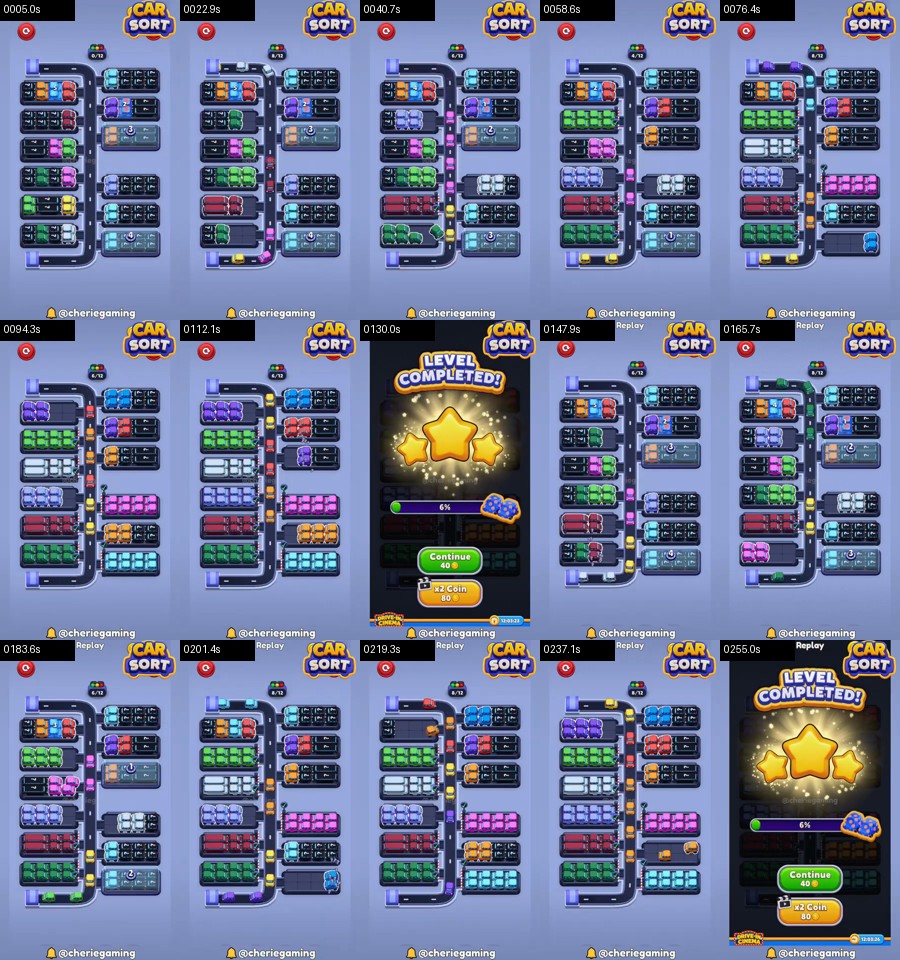
Read the two banks as paired rows
The opening left shelves show orange, blue, green, purple, pink, red, and yellow around dark cells. The right bank begins with pale cyan, red, purple, orange, white, and covered numbered rows. Neither side can be drained independently; one completed left row exposes the matching right checkpoint.
Use this route reference:
upper orange/blue → green left row → purple and pink → first cyan right row → red right batch → orange right face → white and lavender middle rows → lower red/green left bands → second cyan/pink right wave → blue/yellow cleanup
Repeated colors belong to different shelf depths. Finish the complete face beside the active counter instead of reaching for a same-colored row elsewhere.
Open the upper central lane
Start with the complete orange or blue upper-left group touching the road. Finish that face, then clear the neighboring color. Green follows from the left middle shelf and creates the first open vertical strip.
Purple and pink are the next left-side batches. Purple should leave before pink when it occupies the inside bend. Let every marker disappear before switching to the first cyan row on the right.
The opening checkpoint is a dark upper-left bank, a clear central lane, and one exposed numbered face on the upper right. If two colors remain on the lane, finish the earlier left batch.
Pay down the right-side counters
Pale cyan has the longest right-side row and should clear as one batch. Red follows after cyan vacates the top bend. Orange becomes available lower down and uses the same central connection.
Each counter change can reveal another small color face before the active group has reached its garage. Wait. A new face is safe only when the central lane contains no marker. White and lavender occupy the middle-right rows and should be handled separately.
At the right-bank reset, the cyan, red, orange, white, and lavender rows should leave dark horizontal gaps. Those gaps become buffer space for the deeper left layers.
Return to the lower left bands
Red appears as a broad left row, with green below it. Clear red first because it controls the upper part of the central lane. Green follows through the space red creates. Purple or pale blue can sit between them; finish the complete exposed row before moving downward.
Yellow is visible near the bottom but should wait. It enters close to the final right-side column and can block the lower turn if started while green is travelling.
The second left checkpoint shows solid horizontal bands rather than the mixed opening shelves. Work from the highest accessible band toward the bottom.
Use the road markers to time every side switch
The left rows join near the upper and lower bends, while the right rows enter directly beside the central lane. A left marker must disappear before a right face starts, and a right marker must disappear before returning left. This simple timing rule prevents two complete-looking rows from colliding in the middle.
After orange and blue, check the upper bend. After cyan and red, check the center. After the broad lower green row, check the bottom bend. If the relevant section is not dark, finish the color already travelling before following the next counter.
Complete the second right wave
Pink and pale cyan return on the right. Clear pink first if it already touches the road; otherwise finish cyan's complete vertical face. Blue and red can appear behind them. Keep one side of the lane empty while every right batch turns.
The final groups are usually blue, yellow, orange, or cyan near the lower rows. Follow the complete face beside the last active counter. By this stage both banks provide enough dark shelf space for a direct exit.
Recovery advice
A jam high on the lane points to orange, blue, green, purple, or pink from the opening left bank. A middle blockage points to cyan, red, orange, white, or lavender on the right. Trouble near the bottom belongs to the deeper red, green, yellow, blue, or pink bands.
Complete the visible source on the same side as the stranded car. Do not combine a repeated color from the opposite bank; the two batches can approach the central lane head-on. Restart only when partial colors block both ends and neither matching face is exposed.
Before completion, verify that every numbered right row is dark, the left bank contains only one solid cleanup face, and the central lane is empty. The final blue, yellow, or cyan group should travel without pausing.
If two full cleanup faces remain, choose the one whose shelf is nearest the open lane. Finish it and wait for the counter animation. Do not alternate between the two merely because both are visible; preserving one empty side gives the second group a direct route.
The completion state should show dark horizontal gaps on both banks and no colored marker at either end of the lane. If one small face remains beside a numbered garage, clear it before the last broad row.
Allow the final counter change to settle, then confirm the lower bend remains open before committing the completion color.
Level 354 succeeds through controlled side-to-side exchanges. The upper left opens the lane, the right counters reveal deeper shelves, the lower left creates more buffer, and the second right wave finishes only after every earlier row has stopped feeding the center.
If yellow remains for cleanup, release it from the lower face only after the second cyan wave has vanished. Both colors need the same bottom-to-center turn on this narrow board.