Car Sort: Color Puzzle Level 356 Solution Walkthrough
Route Reference
Key opening, middle, and finish positions for this route.
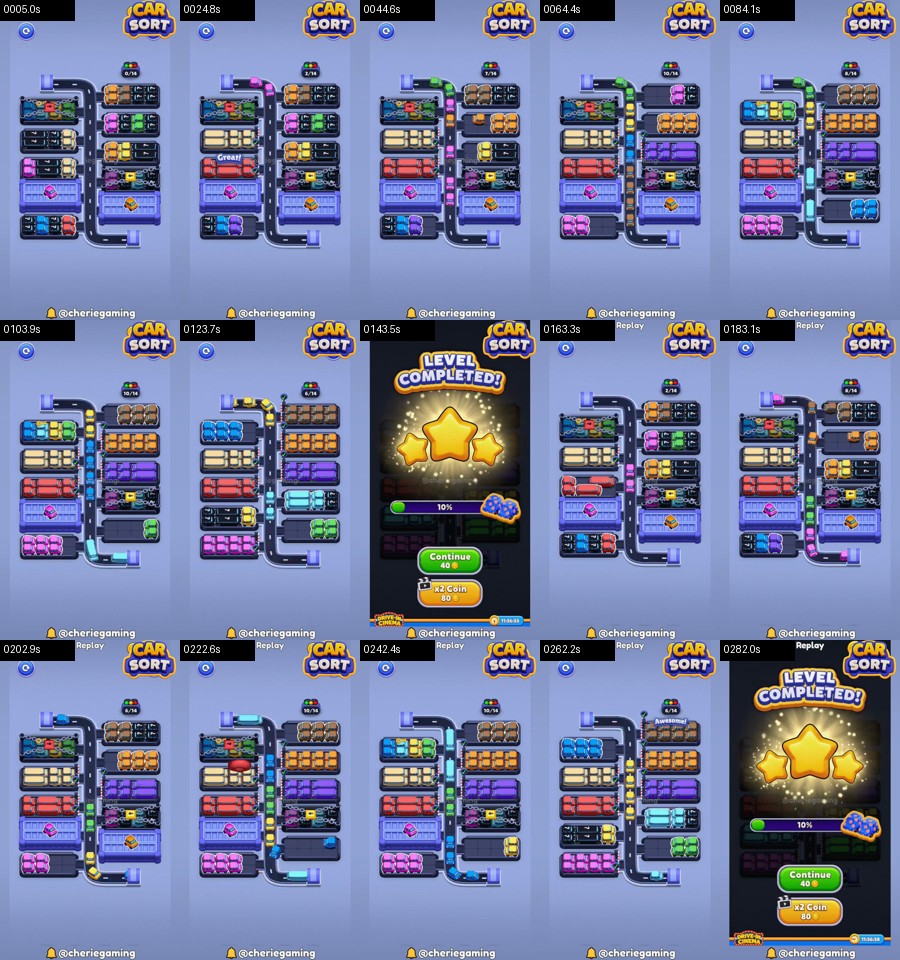
Read the upper and lower blocks separately
The upper block exposes orange and pink near the road, with brown deeper on the right. The lower block begins with cream and red, then reveals purple, green, cyan, and blue around its covers. Both blocks feed the same central lane.
Use this route reference:
upper orange → pink → cream upper-left → brown upper-right → lower cream → red horizontal row → purple lower face → first cover release → cyan/blue right shelf → green lower row → second brown/orange wave → pink and yellow cleanup
Do not switch blocks while a road marker remains. The central lane has no passing space for colors entering from opposite shelf levels.
Open the upper block
Start with orange from the exposed right shelf. Pink follows once orange clears the upper bend. Cream on the left becomes available next and creates a dark band beside the central road.
Brown is a larger row and should leave only after the smaller upper groups finish. Complete it continuously. Its removal reduces the first cover and reveals more of the lower block.
The opening checkpoint is a mostly dark upper block, an empty top bend, and one complete lower cream or red face.
Clear the lower cream and red bands
Move cream from the lower-left shelf, then red across the broad horizontal row. Red controls the entrance to the inner covers and must leave before purple or cyan.
Purple follows from the exposed lower face. A chained dark row can become visible behind it; leave that row until the counter has fully changed. The correct lower reset shows cream, red, and purple gone with the central lane clear.
Use each released cover as buffer space
The first cover opens a cyan or blue shelf on the right. Clear cyan first when it forms the complete face, then blue. Their empty bays give green enough room to leave from the lower block.
Do not fill a newly opened cover space with a partial brown or orange group from above. Its value is the dark shelf area it adds beside the central lane. Finish the current lower color and wait for the road to settle.
Green is the next broad lower row. Clear it before returning to the upper block. If a small yellow face appears below, save it for cleanup.
Handle the second upper wave
Brown and orange return on the upper-right in solid rows. Brown should clear first if it occupies the top bend. Orange follows through the empty center. Pink can reappear below them and should wait until the larger rows finish.
The second cover may expose pale cyan, green, or a dark batch on the lower right. Clear the complete face nearest the road after the upper wave has stopped.
At the late checkpoint, both diamond covers should be open, the upper rows should be dark, and the lower block should show only a few solid cleanup colors.
Check the central lane at four handoffs
The lane should be empty after the first orange-pink pair, after cream and red below, after cyan-blue-green, and after the returning brown-orange rows. These are the only safe moments to change shelf blocks. A marker still moving at a handoff identifies the exact phase that needs completion.
Do not judge the covers alone. A cover can open while the triggering color is still on the road. Let that batch finish, preserve the newly dark shelf as buffer space, and only then tap the complete face revealed behind the cover.
Final rows and recovery
Pink, yellow, cyan, and blue make up the common final groups. Work from the highest complete lower row toward the bottom. Yellow is safest after pink, while cyan and blue need separate passes along the right edge.
A jam above belongs to orange, pink, cream, or brown. A blockage in the lower block points to cream, red, purple, cyan, blue, or green. Complete the exposed source in the same block as the stranded car.
If a cover remains closed, one nearby full row is incomplete. Do not open a color from the other block as a rescue. Restart only when partial colors occupy both ends of the central lane and their matching faces are covered.
Before completion, verify that both covers are open and only one lower shelf retains color. The last group should travel the full lane without meeting upper traffic.
If a small color remains above while a broad lower row is ready, clear the upper face first because it owns the top bend. If two lower faces remain, choose the one already touching the lane. This nearest-first rule prevents a late color from being parked behind the final platform.
Wait for the road markers to disappear after the last delivery. A completely dark upper block and two open cover bays confirm that no hidden shelf layer was skipped.
The final lower face should be solid, fully exposed, and connected to an empty central lane. If any of those conditions is missing, return to the nearest visible row and finish it before attempting the completion batch.
Level 356 succeeds by alternating complete block phases. Orange, pink, cream, and brown open the top; cream, red, and purple release the lower covers; cyan, blue, and green create buffer space; and the returning brown-orange wave unlocks the final pink, yellow, and cyan cleanup.
Keep the route clear.
Before the final yellow row moves, inspect the right edge below the opened cover. A lingering cyan or blue marker there must finish first because yellow has no alternate route around it.