Car Sort: Color Puzzle Level 379 Solution Walkthrough
Route Reference
Key opening, middle, and finish positions for this route.
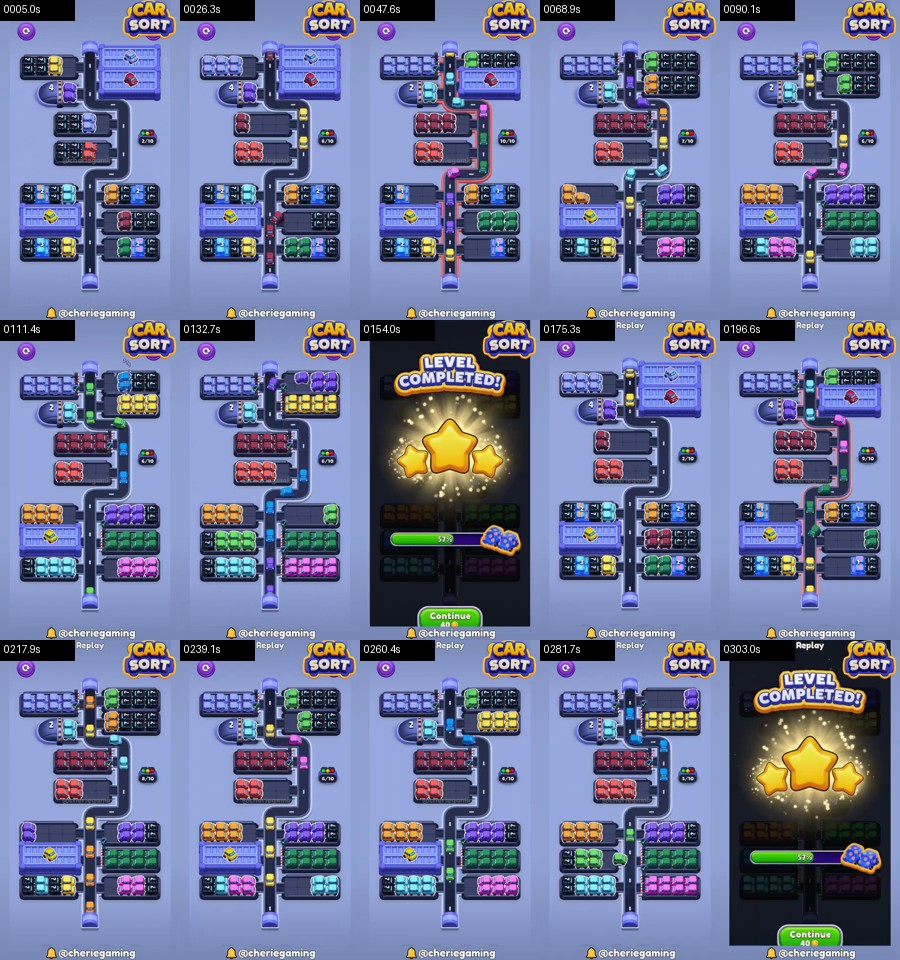
Map the snake and its branches
Upper shelves expose purple, blue, green, red, and orange. Middle branches carry yellow, cyan, pink, white, red, and repeated blue-green rows. Lower banks repeat orange, purple, yellow, cyan, pink, green, and red. Each branch joins the main snake through a single elbow.
Use this route reference:
upper purple-blue → green-red → orange first branch → yellow-cyan middle → pink-white junction → red-blue branch → green lower shelf → orange-purple → yellow-cyan → pink-green-red cleanup
Do not jump past an occupied elbow to a distant matching shelf.
Open the upper snake
Clear purple and blue, then green and red. Orange finishes the first branch. Wait for each elbow to empty before moving down the road.
The opening checkpoint shows dark upper shelves and a complete yellow or cyan face beside the next junction. Lower colors are not ready even if their garage panels are visible.
Pay down the middle junctions
Yellow clears before cyan when it sits inside the bend. Pink and white follow at the next junction. Red and blue then empty the deeper branch, exposing green below.
Every cleared branch should become a dark side pocket. Preserve it as turning space. A partial group left in one pocket can block all later traffic at the main snake.
Follow the second wave downward
Green clears the first lower shelf. Orange and purple follow. Yellow and cyan make the next pair. Pink, green, and red are the final sequence, selected from the branch closest to the open road.
The replay may expose two branches simultaneously. Finish the branch whose elbow is already dark. Do not alternate between distant rows merely because both colors look complete.
Diagnose by junction
A high jam belongs to purple, blue, green, red, or orange. A middle-junction stall points to yellow, cyan, pink, white, red, or blue. A lower blockage identifies the active cleanup shelf.
Trace backward from the stranded marker to the nearest projecting shelf. Complete that face. Starting traffic beyond the next junction cannot clear the elbow in front of it.
If two colors share the snake, finish the one located closer to an empty side pocket. Once it clears, use that pocket to release the second. Restart only when both remaining faces are behind covers.
Before completion, trace the snake from top to bottom. Every branch pocket should be dark and one solid lower face should remain. Clear it continuously.
Level 379 is a junction-management puzzle. Upper shelves open the snake, the yellow-cyan-pink-white-red-blue sequence pays down the center, and lower branches finish nearest-first through the empty pockets.
Two-wave discipline
The second wave resembles the first but begins from deeper shelves. Do not treat a returning red, green, or cyan group as a continuation of its earlier batch. Check which branch face is connected to the active junction and finish that local group alone.
At each junction, require three signs before advancing: the previous shelf is dark, the elbow has no marker, and the next face is fully visible. A counter change by itself is insufficient. This three-part test keeps the long snake from accumulating hidden partial traffic.
During final cleanup, work toward the road rather than away from it. A near branch creates a dark pocket that benefits the far branch; reversing that order asks the distant group to pass a crowded junction. The visible path, not the color name, decides the safe final sequence.
Mark the three major junctions
The upper junction receives purple, blue, green, red, and orange. The central junction handles yellow, cyan, pink, white, red, and blue. The lower junction releases green and the final orange-purple-yellow-cyan-pink-red shelves. Keep these zones distinct even when colors repeat.
Orange closes the upper phase because its branch sits closest to the first descending bend. Let every orange marker leave that bend before yellow begins. A premature yellow car can occupy the only pocket used by the orange tail.
Pink and white are small center faces but form the bridge between the yellow-cyan pair and red-blue. Clear them completely. Their dark branch pocket is where the broad red group turns, so skipping a single white car removes the room red needs.
When the second wave reaches green, check the lower junction rather than the upper road. The returning green shelf is local to the bottom half. Complete it, then move through orange-purple and yellow-cyan as neighboring branches.
If a distant branch lights up, do not cross an occupied junction to reach it. Finish the nearest complete shelf first. Every cleared near branch expands the main road; every partial far branch adds a second stream through the same elbow.
The completion route should pass through three dark junctions in sequence. Trace them visually before the final red or pink face. A colored marker at any junction identifies the previous branch that still owns traffic and should be completed immediately.
Wait for every junction marker to disappear completely.
The upper junction belongs to the first blue-purple-orange phase, the center junction to yellow-cyan-pink-white, and the lower junction to the returning green-orange-purple sequence. Use this location map when repeated colors make the remaining source ambiguous.
If both red and pink appear complete at the end, choose the branch connected to the nearest dark junction. Finish that face, wait for all three junctions to clear again, and then release the outside group. The last cars should move through the branch network as one uninterrupted stream.
Check the middle elbow once more after the first cleanup face parks. It must stay empty before the outside branch begins feeding its longer final batch.