Car Sort: Color Puzzle Level 400 Solution Walkthrough
Route Reference
Key opening, middle, and finish positions for this route.
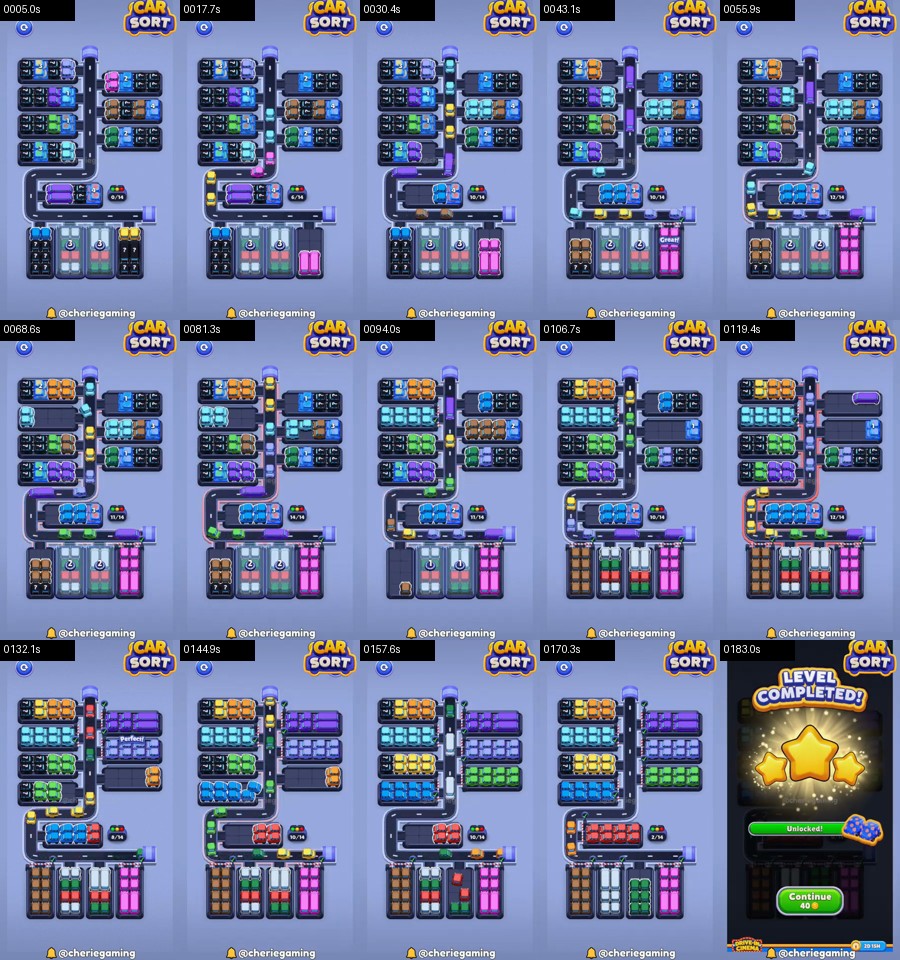
Divide the board into quadrants
The upper-left block exposes cyan and blue faces. Purple and green sit across the top-right. The lower-left shows pink and white around covered cells, while the lower-right contains orange, red, yellow, and blue. A small inner counter determines when the route may rotate to the next quadrant.
Route reference:
upper-left cyan/blue → upper-right purple/green → inner white face → lower-left pink/red → orange lower-right → returning cyan-purple → yellow center band → blue-green lower pair → white-pink return → final red-orange cleanup
Finish the active quadrant before moving diagonally. Opposite blocks feed the center crossing head-on.
Clear both upper blocks
Start with cyan, then blue, in the upper-left. Wait until the top-left corner is dark and move purple from the upper-right. Green follows after purple.
These four faces open a complete white group beside the center. Clear white immediately. Its empty bay turns the crossing into usable buffer space and exposes pink or red below.
The opening checkpoint shows dark upper entrances, an empty crossing, and one complete lower-left face.
Work through the lower-left block
Clear pink first when it touches the road, then red. Keep the lower-left corner empty before rotating to orange in the lower-right. Orange is a broad face and should drain without interruption.
A repeated cyan or purple layer becomes visible as orange leaves. Finish the one already connected to the center, allow a full reset, and then clear the other. These repeated groups open yellow across the middle.
Use yellow to reset all four sides
Yellow controls the central band. Clear it only when no marker remains in any quadrant entrance. Its cars cross the busiest part of the road, and one premature blue or green car can block the entire rotation.
After yellow, drain blue and green from the lower pair. Choose the connected face first, finish it, and then take the other. The empty lower blocks expose returning white and pink.
At the late checkpoint, the upper blocks and middle band are dark, with color limited to one or two lower outside faces.
Final rotation
Clear white before pink if white owns the inside corner. Pink follows through the empty crossing. Red and orange normally make up the final pair; finish the quadrant already connected to the road, reset, and then drain the opposite face.
If a small cyan, purple, or yellow remainder appears, treat it as one final center batch. Do not reopen a dark quadrant merely because its color matches.
Recovery by quadrant
A jam above the center belongs to cyan, blue, purple, or green. A marker on the crossing points to white, yellow, or a returning center face. A blockage below belongs to pink, red, orange, blue, green, white, or the final warm pair.
Complete the visible face in the quadrant feeding the occupied road. If two colors meet at the crossing, stop the later quadrant and finish the earlier one. A counter that does not change usually has one remaining car in the adjacent block.
Restart only when partial groups occupy opposite entrances and both matching faces are covered. Most errors recover once one quadrant is drained completely.
Use the dark blocks as checkpoints. After the upper pass, both top entrances should be empty. After pink-red-orange and repeated cyan-purple, three quadrants should show broad dark gaps. After yellow-blue-green, only the cleanup blocks should retain color.
Rotate around the crossing deliberately
Move clockwise only after the active quadrant has stopped feeding the road. Cyan and blue open the top, purple and green complete that side, and white creates the first center gap. Pink, red, and orange then use the lower half without meeting the opening traffic.
When cyan or purple returns, identify its quadrant by position rather than color. Clear the face adjacent to the dark crossing. A matching group across the board belongs to a later rotation and should remain untouched.
Yellow resets the crossing before blue and green begin the last cool-color sweep. Let yellow disappear completely; its empty block is the buffer used by both later groups.
Before the last batch, verify all four approaches to the crossing are dark and exactly one face remains. Drain it without rotating elsewhere. Level 400 is solved by controlled clockwise handoffs: cool colors clear the top, white opens the lower-left, orange rotates to the lower-right, yellow resets the center, and the returning lower pairs complete the circuit.
If two final faces remain in neighboring quadrants, choose the one already aligned with the open crossing. Finish it, then wait until its road marker leaves the opposite edge. The outside face can then complete a full lap without meeting another group.
The completion layout should resemble four dark blocks around one clear center. Any colored break identifies the quadrant that still owns traffic and must be resolved before cleanup continues.
Use the road markers to confirm the direction of the last rotation. A marker leaving the lower-right quadrant should disappear before the route returns to the upper-left. If it remains at the crossing, finish its visible face instead of starting the final warm color.
When all four blocks are dark, the last column can use the entire perimeter. Let it pass each approach without interruption. The completion counter should fall after one continuous lap, with no need to reopen a solved quadrant.
Keep the center visibly empty throughout that final lap.
Confirm the opposite quadrant remains dark as the tail crosses the center. Any new marker there means the preceding red, orange, white, or pink face still needs completion.