Car Sort: Color Puzzle Level 426 Solution Walkthrough
Route Reference
Key opening, middle, and finish positions for this route.
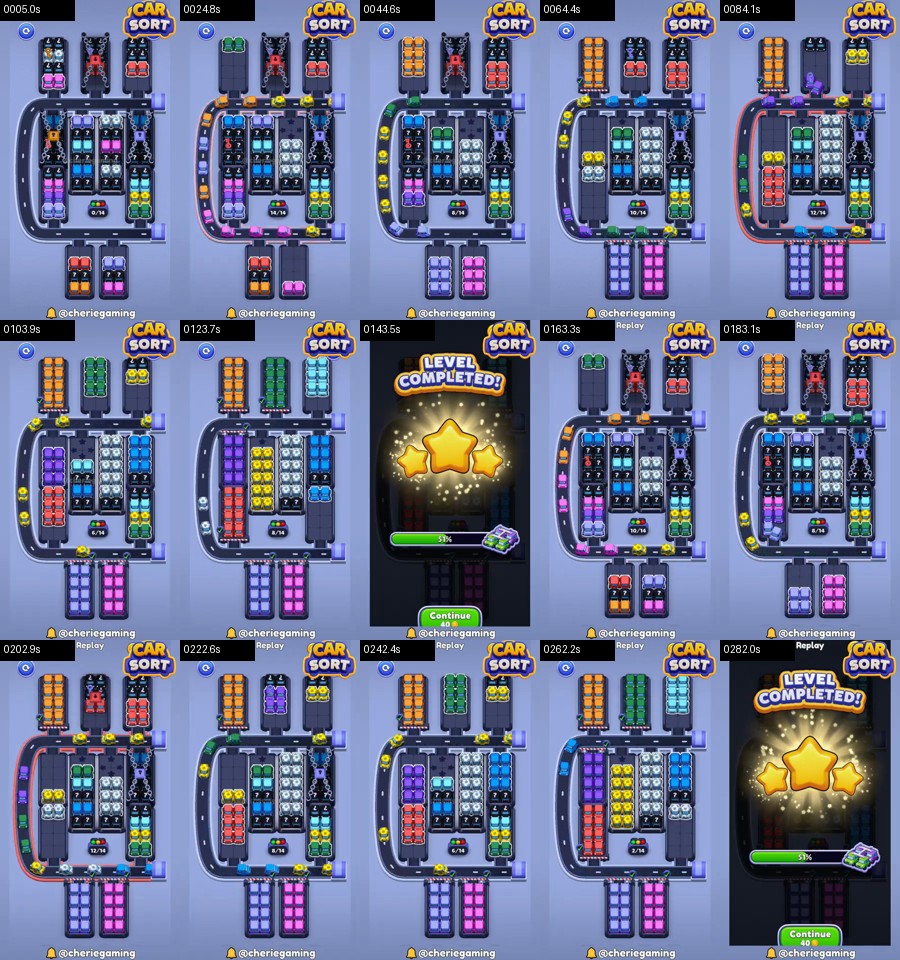
Read the four locked columns
The left central column begins with purple and red. The next column exposes cyan and green. The third is heavily covered by pale locks, and the right column contains blue and green under chains. The roof feeders start with orange, red, green, and yellow; the bottom feeders show pale violet and pink.
Use this route reference:
orange roof → red roof → green roof → yellow roof → purple left column → cyan center-left → green center-left → red left column → first chain release → blue right column → green right column → pale locked column → lower violet → lower pink → returning orange, purple, yellow, cyan, and red cleanup
Clear a complete vertical face, then wait for chains to update. Never tap isolated unlocked cells within a covered column.
Empty the roof bank
Start with orange from the complete upper-left feeder. Red follows, then green. Yellow is last because its garage sits beside chained entrances and needs the top-right corner fully clear.
These long roof groups circle the square. Let each convoy disappear before starting the next. Their deliveries reveal the first solid purple and cyan faces inside the block.
The opening checkpoint is a dark roof bank, open top corners, and at least one full central vertical group. If a chain still obscures every column, one roof batch is incomplete.
Unlock the left half of the block
Purple leaves first from the left column. Cyan follows from the next column. Green then clears the complete face below or beside cyan, and red finishes the left stack.
This left-half sweep creates two dark vertical lanes and triggers the first major chain release. Keep those lanes empty. They are the only buffers when the right blue-green columns begin feeding the road.
Do not move the lower violet or pink columns yet. Their bottom entrance shares a corner with every central convoy.
Open the right and pale locked columns
Blue is the first safe right-side face. Clear it, then green. The pale lock column begins resolving after those deliveries. Wait until the full pale-blue or white face is exposed before tapping.
Clear that pale group as one long convoy. It opens another chain and reveals yellow, cyan, or purple beneath. Select the complete face nearest the road, not a distant single cell.
At the central checkpoint, the left lanes are dark, the right blue-green pair is cleared, and most snowflake covers have disappeared.
Use the bottom feeders after the center is open
Pale violet leaves from the lower-left column first. Pink follows from the lower-right. These groups are tall and should never overlap. Each uses two corners before reaching its destination.
Their removal exposes returning orange and purple rows inside the block. Clear the nearer complete row, then yellow or cyan. Red is often the last long central column and deserves an empty square.
The final board has open chains through all four central columns, dark lower feeders, and at most one complete roof or center stack. Let the last convoy clear every corner.
Distinguish chains from frozen faces
Two different blockers appear inside this square. Chain overlays hide entire vertical lanes, while the pale snowflake blocks occupy individual cells in the right-center column. A chain opening reveals a colored face that may still be unsafe; a snowflake disappearing can reveal only part of a longer row. In both cases, wait until a complete vertical color is visible before releasing it.
The replay supplies a useful left-to-right progress check. Early on, purple and pale violet occupy the left pair while cyan and black-covered cells dominate the middle. After the roof orange and red groups clear, a solid red column becomes available on the left. Later, blue appears on the right beside a tall white frozen block. If blue is still exposed when the pale block begins moving, finish blue first and keep the newly freed right lane empty.
The bottom violet and pink towers are not ordinary cleanup garages. They enter immediately below the longest central columns and therefore need the entire bottom edge. Violet is safe once the left-center lanes have gone dark; pink waits until the right-center pale column and its returning colors have cleared. At the final checkpoint, the central block should contain large dark vertical gaps, not a checkerboard of isolated empty cells.
One more clue is the yellow hazard-marked traffic along the outer road. Those markers show that a batch is still circulating even when its source column already looks empty. Wait until they have disappeared before starting the next central face.
Recovery among chains and snowflake covers
A top-edge jam belongs to orange, red, green, or yellow. A central-side jam belongs to purple, cyan, green, red, blue, or a pale locked column. A bottom jam belongs to violet or pink.
If a chain remains, finish the exposed row directly beside it. An unrelated outside color cannot open that local cover. Wait for the animation to reveal a complete face.
When blue and green overlap on the right, finish blue first if it already owns the corner, then green. Adding a pale group only fills the next edge. If the pale column was started too soon, stop and complete the active right color before returning to it.
If the two bottom columns mix, complete the leading violet or pink source. Restart only when its destination remains chained and the trailing color blocks the lower turn. On a retry, preserve both dark left lanes until the pale column is open.
Level 426 is a lock-by-lock solution. Orange-red-green-yellow clear the roof; purple-cyan-green-red open the left half; blue-green and the pale column resolve the right-side chains; violet-pink clear the bottom; and orange-purple-yellow-cyan-red finish the exposed layers. The board looks complicated, but every complete vertical face removes one specific obstruction and creates the space required by the next.