Car Sort: Color Puzzle Level 216 Solution Walkthrough
Route Reference
Key opening, middle, and finish positions for this route.
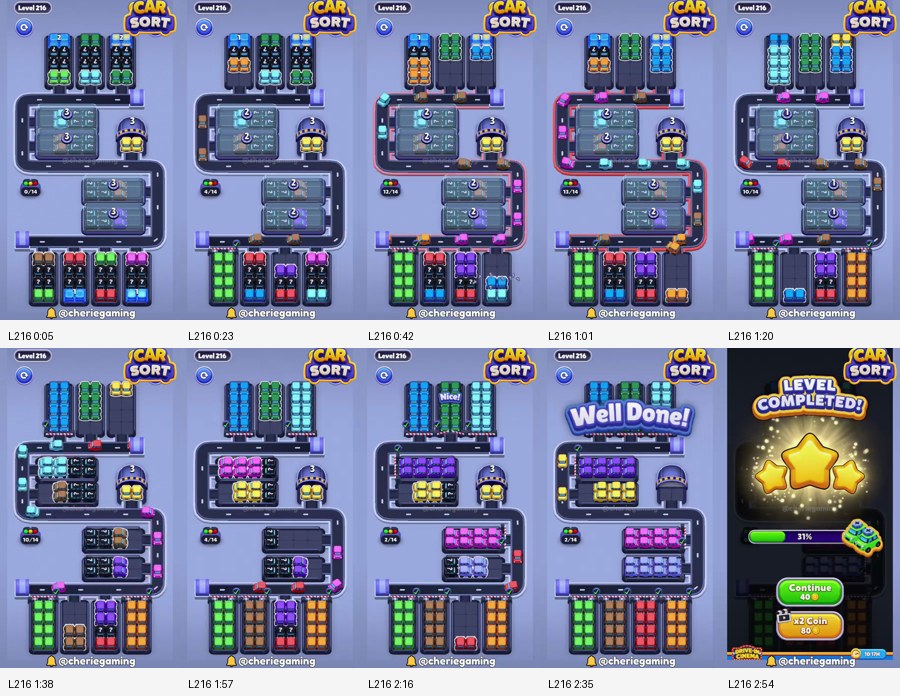
Two Loops Connected By One Right-Hand Turn
Car Sort: Color Puzzle Level 216 has an upper rectangular loop and a lower rectangular loop joined on the right. Three tall columns stand above, four numbered columns stand below, and five broad covered shelves fill the two loops. A small yellow garage sits on the upper-right side. Cars from every shelf eventually pass through the same joining turn, so the loops cannot safely carry unrelated colors at the same time.
The opening upper towers show blue, green, cyan, and orange fronts. The bottom bank exposes green, red, blue, purple, cyan, and pink. The large center covers begin with counters rather than clear color bands. Solve the upper loop first, use the joining turn to reduce the middle covers, then activate the bottom bank.
Recommended route:
upper orange -> upper cyan/blue -> upper green -> yellow side garage -> upper covered shelves -> lower covered shelves -> bottom green -> bottom red/blue -> purple -> orange and pink cleanup
The order of a covered layer can vary with what appears, but never reduce a second cover while the first color occupies the right-hand turn.
Establish The Upper Loop
Orange is the first useful upper color because it appears on the left tower and has a direct road entrance. Complete orange before moving cyan or blue. Cyan/blue then clears the middle top column, and green follows from the remaining tower.
The small yellow garage on the right is a checkpoint, not an opener. Use it after the upper road is clear. A yellow car sitting at the joining turn blocks both loops, so do not release yellow behind another color.
Opening checks:
- orange leaves the upper-left entrance;
- cyan/blue completes without green joining the top edge;
- green reaches its garage and the upper-right turn clears;
- yellow uses the side garage alone.
If a top color stalls, finish that column. Do not open a broad covered shelf to search for more road space; the released cars enter the same upper loop.
Peel The Broad Covers Layer By Layer
The upper loop contains three large covered shelves. Open the shelf closest to an empty road segment. Reveal one layer, complete its color, and stop when the counter changes. Early layers become cyan, brown, pink, yellow, and purple bands in the route snapshots.
The lower loop contains two more broad shelves. Leave them covered until the upper shelves have reduced. Otherwise, cars from both loops converge on the connector and neither batch can turn.
Use this shelf rhythm:
- expose one upper layer;
- finish its color;
- clear the right connector;
- expose the next upper layer;
- move to a lower shelf only after the upper loop is quiet.
Later checkpoints show the upper shelves reorganized into pink and yellow rows, while the lower shelves show dark and purple bands. That clean separation is the correct midgame state. Do not try to make every counter fall evenly.
If two covers expose different colors together, complete the color already farther around its loop. Leave the other row parked. Once the connector empties, finish the second row before opening another layer.
Bring In The Bottom Columns After The Connector Opens
The four lower columns are late reserves. Green forms the clearest far-left batch and should move first when the lower loop is empty. Red or blue can follow from the middle, then purple from the next numbered stack. Orange and pink are late cleanup colors.
Open one numbered column at a time. A counter reaching a new layer may reveal a different color, so pause after every completed batch. If the new layer matches a color on the lower covered shelf, combine them only when the road already carries that color.
The bottom road is short. Do not alternate green from the far left with orange from the far right. Finish green, wait for the joining turn to clear, and then cross to the next column.
The fixed yellow garage beside the upper loop remains useful as a late traffic signal. If its counter still shows an unfinished group while the lower orange column is ready, return to yellow first. Yellow has to clear the short connector above the lower loop; leaving one yellow car there can make a bottom batch appear blocked for no obvious reason. Conversely, once that garage is visibly complete, do not keep searching the covered upper shelves for another yellow layer. Continue with the exposed lower column and let any hidden yellow wait for its own later counter reveal. This distinction prevents the side garage from becoming a reason to reopen the upper loop during cleanup.
Also watch the two inside bends, not only the connector. A brown or pale-purple car can finish crossing the connector but remain on the lower loop's upper edge. Wait until it rounds the next bend before releasing a full bottom column. That extra pause preserves enough moving space for the long green and orange batches.
Final Two-Loop Checkpoints
Near the finish, the upper bank becomes tall blue, green, and cyan columns, the upper covers show purple/yellow, and the lower covers show pink and pale purple. The bottom bank settles into green, brown/red, and orange columns. Clear complete visible bands in the loop that currently has the empty connector.
If the upper loop jams, stop all bottom taps and finish its active color. If the lower loop jams, stop opening upper covers and complete the lower batch. If a car sits exactly at the connector, its color has priority over everything else.
Recovery sequence:
- stop opening counters;
- identify the connector car;
- finish that color from its current shelf or column;
- clear any second color already inside the same loop;
- resume with the highest unfinished covered layer.
Avoid using the second loop as storage. The connector makes the two rectangles one road system. A car that looks safely parked in the lower loop can still block a garage route from above.
Level 216 is solved by handing control from the upper loop to the lower loop. The top towers open the first circuit, the broad shelves release one layer at a time, and the bottom columns wait until the shared turn is free. Preserve that handoff and the final purple, orange, and pink batches move cleanly to completion.