Car Sort: Color Puzzle Level 231 Solution Walkthrough
Route Reference
Key opening, middle, and finish positions for this route.
Four Covered Towers Above Three Long Rows
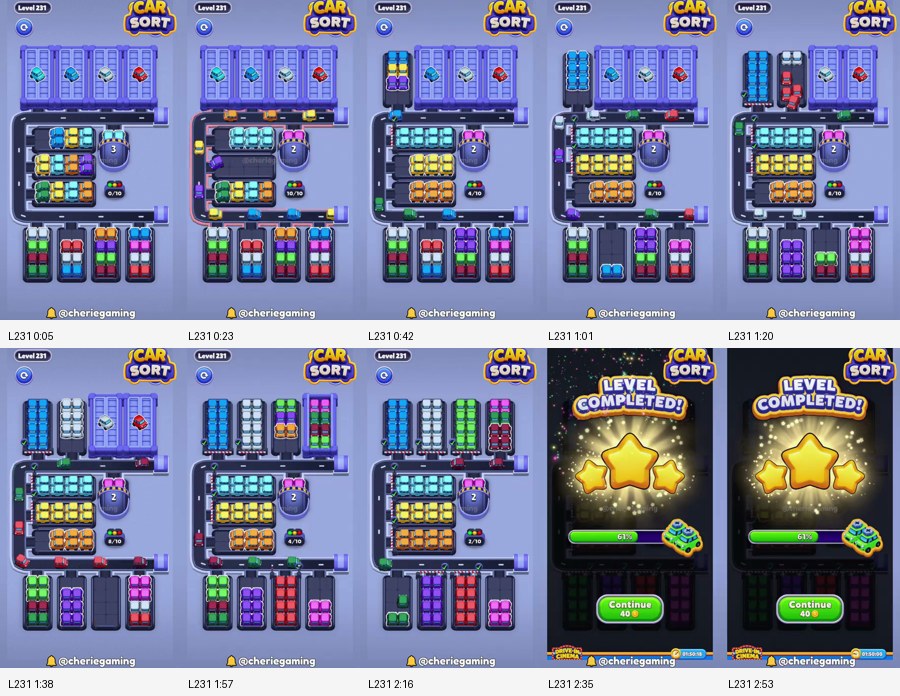
Car Sort: Color Puzzle Level 231 has four pale-purple covered towers above a rectangular road, three long horizontal rows inside it, and four reserve banks below. A small numbered garage sits on the inner right. The central rows quickly resolve into cyan, yellow, and orange bands, while the top towers reveal blue, white, green, and pink/red layers. The bottom bank holds green, purple, red, pink, and hidden colors.
The road is roomy only when one row moves at a time. A full cyan band occupies the upper edge, yellow uses the middle turn, and orange fills the lower edge. Starting two of them together blocks both sides of the rectangle.
Recommended route:
first top blue/yellow layer -> top white -> top green -> cyan center row -> yellow center row -> orange center row -> side-counter pink/purple -> bottom green -> bottom purple -> bottom red/pink -> final top red
Stop whenever a cover reveals a new color. Finish the active batch before advancing another tower.
Establish The Upper Garage Routes
Open the leftmost top layer whose color has a clear corner. Blue or yellow commonly provides the first batch. Complete it, allow the upper road to empty, and then take white from the next tower. Green follows once the left side is open.
Do not reduce all four covers evenly. Their cars enter adjacent points on the top road. A counter can wait at one remaining layer without causing any problem.
Opening checks:
- the first top batch clears one corner;
- white reaches its garage;
- green leaves the upper road empty;
- the center cyan row remains parked until no top car is travelling.
If a top car stalls, finish that tower layer rather than tapping the center.
Clear Cyan, Yellow, And Orange As Separate Bands
Cyan is the highest center row and the first long batch. Send all visible cyan cars continuously. Do not interrupt them with yellow. Once the top and right edges are clear, move yellow from the middle row.
Orange is the lowest central band and should wait until cyan and yellow stop feeding the road. It uses the bottom edge for several trips and can block every reserve bank if started early.
The route snapshots show all three bands becoming clean and complete before the lower phase. Use that state as a checkpoint:
- cyan has an unobstructed upper route;
- yellow owns the middle transition alone;
- orange starts only after the bottom corners clear;
- no top cover changes color during a long row.
If cyan and yellow meet, finish the color farther around the loop, then complete the second. Do not add orange as a third batch.
Use The Side Counter Between Rows And Reserves
The small round counter on the right reveals a short pink, purple, or matching color group. Handle it only when the adjacent road segment is empty. It is a transition garage, not an alternate route.
After a central row clears, reveal one side-counter layer and finish it. If the counter changes color, leave the new front parked until the next road reset. This keeps the side group from colliding with a long center band.
The side counter should be nearly finished before the bottom red and pink columns begin. A late car from it can otherwise enter the same right corner as the reserve traffic.
Open The Four Bottom Banks For Cleanup
Green is a useful first lower color on the left. Purple follows, then red and pink from the right. Each bank contains layers, so stop after every color change.
For each bank:
- expose one visible layer;
- complete that color;
- wait for the lower road to clear;
- inspect the next front;
- switch banks only when the new color has no open garage route.
Late checkpoints show green, purple, red, and pink as full vertical columns. Clear complete columns instead of trying to make every counter fall together.
Final Tower Cleanup And Recovery
The top covers eventually become tall blue, white, green, and red/pink towers. Return to any remaining top column after the center and bottom stop feeding traffic. Finish one full layer through an empty upper road.
If the upper edge blocks, stop center and bottom taps and complete the active tower color. If the lower edge blocks, finish the orange row or reserve batch already there.
For mixed traffic, identify the leading color, complete it from its current row or tower, then finish the second color before opening another cover.
An empty center row should remain empty. It proves that feed has stopped and keeps the source of every new road car predictable. Do not reopen an unrelated layer simply because the rectangle looks spacious.
Compare Garage Columns Before Starting A Long Row
Before cyan, yellow, or orange begins, glance at the corresponding visible tower rather than only the road. A completed or clearly available garage column confirms that the whole band can keep moving. If the garage is still blocked behind another color, leave the row parked even when its first car can enter the rectangle.
Cyan is the best early test because its row sits nearest the upper road. If cyan moves cleanly, the left-to-right circulation is established. Yellow then confirms the middle route, and orange confirms the bottom route. A failure at one of these checkpoints identifies the blocked edge without opening more counters.
During cleanup, use the same rule in reverse. A lower green or purple column should not start until its garage route is visible and the central bands have stopped feeding cars. This prevents a reserve batch from circling the loop while waiting for a tower that is still occupied.
If the garage state is unclear, finish the color already on the road and wait. A brief pause is safer than exposing a new layer to test a route.
Level 231 is controlled by three long bands. Top covers establish the garage routes, cyan, yellow, and orange use the rectangle in sequence, the side counter bridges the handoff, and lower reserves wait for cleanup. Preserve one-color traffic and the final green, purple, red, and pink columns reach their garages without competing at the corners.