Car Sort: Color Puzzle Level 232 Solution Walkthrough
Route Reference
Key opening, middle, and finish positions for this route.
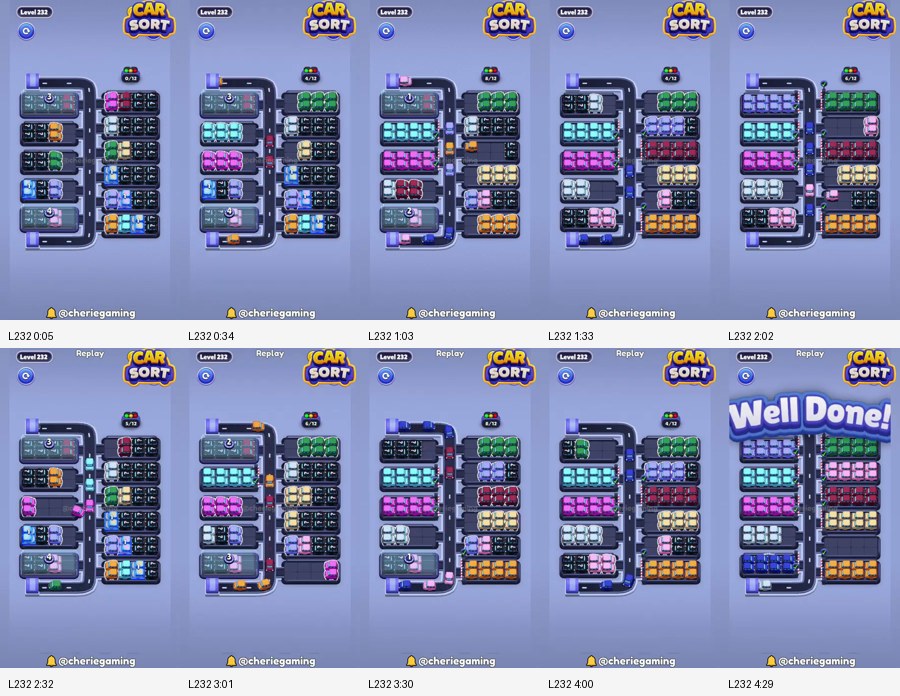
Twin Shelf Walls Around A Narrow Central Road
Car Sort: Color Puzzle Level 232 builds two tall walls of horizontal parking shelves around a thin central road. The left wall includes two large numbered covers, while the right wall stacks green, red, cream, orange, dark, and pink rows. The connecting road bends at the top and bottom, so every shelf release must pass through one of two narrow junctions.
The opening contains scattered fronts, but later frames show distinct bands: pale purple, cyan, pink, white, and blue on the left; green, red, cream, dark, and orange on the right. The safest route clears the road-facing rows, reduces one large cover, and alternates walls only after the central lane empties.
Recommended route:
upper-left exposed layer -> upper-right green -> left cyan -> right red -> left pink -> right cream -> left white/blue -> right orange -> large lower-left counter -> final purple/pink cleanup
This is an area order. If a counter reveals another color, finish the current road batch before changing sides.
Open The Top Junction
Begin with the exposed color nearest the upper-left road mouth. Complete it and let the top bend clear. Green on the upper-right shelf can then use the same junction from the opposite side.
Do not release both walls together. Cars meet in the narrow center and block access to every deeper row.
Opening checks:
- one left layer clears;
- the top road becomes empty;
- right green reaches its garage;
- neither large left counter is reduced while traffic remains.
If a car stalls at the top junction, finish that shelf color before touching another row.
Alternate Complete Bands, Not Individual Taps
Cyan becomes a strong left-side band. Move it completely. Red follows from the right only after cyan leaves the central lane. Pink then uses the left, followed by cream on the right.
This controlled alternation opens both walls without mixing them. Empty shelf space should remain empty while the opposite wall moves.
Use these visual checkpoints:
- cyan leaves a full empty strip on the left;
- red clears the matching height on the right;
- pink travels alone through the center;
- cream opens the next right-side layer;
- white and blue remain separated until the junction resets.
If two colors meet, complete the car farther along the central road first, then finish the second. Do not open a third shelf.
Reduce The Large Left Counters At Quiet Moments
Two broad covered shelves on the left hold several layers. Open one only after a right-side batch completes. Reveal the front color, finish it, and stop when the counter changes.
The upper cover controls access to the pale-purple/cyan region. The lower cover governs later pink, white, and blue rows. Do not reduce them together. Cars from both covers share the same left entrance and can form a queue before reaching the center.
If a revealed layer matches the active road color, combine the batches only when no blocker lies between them. Matching colors on opposite sides of a different car are not a safe group.
Clear The Deep Right Rows In Order
After green and red, the right wall reveals cream, dark red, and orange bands. Clear the highest exposed full row before the one below it. Orange is a long late batch and should wait until the bottom junction is empty.
Pink or pale purple may remain at the right edge. Finish those shorter rows before orange if they block its shelf mouth.
The replay shows the right wall becoming clean green, red, cream, dark, and orange bands while the left consolidates into pale purple, cyan, pink, white, and blue. At this stage the uncertainty is gone; choose the complete band nearest the empty central road.
Recovery And Replay Checkpoints
If the top bend blocks, stop deep shelf taps and finish the active upper color. If the bottom bend blocks, finish the lowest active row before returning upward.
For a mixed central lane:
- stop both walls;
- identify the leading color;
- complete it from its current shelf;
- finish the second road color;
- resume at the highest unfinished road-facing row.
The replay provides three reliable states: scattered fronts become full bands; large left counters reduce between right-side batches; orange and blue remain late cleanup colors after the central lane opens.
Do not chase matching colors across both walls. The shortest safe path is usually to finish the full row already closest to the road. Once it clears, the matching distant row can move later without obstruction.
Keep One Junction As A Permanent Buffer
The twin walls leave very little open road, so one of the top or bottom junctions should remain empty throughout a batch. During upper green and cyan, preserve the lower bend. During late orange, blue, and pink, preserve the top bend. This empty junction gives moving cars somewhere to complete their turn.
If both bends become occupied, stop tapping immediately. Do not try to push one color through by releasing more matching cars. Finish the batch whose leading car is closest to a garage, then clear the second bend before resuming.
The large left counters can make the wall appear to shrink even while their cars remain on the road. Judge the buffer by visible moving cars, not by the empty shelf graphics. A counter layer is not finished until its last car has passed the central lane.
Before the final orange row, verify that the lower junction and center are both empty. Orange is long enough to occupy most of the route. Giving it the whole lane avoids the common late jam with blue or pink from the opposite wall.
Level 232 is controlled by wall handoffs. A left batch opens the central lane, a right batch uses it, and the large counters release only between those movements. Clear complete rows, protect both junctions, and the final orange, blue, pink, and purple bands travel directly instead of meeting in the middle.