Car Sort: Color Puzzle Level 233 Solution Walkthrough
Route Reference
Key opening, middle, and finish positions for this route.
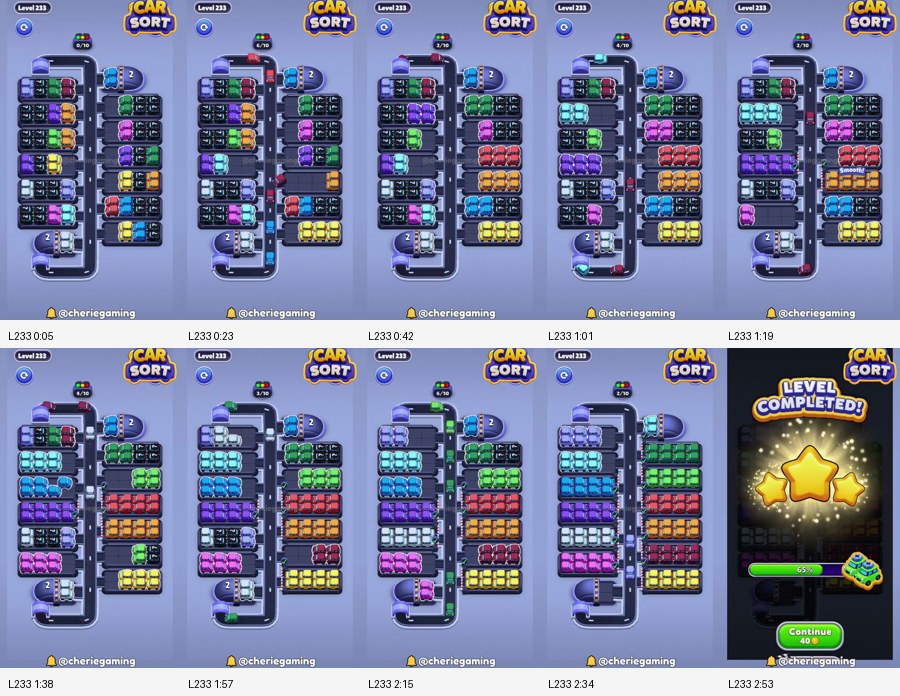
Two Rack Towers With Side Garage Counters
Car Sort: Color Puzzle Level 233 places tall shelf walls on both sides of a central vertical road. A small blue garage counter sits near the upper right, while a white counter sits near the lower left. The shelves contain red, green, purple, cyan, orange, yellow, pink, and dark covered layers. Every row must enter the thin middle lane before reaching a side counter or garage.
The route snapshots show the scattered opening fronts resolving into clean bands: pale purple, cyan, blue, purple, pink on the left; green, light green, red, orange, dark red, and yellow on the right. The solution works from the road-facing rows outward and treats each side garage as a transition batch.
Recommended route:
upper-left red/green -> upper-right blue-counter layer -> right green -> left cyan -> right light green -> left purple -> right red/orange -> lower-left white-counter layer -> left pink -> right dark-red/yellow cleanup
Switch walls only when the central lane is empty.
Open The Upper Junction And Blue Counter
Begin with the short red or green group nearest the upper-left entrance. Complete it and clear the top junction. Then use the blue side counter on the upper right as a compact batch.
Reduce the counter one layer at a time. If its color changes, stop. Do not continue while a left-wall car remains in the center.
Opening checks:
- the upper-left row shortens;
- the central lane clears;
- the blue counter completes one visible layer;
- deeper rows remain parked.
If the counter car stalls, finish that layer before touching either wall.
Alternate Green, Cyan, And Purple Bands
Green becomes the first strong right-side band. Clear it completely, then move cyan from the left. Light green follows on the right after cyan reaches its garage. Purple then uses the left side.
This alternation preserves an empty shelf mouth opposite the active batch. Do not alternate individual cars. Each full row should own the central lane until it is empty.
Visual checkpoints:
- right green leaves an empty upper strip;
- left cyan forms and clears a full band;
- light green opens the next right row;
- left purple moves after the central lane resets;
- red/orange remain parked below until the upper bands are gone.
If cyan and green meet, finish the leading color, then the second. Do not release purple as a third batch.
Treat The Lower White Counter As A Gate
The lower-left white counter controls the bottom junction. Leave it until the upper and middle bands have reduced. Open one white layer, finish it, and stop when the value changes.
Clearing this counter opens the route for left pink and the deepest right red/yellow rows. If a white car remains at the bottom bend, do not start orange from the right; both need the same central entrance.
After white, the bottom junction should visibly clear. That state marks the transition into final rack cleanup.
Clear Red, Orange, Pink, And Yellow From The Bottom Up
Red and orange form strong right-side middle bands. Clear the higher one first. Pink becomes a clean lower-left row and should move after the white gate. Dark red and yellow remain late on the right.
Orange is a long row and needs the central lane without interruption. Pink uses the lower junction after orange clears. Finish dark red before yellow if it lies above the yellow shelf mouth.
The late board displays full color bands on both walls. Choose the complete row nearest an empty entrance rather than opening another covered layer.
Recovery And Final Lane Checks
If the upper junction blocks, stop lower rows and finish the active upper color. If the lower junction blocks, stop the blue counter and upper shelves and complete the active lower batch.
For mixed central traffic:
- stop both walls and both counters;
- identify the car farther along the lane;
- complete that color;
- finish the second color;
- resume at the highest unfinished road-facing row.
Do not combine matching colors from opposite walls unless the lane between them is empty. A blocker in the center turns the apparent same-color group into two separate queues.
Three route states confirm progress: the blue side counter opens after the first upper row; green/cyan/purple bands alternate through the middle; the white lower counter clears before pink, dark red, and yellow.
Decide Which Wall Owns The Next Move
After every batch, inspect the two shelf mouths beside the central lane. The wall with a full visible color and an empty entrance should move next. A wall whose first car is covered, chained, or blocked behind another row should wait even if its matching garage looks ready.
This check is especially useful around the middle green and purple phases. Green may be exposed on the right while purple is already approaching from the left. Finish purple if it has entered the lane; then green can use the vacated junction. Do not alternate to keep both walls visually balanced.
Late in the board, pink on the left and red/yellow on the right are all fully visible. Choose the one closest to the empty lower junction, clear the entire row, and only then switch walls. The final rows are long enough that a premature switch can recreate the same center jam as the opening.
If neither wall has a clear entrance, the unfinished group belongs to one of the side counters. Complete that compact batch first and reassess the shelf mouths.
Level 233 is controlled by two junctions and two side counters. The upper counter opens the first wall handoff, complete bands alternate through the center, the lower white counter releases the bottom, and final rows move only through an empty lane. Respect those gates and the crowded twin racks become a predictable sequence of same-color runs.