Car Sort: Color Puzzle Level 235 Solution Walkthrough
Route Reference
Key opening, middle, and finish positions for this route.
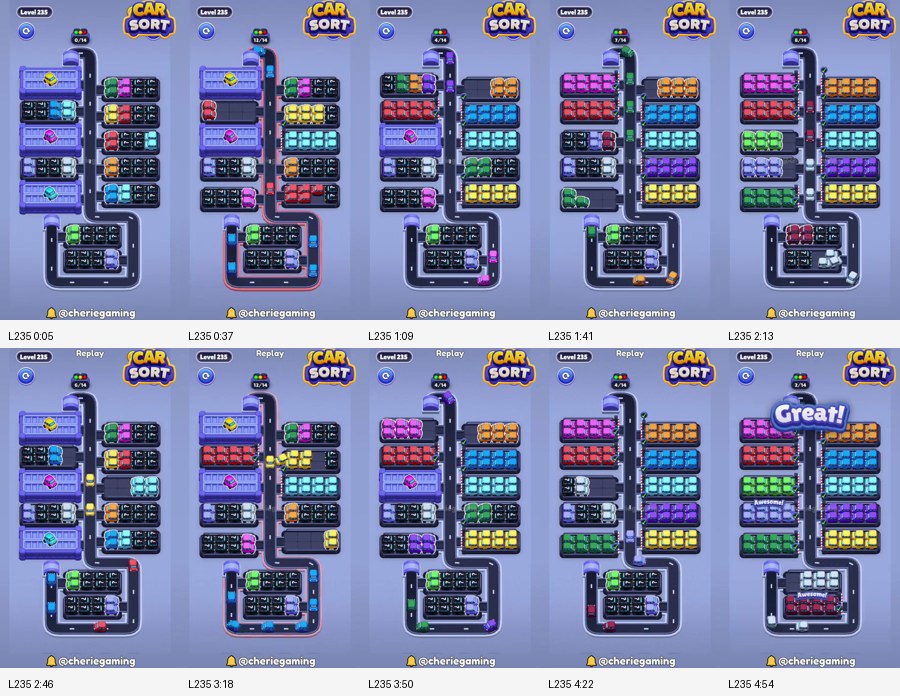
A Tall Main Yard And A Separate Lower Pocket
Car Sort: Color Puzzle Level 235 combines a tall main yard with a small looped pocket below it. Three broad covered shelves line the left of the main yard, several horizontal racks line the right, and a vertical road divides them. The lower pocket contains short green, red, white, and dark covered groups. All traffic eventually depends on the main vertical road and its lower bend.
The route snapshots show the main racks resolving into strong pink, red, orange, blue, cyan, green, purple, and yellow bands. The broad left covers reveal transition layers, while the lower pocket remains mostly closed until the upper yard opens.
Recommended route:
upper-left cover layer -> upper-right pink/red -> right orange -> right blue/cyan -> middle green -> purple/yellow shelves -> lower pocket green -> lower pocket white/red -> final pale-purple and dark layers
Switch areas only when the connecting bend is empty.
Open The Main Vertical Road
Begin with the visible layer nearest the top-left cover or upper-right rack. Complete one color and let the vertical lane clear. Pink/red becomes the first strong upper-right batch, followed by orange.
Do not reduce all three left covers together. Their exits face the same lane. A newly exposed layer can wait behind its cover while the active color travels.
Opening checks:
- one upper layer clears;
- the vertical road becomes empty;
- pink/red leaves the upper-right shelf;
- the lower pocket remains inactive.
If a car stalls, finish that shelf or cover color before opening another area.
Peel The Right Racks Downward
After pink/red, clear orange from the next full row. Blue and cyan follow as separate bands. Green appears lower and should wait until the rows above have stopped feeding traffic.
Purple and yellow form late right-side bands. They need the full lower bend, so do not interrupt them with a car from the lower pocket.
Use these visible states:
- pink/red empties the top rack;
- orange clears the next shelf;
- blue and cyan occupy separate rows;
- green opens the lower half;
- purple and yellow remain final main-yard groups.
If blue and cyan meet in the lane, finish the leading color, then the second. Do not add green.
Treat The Broad Left Covers As Gates
Each left cover reveals multiple layers. Open one between right-rack batches, complete its visible color, and stop when the counter changes. The upper cover controls the top junction, the middle cover affects the central lane, and the lower cover guards the turn into the pocket.
Do not assume a cleared cover means its cars have left. Wait until the road is visibly empty before moving to the next rack.
The replay shows these covers remaining partially visible while the right bands consolidate. That confirms they are gates, not a block that must be exhausted first.
Hand The Road To The Lower Pocket
The lower loop contains green, white, red, and hidden dark layers. Open it only after green/purple/yellow from the main yard no longer uses the lower bend.
Green is a useful first pocket batch. White follows, then red. Reveal one covered layer at a time and stop on every color change.
The pocket road is small. Do not alternate green and white or open both sides together. Finish a complete batch, wait for the connector to empty, and then choose the next color.
Replay Recovery And Final Checks
If the main vertical road blocks, stop the pocket and finish the active main-yard color. If the pocket blocks, stop all upper covers and complete the local batch.
For mixed traffic, finish the color farther along the connecting road, then complete the second before resuming from the highest unfinished rack.
Three route states confirm progress: upper pink/red/orange opens the main yard; blue/cyan/green/purple/yellow become clean right-side bands; the lower green/white/red pocket activates only after the main bend clears.
Avoid starting pocket red while yellow remains on the main road. Both use the connector and can lock one another despite being far apart visually.
Use The Three Broad Covers As Board-State Markers
The left covers divide the tall yard into upper, middle, and lower phases. After the upper cover's visible color clears, the road above the central bend should be empty. After the middle cover reduces, blue/cyan and green should be separated into clean right-side bands. After the lower cover opens, the connector to the pocket should be visible and quiet.
If a cover counter drops but the matching road area stays crowded, its last car has not completed the route. Stop tapping and finish that color. A numerical change is not a completed checkpoint until the road beside the cover is empty.
During the late main-yard phase, leave the lower cover parked if purple or yellow is still travelling. Its next layer can enter directly onto the connector and block the pocket before it begins. Finish the long shelf band first.
Before opening the pocket, inspect all three cover mouths. They should be empty or show deliberately parked colors. Any unexplained car means the main yard can still feed the road. Complete that batch before handing control downward.
This audit makes pocket cleanup predictable: green moves first, white follows through the same clear connector, and red finishes after both local bends reset.
If the pocket shows a different front color, keep the same rule: finish the active main-road batch, open only one local layer, and leave the connector empty before switching colors.
Level 235 is controlled by the handoff between two yards. Left covers release one layer at a time, right racks clear downward, and the lower pocket waits for a quiet connector. Preserve that order and the final green, white, red, purple, and yellow batches reach their garages without turning the vertical road into storage.