Car Sort: Color Puzzle Level 239 Solution Walkthrough
Route Reference
Key opening, middle, and finish positions for this route.
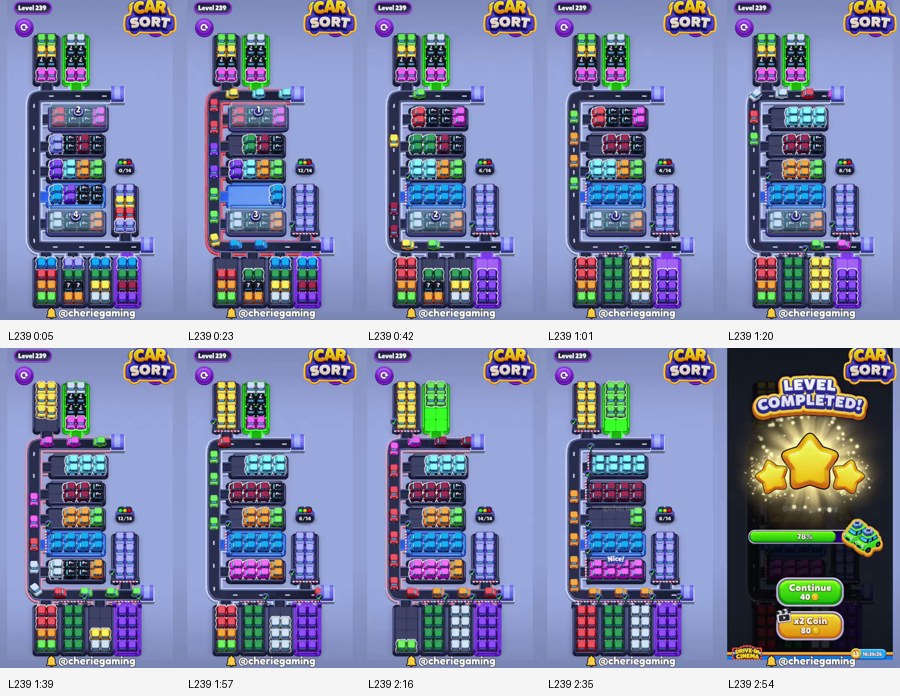
Two Top Towers Above A Layered Central Yard
Car Sort: Color Puzzle Level 239 places two compact towers above a rectangular road, a layered shelf yard inside it, and four reserve banks below. The center includes two broad counter covers plus rows that reveal red, green, cyan, dark red, orange, blue, pale purple, and pink. The top towers later become yellow and green columns, while the lower bank resolves into red, green, white, and purple.
The broad covers make the center look like one block, but its layers must be released separately. The safest solution establishes the top road, works down the center rows, then hands the lower edge to the reserves.
Recommended route:
top yellow/green -> upper center red -> center green -> cyan row -> dark-red row -> orange -> blue -> lower pink/pale-purple -> bottom red -> bottom green -> bottom white -> bottom purple
Finish every visible color before reducing another counter.
Establish The Two Upper Routes
Begin with the visible layer in the left top tower. Complete it and clear the upper-left corner. Move the right tower only after the top road empties.
The towers eventually display strong yellow and green columns. Do not mix them on the road simply because both are exposed. One complete tower layer creates a reliable entrance for the center.
Opening checks:
- the left tower shortens;
- its cars leave the upper road;
- the right tower completes one layer;
- bottom banks remain closed.
If a top car stalls, finish that tower instead of tapping a center cover.
Peel The Center From The Highest Exposed Row
Red becomes the first strong center band. Clear it completely. Green follows from the next visible row, then cyan. Dark red occupies a deeper band and should wait until cyan has cleared the right side.
Each empty row exposes the shelf below. Leave that gap empty while the next color travels.
Center checkpoints:
- red opens the upper shelf;
- green clears without cyan joining it;
- cyan uses the right edge alone;
- dark red opens the lower half;
- orange and blue remain separated late.
If cyan and dark red meet, complete the leading color, then the second. Do not add orange.
Use The Broad Covers As Stop Signals
The large pale-purple covers reveal several layers. Open one when the adjacent road segment is empty, complete the visible color, and stop when the counter changes.
The upper cover controls access to early red/green/cyan rows. The lower cover guards orange, blue, and pink. Do not reduce them together. Their cars merge on the same side of the rectangle.
If the counter drops but a car remains on the road, the layer is not finished. Wait for that car to reach its garage before continuing.
Clear Orange, Blue, And Pink Before The Reserves
Orange and blue become long lower-center bands. Send each continuously through an empty lower edge. Pink or pale purple forms the final visible center row.
Do not open a bottom reserve during these long batches. Reserve cars enter directly beneath them and can block the lower-right corner.
The center phase is complete when the broad cover mouths are quiet and the lowest pink/pale-purple row has cleared or is the only active color.
Open The Four Bottom Banks
Red is a useful first lower batch on the left. Green follows, then white and purple. Each bank contains hidden layers, so stop on every color change.
For each reserve:
- reveal one front layer;
- complete its color;
- wait for both lower corners to clear;
- inspect the next front;
- switch banks only when the route requires it.
Late checkpoints show full red, green, white, and purple columns. Clear complete columns rather than lowering all counters evenly.
Recovery And Final Checks
If the upper edge blocks, stop center and lower taps and finish the active top color. If the lower edge blocks, finish the center row or reserve batch already there.
For mixed traffic, stop every counter, complete the leading road color, finish the second, and resume from the highest unfinished center row.
Three board states confirm progress: yellow/green opens the top, center rows resolve into cyan/red/orange/blue/pink bands, and lower red/green/white/purple activates only after the center quiets.
Avoid starting bottom purple while center pink remains on the lower road. Finish pink, reset the loop, and then send purple.
Compare The Two Covered Checkpoints Before Cleanup
Before opening the lower reserves, inspect both broad covers. The upper one should no longer feed red, green, or cyan into the road. The lower one should either be empty or display a deliberately parked layer after orange, blue, or pink. If a car remains at either mouth, the center phase is incomplete.
Finish that visible color before touching the bottom bank. A hidden center car entering during cleanup can block a full reserve column at the lower-right corner.
Use the clean horizontal bands as proof. Cyan should have left an empty upper-middle strip; dark red and orange should no longer occupy the center turn; blue and pink should be complete or clearly isolated. Once those states match, the lower road belongs to the reserves.
During final cleanup, do not return to a changed cover layer unless one of its cars is already on the road. Complete red, green, white, and purple below first. The now-quiet center gives each reserve a predictable route, and any remaining covered layer can finish afterward through an empty rectangle.
Level 239 is controlled by layered releases. Two top towers establish the rectangle, broad covers reveal center rows one color at a time, long lower bands clear before the reserve phase, and bottom banks wait for a quiet road. Preserve those handoffs and the final red, green, white, and purple columns move without a corner jam.