Car Sort: Color Puzzle Level 247 Solution Walkthrough
Route Reference
Key opening, middle, and finish positions for this route.
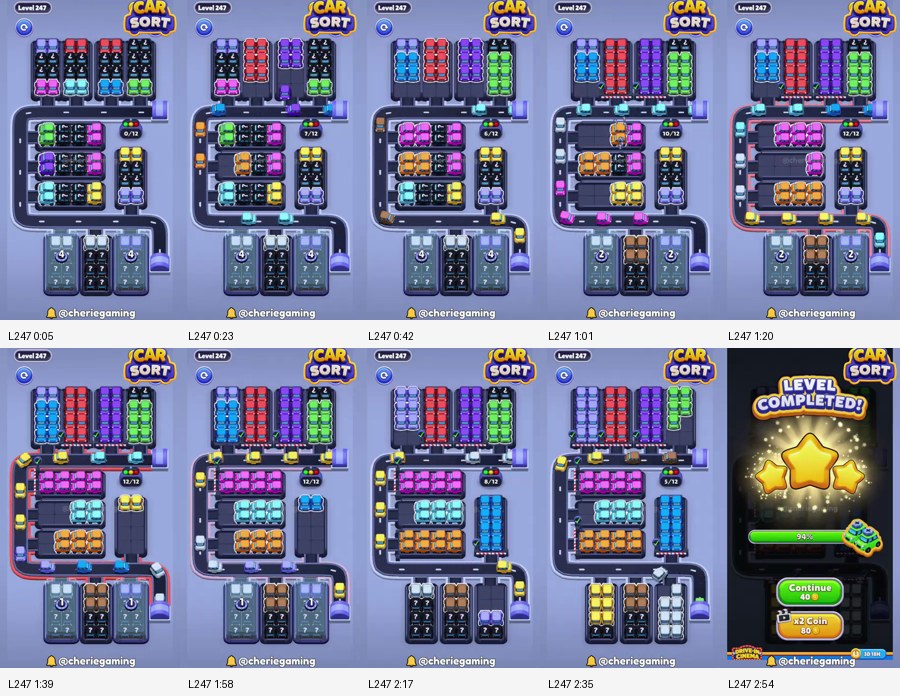
Reading the opening layout
The top of the board contains four tall color groups: light blue on the left, then red, purple, and green on the right. These are not immediately available as complete sets because the road and the central shelves decide which cars can actually leave. Under them, four horizontal garages hold mixed rows. Pink cars sit at the exposed right ends of the upper shelves, while cyan, orange, yellow, brown, and dark cars remain trapped deeper inside.
The right edge matters most. A short vertical lane connects the shelf exits to the outer loop, and a small side garage occupies part of that connection. If a wrong color waits there, cars from every shelf can be delayed. The bottom bend is equally important because it is the only approach to the locked columns. Treat these two corners as checkpoints rather than storage spaces.
The opening counter shows twelve waiting places. That sounds generous, but several early colors appear only in pairs or partial groups. Filling the counter with unrelated cars makes the board look active while actually removing the flexibility needed to finish a color. The safest opening is to use the exposed pink cars to create space across the middle shelves, then complete whichever small group becomes available without forcing cars from the bottom.
Recommended route order
A reliable color order is:
pink → cyan → orange → yellow → brown → blue → lower-column colors → red, purple, and green cleanup
This is a route priority rather than a rigid tap-by-tap list. Cars of the same color may appear on more than one shelf, and the lower locks can change which group becomes complete first. The important rule is to clear the exposed shelf ends before committing to the bottom columns.
Pink is the natural first target. Several pink cars are already facing the shelf exits, so moving them does not require digging through another color. As those cars leave, the horizontal rows shorten and the orange and cyan groups become readable. Avoid tapping one car from every visible top stack at this point. The upper stacks are useful reserves; they should feed a nearly finished group, not begin four new ones.
Cyan is a good second checkpoint because its cars occupy the left side of a lower shelf and can travel around the outside without competing with the pink group. Once cyan is complete, there is a clean lane across the center. Orange follows from the middle shelves, and yellow should be cleared as soon as the small yellow group reaches the lower-right bend. Do not leave yellow parked on that bend while working elsewhere—it blocks the only route toward the locked area.
Opening the four horizontal shelves
Start with the rightmost exposed cars on the upper two shelves. Build one pink group at a time and watch the counter after every move. When the pink row is close to complete, take the matching car from the adjacent shelf rather than reaching into a top column. This preserves the compact top groups for the second half of the level.
The next shelf reveals orange. Orange cars travel safely once the pink line is gone, but they should not be mixed with several brown cars. Brown sits deeper and cannot usually be completed yet. If a brown car becomes exposed, leave it in its garage until enough matching brown cars are visible. A parked brown car on the loop consumes road capacity without opening anything useful.
On the lower shelves, cyan and yellow should be separated cleanly. Finish cyan first if its group is already aligned; otherwise take the exposed yellow set and immediately complete it. The worst middle-game position is a counter holding two cyan, two yellow, two orange, and two brown cars. Every pair appears promising, but none frees a slot. Level 247 rewards completion, not collection.
As the shelves empty, the road around the central rectangle becomes the board's temporary working area. Keep the right vertical segment clear. Cars can wait along the left and top portions of the loop more safely because those spaces do not cut off the shelf exits.
The bottom lock release
The four bottom columns should be treated as the second phase of the walkthrough. Their covers display question marks and small counters, so the hidden order cannot be solved confidently from the opening screen. The replay shows them releasing only after enough cars have been delivered through the outer loop.
Open one lower column at a time. When a cover lifts, inspect the newly visible front color and compare it with the groups still sitting above the road. If it matches a nearly complete color, finish that group immediately. If it introduces a new color, leave the neighboring columns closed until the first new group is under control.
Brown becomes important near this transition. The brown row can travel down the right side once yellow is gone, and clearing it creates a large empty block in the middle. Blue then uses that space efficiently. The late replay shows full blue and brown groups occupying clean rows rather than being scattered around the loop; that is the state to aim for.
The lower covers may tempt you to tap every newly unlocked car. Resist that. Their purpose is to supply exact missing pieces. Pulling three different colors from three columns recreates the mixed counter problem from the opening, only with less road available.
Final color columns and cleanup
The tall red, purple, green, and light-blue stacks at the top are the stable finish. By the time the central shelves and bottom locks have been resolved, each of these colors can descend into an open route without weaving around partial groups. Complete one vertical color at a time.
Light blue is often the easiest first late color because the left side is already open. Red and purple can follow through the center. Green should be left until the right edge no longer contains a waiting car; its column sits closest to the critical exit, and starting it too early can crowd that junction.
Use the last twelve-counter phase as confirmation. The replay reaches a fully organized state with the long pink, cyan, and orange groups placed across the central garages and the remaining colors arranged in columns. If your board still has mixed cars circling the outside when the bottom columns are open, stop and finish the color with the most visible members. Do not continue opening locks merely because they are available.
Recovery advice
If the right-side road is blocked, trace the waiting cars back to the color with the largest visible set. Complete that set before tapping anything else. A single completed color normally frees enough room for the trapped shelf to exit.
If the counter is full of pairs, choose the pair whose third and fourth cars are already exposed on a horizontal shelf. Do not choose a color whose missing cars remain behind question-mark covers. The visible route is more reliable than a guess about the lower columns.
If you opened the bottom too early, keep the released car in its column when possible and return to pink, cyan, orange, or yellow. Clearing one central shelf restores the connection between the outer loop and the lower bend.
If the replay state no longer matches your board, restart and use three checkpoints: all exposed pink cars cleared before mixing deep shelf colors; cyan, orange, and yellow resolved before opening several lower columns; and the right vertical lane empty before starting the tall top stacks. Those checkpoints make the Level 247 solution repeatable even when individual taps occur in a slightly different order.
The central idea of Level 247 is controlled release. Empty the horizontal garage ends, use the lower columns only to finish colors that are already close, and preserve the right-side junction for movement. Once the middle rectangle is clean, the tall color stacks turn the final section into a straightforward one-color-at-a-time cleanup.