Car Sort: Color Puzzle Level 250 Solution Walkthrough
Route Reference
Key opening, middle, and finish positions for this route.
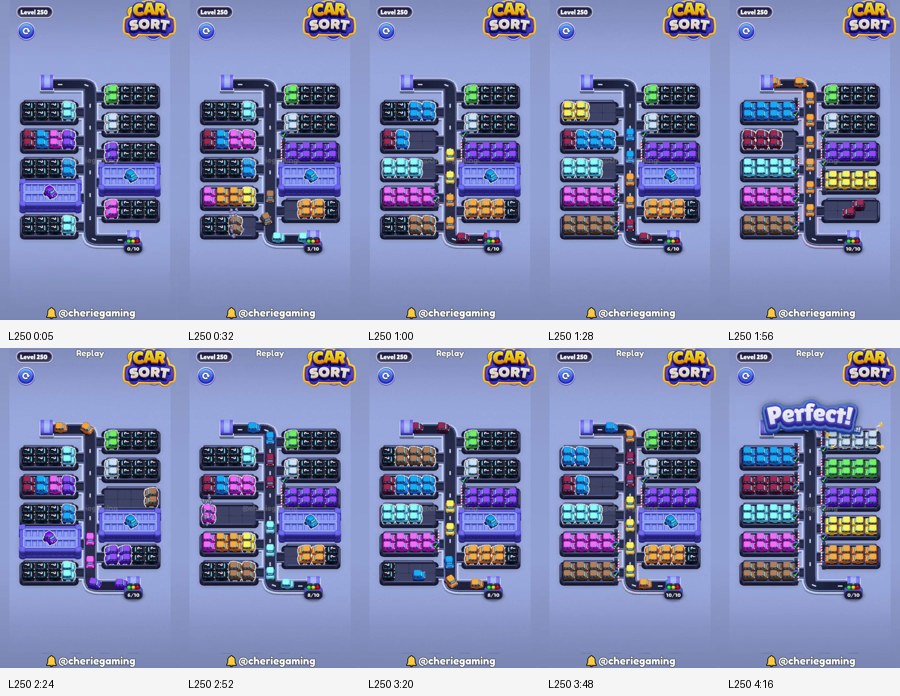
Understanding the split garage
The left bank contains several short horizontal rows, including cyan, red, pink, blue, and dark cars. The right bank holds green, white, purple, yellow, orange, and more dark cars. Each row exits toward the center, so every moving car wants to use the same vertical channel.
The two purple covered blocks divide the middle into upper and lower sections. They display counters and reveal more cars later. A small road loop runs around them, but the bends are tight. If one partial color stops above the upper cover and another stops below the lower cover, cars from both garage banks can be trapped.
The active counter shows ten spaces. Because the board contains many distinct colors, the counter is the real constraint. Keep no more than two incomplete colors active whenever possible. A third partial group should be started only if it immediately exposes the final cars for one of the first two.
Suggested color order
The safest overall route is:
pink → orange → cyan → yellow → red → brown → blue → white → green → purple → dark-car cleanup
Pink and orange are useful openers because they sit at accessible ends on opposite sides and can be completed without emptying the entire bank. Cyan and yellow then clear larger horizontal lanes. Red and brown form the middle transition, while blue, white, green, and purple become clean late groups after the covers release.
This order can flex around a cover reveal. If a newly exposed car completes the color already on the counter, take it immediately. Do not change to a completely new color just because its first car becomes visible.
First pass through the left and right shelves
Start with exposed pink cars from the left-middle rows. Pink has a short path into the lower portion of the central road and removes blockers in front of cyan or red. Bring its matching cars together before taking an unrelated blue car from the row above.
On the right, orange is the corresponding early target. Orange cars occupy a lower shelf and can enter the road through the bottom curl. Move them while that bend is still empty. If a brown or purple car is exposed during the process, leave it in the shelf unless the counter already contains matching cars.
After pink and orange, compare cyan and yellow. Cyan controls several left shelves; yellow controls a right shelf near the middle. Complete whichever group has a fully open exit, then complete the other. Do not alternate cyan and yellow car by car. Alternation fills both sides of the narrow central lane and can produce a standstill at the lower bend.
The first checkpoint is a board with pink and orange removed and at least one large cyan or yellow row complete. The vertical channel should contain little or no waiting traffic. If it is already crowded, finish the color nearest completion before touching either covered block.
Using the center channel correctly
Think of the center road as a transfer lane, not a parking garage. A car should enter it only when there is a known destination or when its full matching group is about to follow. Long pauses in this channel prevent both banks from operating.
The upper bend serves the top left and top right shelves. Preserve it for cyan, blue, green, and white traffic. The lower bend serves pink, orange, yellow, brown, and purple. Mixing upper and lower colors across the same bend is unnecessary until late in the level.
When the upper cover advances, keep the space immediately above it empty. When the lower cover advances, do the same below it. New cars need room to turn toward the correct bank. A waiting car directly beside the cover can make the revealed color appear unusable even though the route order is otherwise correct.
Red is a useful transition color because its left-side row becomes clear after pink or cyan moves. Complete red before pulling multiple brown cars from the bottom. Brown then clears the deepest left shelf and opens the lower curl for the second half.
Cover releases and the second pass
The central covers gradually reveal cars as deliveries accumulate. Treat each reveal as a missing-piece opportunity. If the new car is blue and blue is already visible on the left, form blue now. If it is white or green from the right bank, wait until the upper channel is open and then finish that color in one sequence.
Blue should usually precede white and green because its left shelf is exposed earlier. Clearing blue also opens a direct line from the upper-left entrance. White follows through the top-right shelves, and green can use the same route after white has vacated it.
Purple is present on the right and may also appear near a covered block. Postpone it until the lower road no longer contains orange, yellow, or brown. Purple becomes simple once its scattered sources can meet in the empty lower channel.
Dark cars appear in many rows and often sit behind brighter colors. They are best treated as final cleanup. Moving isolated dark cars early gives them no immediate group and consumes the counter spaces needed for the visible colors. Once the colored rows are gone, the dark cars align naturally and can be cleared without traffic competition.
A shelf-by-shelf execution plan
On the left bank, prioritize the exposed end of the pink row, then the cyan rows, followed by red and brown. Blue waits until the upper entrance is free. If two left rows reveal the same color, finish that shared color rather than continuing strictly from top to bottom.
On the right bank, use orange to free the bottom, yellow to clear the middle, then white and green to clear the upper rows. Purple belongs after the lower bend is clean. The exact shelf receiving a completed group does not matter; the exit lane matters much more.
After each completed color, look at the central channel before making the next tap. One stationary car is acceptable if its partners are exposed. Two unrelated stationary cars indicate that the next move must complete one of those colors. Three unrelated cars usually means a restart will be faster unless a cover is about to provide an exact match.
The replay eventually shows clean, uniform rows on both sides: blue, red, cyan, pink, and brown on the left; green, white, purple, yellow, and orange on the right. This arrangement is a useful late checkpoint. Your colors may occupy different shelves, but each row should be uniform and the central road should be mostly empty.
Fixing a blocked Level 250 board
If the upper channel is blocked, finish blue, cyan, white, or green—the color of the car sitting closest to the upper cover. Do not try to route orange or brown through that area.
If the bottom curl is jammed, stop the top shelves and complete pink, orange, yellow, brown, or purple. Work from the outside end of the waiting line so the bend clears rather than gains another car.
If a cover exposes a new color while the counter is nearly full, leave the revealed car where it is when possible. Complete a visible shelf group first. The cover will remain available; counter capacity will not.
If both garage banks are partially opened and no group can finish, trace back to the last completed color. On a restart, take all reachable cars of the next chosen color before exposing the following shelf. This prevents the common pattern of collecting one car from every row.
If you cannot match the replay's exact shelf placement, focus on four checkpoints: pink and orange gone first; cyan and yellow removed before heavy cover use; red and brown clearing the lower channel; and blue, white, green, purple, then dark cars completing the open-board phase. These conditions are more important than the physical garage selected by the game.
The Level 250 walkthrough is fundamentally about alternating access without mixing traffic. Clear a productive color from one bank, let the center empty, then work the other bank. Keep the cover exits open and save isolated dark cars for last. With those rules, the two crowded garage blocks resolve into a controlled sequence of uniform rows.