Car Sort: Color Puzzle Level 249 Solution Walkthrough
Route Reference
Key opening, middle, and finish positions for this route.
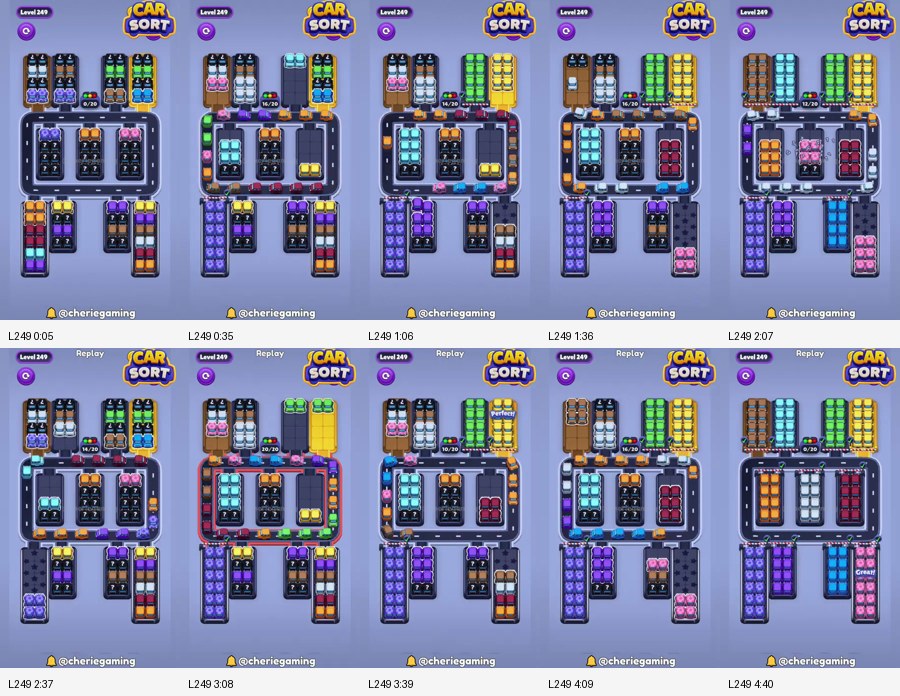
Mapping the four sides
Across the top are paired columns containing brown, white, green, and yellow cars. The left and right edges hold additional tall stacks, including purple, orange, red, yellow, and mixed dark cars. Shorter lower columns sit beneath the ring, with purple prominent near the center and pink on the lower right.
Inside the road are three separate covered garages. Their question marks and counters make them the biggest source of uncertainty. They are also surrounded by the only continuous travel lane, so a car stopped beside one cover can block movement between the outer columns.
The opening capacity is twenty, larger than many nearby levels. Do not interpret that as permission to collect twenty unrelated cars. The high capacity exists because the board contains many long groups and because some sets span opposite sides. You still need to complete colors deliberately.
Route priority
A stable order for Level 249 is:
light blue → orange → white → brown → green → yellow → red → pink → purple → center-garage cleanup
Light blue is an effective opener because a tall cyan group has direct access near the left-center entrance. Removing it creates a large working lane beside the left covered garage. Orange then uses the newly opened bottom-left and side routes.
White and brown should be handled as neighboring top tasks. They can swap if one group becomes complete first, but do not mix both with green and yellow simultaneously. Green and yellow occupy the right half and become much easier after the top-left groups are gone.
Purple appears in several lower stacks and is visually tempting. It is usually safer late. Its cars are spread across multiple entrances, so starting purple early fills the ring without immediately emptying a single column.
Opening the left half
Begin with the light-blue cars whose path enters the ring beside the left central garage. Send them into one consistent destination. Their removal shortens the outer column and exposes orange or another useful side color without disturbing the covered garage.
Move orange next if a complete set is available along the left and lower edge. The orange column has a direct road connection once cyan is gone. Keep the bottom-left corner open: it is the turning point for cars leaving both the side stack and the lower stack.
The first major checkpoint is a clean cyan group and a clean orange group, with the left section of the ring mostly empty. If you instead have cyan, orange, purple, and brown all circulating together, pause. Finish whichever has the most members already on the road before exposing another column.
White and brown descend from the top. Complete one entire top pair at a time. Brown often becomes the better first choice when its cars appear both in the upper pair and near the center. White is safer when the left top entrance is clear. The precise order can vary, but the upper-left junction must never hold two partial colors.
Moving across the top and right side
After the left half is stable, turn to green and yellow. These tall, nearly uniform columns are valuable because they can clear a large amount of board space with few decisions. Green should usually leave before yellow if it is closer to the central top entrance.
Yellow uses the rightmost route and can conflict with red or pink cars waiting below. Finish yellow in one run. Do not pull a red car from the right edge in the middle of a yellow sequence merely because it becomes exposed. The newly visible red can remain parked until yellow has vacated the corner.
The replay's middle state shows complete green and yellow blocks above a much cleaner ring. That is the target arrangement. By this point, the center covers may have advanced, but they should not dominate the road.
Red comes from the right side and from a center reveal. Wait until enough red cars are visible to finish the group. Pink is similar: a conspicuous pink lower-right column supplies several pieces, but the remaining matches may not appear until a cover changes. Keep the pink entrance free until that match is known.
Releasing the three center garages
The center garages should be opened in response to the board, not all at once. When a counter reaches its release point, look at the front car and ask whether it completes an existing color. If it does, take it immediately. If it begins a new color, finish a visible outer group first.
The left center garage influences the cyan and orange route. It is safest after those colors have cleared. The middle garage shares the lower crossing with purple stacks and should remain quiet until the bottom road has space. The right garage affects red and pink traffic, making it the natural late release.
Every center garage needs an escape lane on both sides of its opening. Parking a partial group directly in front of a cover may seem harmless, but the next revealed car then has nowhere to turn. Keep the inner ring moving clockwise or counterclockwise as a single stream rather than sending cars toward one another.
The counters also provide pacing. When the delivery total climbs, expect a new reveal and leave two or three free waiting slots. A completely full counter just before a cover opens is a common reason the otherwise correct route fails.
Purple as the late consolidation color
Purple is distributed among the left lower stack, center lower stacks, and possibly a released garage. This distribution explains why it should be delayed. Once most other columns are gone, each purple source connects to the ring without interference, allowing several purple cars to merge in quick succession.
Clear the lower-center purple column first if it is already accessible. Then take matching purple cars from the left side and any center reveal. Avoid splitting them between two waiting garages. A single complete purple group opens more space than two partial purple lines.
Pink can be resolved immediately before or after purple depending on the right garage. If the full pink lower-right column is exposed, finish pink first and use the resulting entrance to move purple. If pink still lacks partners, leave it and consolidate purple from the other three sources.
Recovery and checkpoint checks
If the inner ring is blocked, identify which car occupies a junction in front of a covered garage. Complete that car's color using visible outer columns. Opening another cover almost never fixes a blocked ring.
If the bottom is crowded with purple and yellow, finish yellow from the right stack before adding more purple. Yellow has a more concentrated source and therefore clears faster.
If red or pink is stranded on the right, stop using the left-side columns and work only on the nearest matching right-side group. Moving unrelated cars across the ring increases the traffic conflict.
If a center reveal introduces a color you cannot finish, leave at least three counter spaces unused and clear a long uniform outer column. Green, yellow, cyan, or orange usually provides the fastest reset.
For a clean restart, use visible milestones rather than memorizing every tap: first empty cyan and orange from the left; then clear white and brown from the upper-left; next remove green and yellow from the upper-right; resolve red and pink on the right; and finally combine purple with the remaining center cars. The physical slots may differ, but the road should become progressively emptier at each milestone.
Level 249 becomes manageable when the covered center is treated as a supplier rather than the starting point. Clear the long outer columns, reserve space for each reveal, and postpone the widely distributed purple cars until the ring is open. The final cleanup then consists of complete color groups traveling through an almost empty rectangle.