Car Sort: Color Puzzle Level 258 Solution Walkthrough
Route Reference
Key opening, middle, and finish positions for this route.
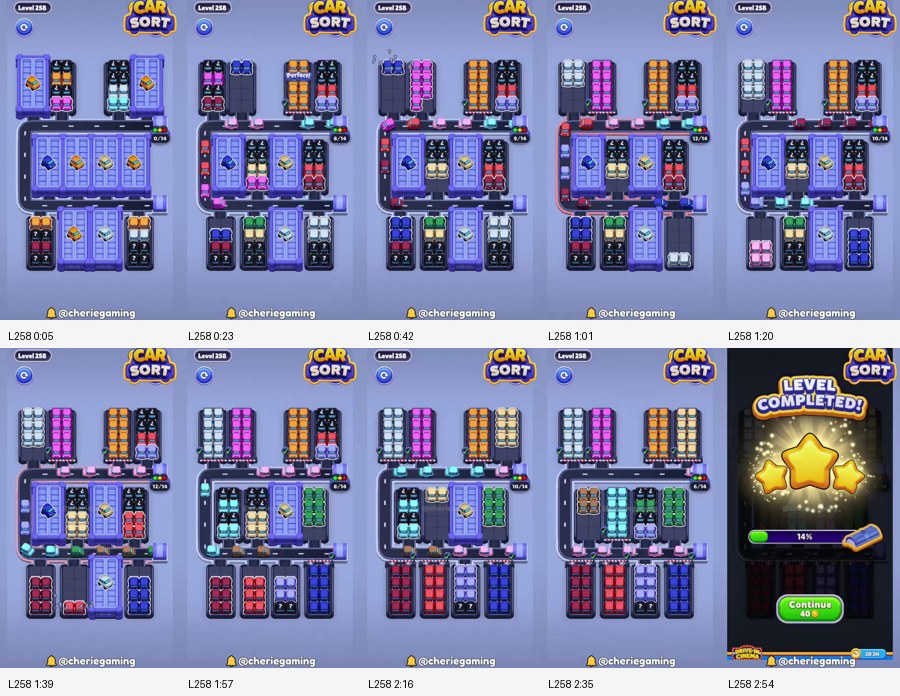
Understanding the four platforms
The center contains four long purple bays with colored markers. The markers include blue, orange, beige, cyan, and other colors. Cars on or behind these platforms do not all move at once; the outer color groups and delivery count control their usefulness.
Above the road are stacks containing pink, orange, white, dark red, cyan, blue, and dark cars. Below are red, green, white, dark blue, and covered columns. Every group must enter through either the upper or lower edge of the rectangular loop.
The counter holds fourteen cars. That capacity is needed because some tower groups are long, but it should not be filled with one car from every platform.
Route priority
A safe order is:
pink → orange → white → dark red → blue → red → cyan → green → brown and beige → remaining dark cars
Pink and orange clear the upper towers and create room along the top road. White then links an upper stack with a lower source. Dark red simplifies the right side.
Blue and red open the lower gates. Cyan and green coordinate with central platform markers. Brown and beige appear later and should wait until the station lanes are empty.
Top-tower opening
Begin with pink from the upper-left progression. Complete the visible group rather than taking isolated blue cars from a platform. Pink clears the top-left entrance and reveals a cleaner route for orange.
Orange occupies a tall upper stack and has matching platform markers. Move the tower only when the top road is empty. Finish orange in one sequence so it does not remain parked beside the center.
White is split between the upper-left and lower-right areas. Wait until both sources are visible, then combine them. A partial white group can safely wait only if it does not occupy the lower entrance.
Dark red comes from the upper-right stack and a lower-left source. Complete it after white, using the right edge as a dedicated lane. Do not mix blue into this sequence.
The first checkpoint is an open top road with pink, orange, white, and dark red organized into complete columns or cleared destinations.
Working with platform markers
Treat each colored marker as a route request. A platform should be activated when a matching group is already visible in an outer stack. Taking a marker car without its partners starts a color that may not finish for several moves.
Use the central bays from left to right only when that matches the exposed outer colors. The physical order is less important than completion. If the third platform offers cyan while blue is already active, finish blue first.
Keep the road directly above and below the platforms clear. Newly available cars need room to turn. Parking one orange car at the top and one red car at the bottom can isolate the entire center.
As a platform empties, it becomes useful working space. Do not immediately refill that space with a mixed color; preserve it for the next complete group.
Lower columns: blue and red first
Blue has a strong lower-right source and also appears in the upper or central stacks. Complete blue once the right road is free. It removes a tall column and opens the bottom approach.
Red follows from the lower-left. Its group is concentrated and can travel around the left corner after blue leaves. If dark red is still active, finish dark red first; similar colors should not share the road.
Several bottom columns begin covered. Open only the one matching the active group. If a cover reveals green while red is unfinished, leave green and complete red.
Reserve three counter spaces before a lower cover changes. A newly exposed tower can release multiple cars and must not arrive into a full waiting area.
Cyan, green, brown, and beige
Cyan is a bridge color between the upper stacks and central platforms. It becomes safe after blue and red clear the lower edges. Combine all visible cyan pieces in a single run.
Green is concentrated in a lower column and a platform reveal. Clear it next, keeping the bottom-center entrance dedicated to green until the group completes.
Brown and beige appear in the late developed board. Their sources are not fully useful at the opening, so moving an early isolated piece only consumes capacity. Once cyan and green are gone, both colors can form clean columns through the open center.
Finish remaining dark cars last. They begin behind bright tower colors and become aligned only after the station has emptied.
Recovery advice
If the upper road is blocked, complete pink, orange, white, or dark red based on the waiting car. Do not activate another platform.
If the lower entrance is crowded, stop opening covered columns and finish blue, red, cyan, or green from the exposed tower.
If a platform marker introduces a new color into a nearly full counter, leave other platform cars untouched and complete the most advanced outer group.
If white or dark red is split between top and bottom, clear one corner with a concentrated color before trying to merge the two sources.
If brown or beige appears too early, keep it on its platform when possible. These colors are late supplies and should not displace the opening groups.
On restart, use four stages: pink and orange open the top; white and dark red clear the sides; blue and red open the bottom; cyan, green, brown, beige, and dark cars resolve the platforms on an empty road.
The Level 258 solution is about matching platform access to a ready outer tower. Do not activate every station bay simply because it becomes available. Complete one color, clear its entrance, and use the resulting space for the next marker. With that discipline, the four-platform board stays fluid from the first pink group to the final dark cleanup.