Car Sort: Color Puzzle Level 260 Solution Walkthrough
Route Reference
Key opening, middle, and finish positions for this route.
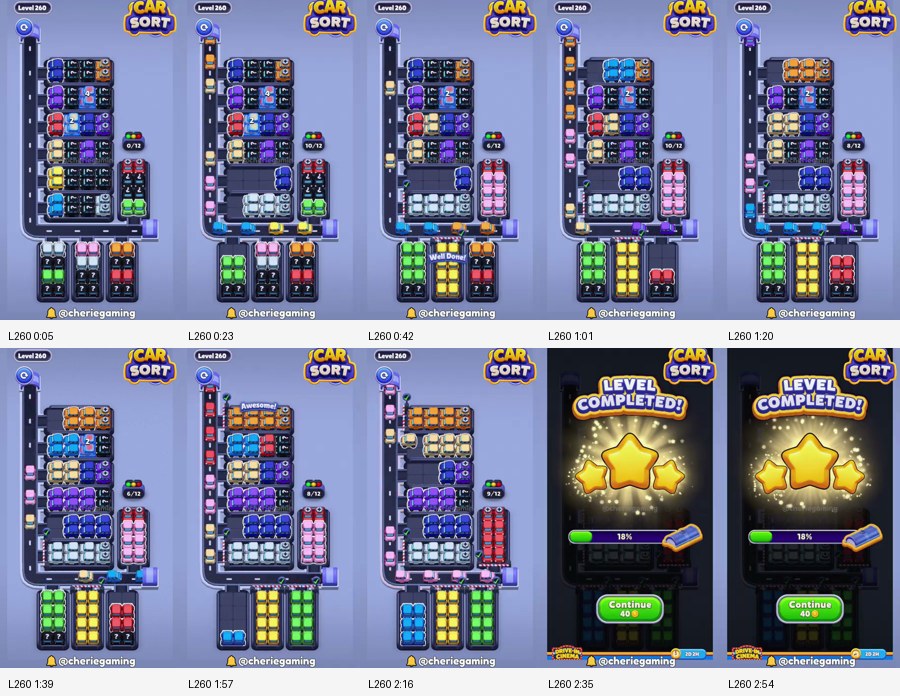
Board structure
The upper shelves contain orange, blue, red, beige, purple, dark blue, white, and dark cars. Pink occupies the right-side column, with red and green beneath or behind it. The three lower garages later supply blue, yellow, green, and red.
The road begins at the upper left, descends along the left edge, crosses below the shelf block, and turns up briefly on the right. The bottom crossing is both an exit for the center and an entrance for every lower column.
The counter holds twelve cars. Several central groups contain four or more cars, so completing a full row is much safer than holding pairs from multiple numbered shelves.
Reliable route priority
Use:
white → dark blue → purple → beige → orange → blue → pink → red → yellow → green → remaining dark cars
White opens the lowest visible central row. Dark blue and purple then clear the rows above it. Beige removes a concentrated middle band. Orange and bright blue simplify the upper shelves.
Pink controls the right-side column and should wait until the lower crossing is open. Red links that column with a bottom release. Yellow and green are concentrated in the late lower garages.
Clearing from the bottom upward
Begin with white in the lowest central shelf. Its cars have a short path to the bottom crossing and form a complete group without opening a covered column. Removing white gives the road a broad staging area.
Dark blue is the next lower row. Keep it distinct from the brighter cyan-blue group above. Finish dark blue completely before taking a bright blue car.
Purple follows and clears the center of the stack. Several purple cars are exposed together, so they should leave in one sequence. A numbered car may remain behind; leave it until its counter or matching group is ready.
Beige sits above purple and becomes accessible after the lower rows shrink. Complete beige through the left side, keeping the bottom turn free.
The first checkpoint is an empty or organized lower half with white, dark blue, purple, and beige resolved. The road below the shelves should contain no waiting pair.
Upper orange and blue rows
Orange occupies the top shelf and is best handled before bright blue if its exit is exposed. Move the full orange line around the left edge. Do not pull orange from a lower cover while the top group is incomplete.
Bright blue follows from the upper-middle shelves. Its removal exposes red and numbered cars. Complete blue before touching the right-side pink column, because both streams use the bottom crossing.
If a numbered car becomes available during this phase, ask whether it finishes orange or blue. If not, keep it in its shelf. Numbered pieces should serve as exact matches rather than new active colors.
By the end of the upper phase, the central block should show large uniform rows and significant empty space. That empty center will receive the side and bottom groups.
Right-side pink and red
Pink forms a tall external column on the right. Start it only when the lower-right turn is empty. Move every available pink car together so the column does not remain attached to the road.
Red appears behind or beside pink and also in the rightmost lower cover. Wait until both sources can combine, then complete red. Pulling the bottom red group before pink clears traps it below the crossing.
The right side is a checkpoint: pink must be complete, red must have an open match, and the bottom road must be clear before yellow or green begins.
Three lower supply columns
Open the lower column whose front color matches the active group. Blue may provide a finishing piece for the upper phase; yellow and green generally belong to the late cleanup.
Yellow is concentrated in the middle lower column and can leave quickly once red clears. Complete the entire yellow group before moving green from either neighboring column.
Green is last among the major bright colors. Its cars appear in the left or right lower source and the side progression. With the center empty, all green pieces can merge without blocking another route.
Keep two or three counter spaces available at every cover transition. If a cover exposes a different color, leave it parked and complete the group already in transit.
Final numbered and dark cars
Numbered cars that were impossible to use early become straightforward after the visible rows disappear. Their counters have advanced, and the empty central shelves provide destinations.
Dark cars remain behind several upper colors. Save them for the final pass. Move one complete dark shade at a time rather than mixing similar-looking groups.
The successful late state displays orange, beige, purple, dark blue, and white as clean central rows, with blue, yellow, green, pink, and red grouped around the outside. Exact garages may change, but the board should be uniform.
Recovery plan
If the bottom crossing is blocked, finish the waiting color before opening a lower cover. White, dark blue, purple, or pink is usually responsible.
If the central shelves are half-open, return to the lowest row with a complete visible group. Clearing upward restores the intended order.
If pink and red are mixed on the right, finish pink first unless a complete red set is already exposed in the lower column.
If yellow and green are both active below, complete yellow from the concentrated middle column, then let green use the cleared route.
If a numbered car fills the last counter space, restart from the last checkpoint and leave that car in its garage until its full color group is visible.
For a clean replay, remember the phases: white through beige clear the lower shelves; orange and blue clear the top; pink and red open the right; yellow, green, numbered cars, and dark groups finish from below.
Level 260 rewards a bottom-up approach. Empty the central floor before using outside supplies, keep the lower crossing clear, and release each covered column only for a color already prepared. The tall shelf stack then resolves without wasting the twelve available spaces.