Car Sort: Color Puzzle Level 263 Solution Walkthrough
Route Reference
Key opening, middle, and finish positions for this route.
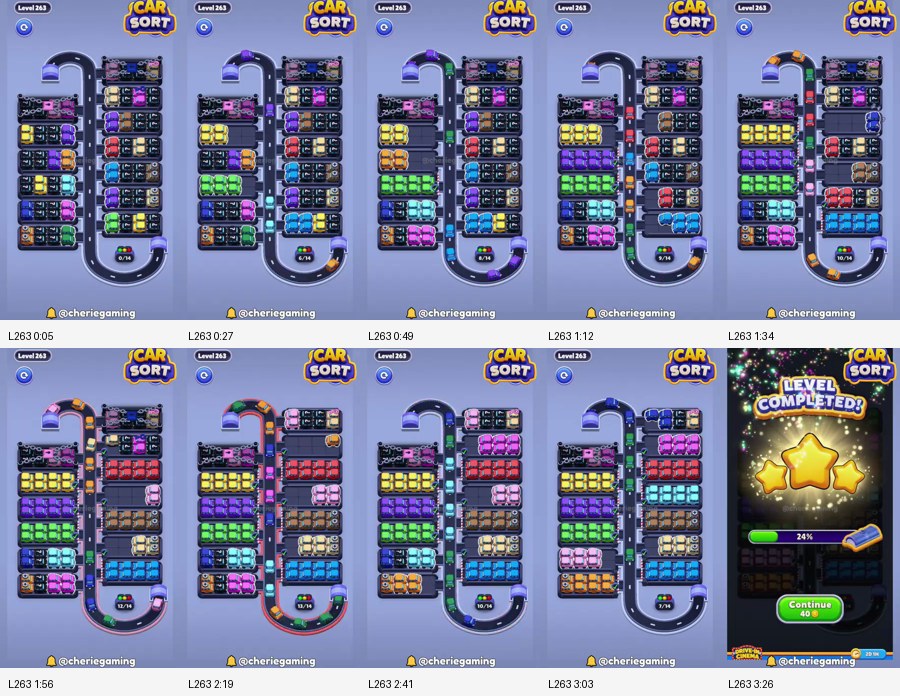
Reading the two garage banks
The left bank is shorter and wider. Pink appears near the top, with yellow, purple, green, cyan, orange, and mixed dark rows beneath it. The right bank is taller and contains pink, beige, purple, red, blue, orange, yellow, green, and dark cars.
The road starts at the upper-left hook, runs vertically between the banks, turns around the bottom, and ends at a lower-right exit. Shelf traffic can therefore enter from both directions. If two different colors approach the central spine from opposite sides, they can stop every row behind them.
The counter holds fourteen cars. Use it to finish one long color group, not to store exposed end cars from every shelf.
Recommended route order
A reliable priority is:
yellow → purple → green → cyan → pink → red → brown → beige → orange → blue → dark cleanup
Yellow, purple, and green have strong visible groups on the left and create the first large openings. Cyan then clears a lower-left band. Pink bridges the upper rows across both banks.
Red, brown, and beige simplify the right bank. Orange and blue become complete only after deeper shelf ends are exposed. Dark cars are distributed behind the bright colors and belong to the final pass.
Opening the left-side block
Start with yellow where several cars are already visible in a compact left row. Move the full group through the lower part of the road. Avoid tapping a pink car from the upper shelf while yellow is in transit.
Purple follows from the next exposed band. Its route uses the center spine, so wait until yellow has completely left. Finishing purple reveals a broad green row.
Clear green as a single block. Some matching green cars may sit on the right, but take them only if the road is empty and they complete the group immediately. Do not begin a second green set that cannot finish.
Cyan is the fourth left-side target. Its cars occupy a lower row and have a direct approach to the bottom curve. Completing cyan removes the last major obstacle from that turn.
The first checkpoint is a left bank containing clean yellow, purple, green, and cyan groups or empty shelves. The central road should have no mixed queue.
Upper pink transition
Pink appears in the upper-left shelf and several right-side rows. It is the natural bridge between the two banks, but it should not be started before the lower-left traffic clears.
Take the exposed upper pink cars, then collect their right-side matches while the top hook is free. Complete pink in one sequence. A pink pair waiting near the hook can block every right-side row below it.
Once pink is gone, the top connection becomes available for beige and red. Preserve that opening instead of filling it with an isolated orange car.
The route counter advances during these complete groups. When it approaches a transition, leave several spaces open in case a deeper shelf exposes more than one matching car.
Right-bank red, brown, and beige
Red becomes concentrated in the middle-right after pink leaves. Complete it before brown if the full row is visible. Red uses the lower half of the center spine and should not meet beige coming from above.
Brown occupies a long right-side row later in the route. Its removal creates one of the largest empty shelves on the board. Finish every visible brown car before changing colors.
Beige appears above and below brown. Wait until both sources connect, then route the group through the upper hook. If brown still occupies the central shelf, beige may have no clean turn.
The developed replay state shows red, brown, and beige forming orderly horizontal bands on the right while the left remains organized. That uniformity is more important than matching a particular destination slot.
Orange and blue cleanup
Orange is present deep in both banks and becomes useful after the central colors clear. Choose the side with the larger exposed orange set, move it completely, then collect the opposite-side matches.
Blue is similarly distributed but usually depends on a lower right shelf. Finish it after orange so that the bottom curve remains dedicated to one color.
Dark cars should wait until the bright shelf ends are gone. At that point, each dark shade is exposed in a coherent row and can circle the U-road without competing traffic.
If a familiar color reappears as a second group, treat it as a new complete task. Do not leave one car circulating from the opening in anticipation of a late set.
Road checkpoints
Before changing colors, inspect both bends. The upper hook should be empty before a right-side upper row moves. The bottom curve should be empty before a left lower row or deep right row moves.
Allow traffic to use one direction at a time. A complete group moving clockwise is safe. One car clockwise and another counterclockwise can form a permanent meeting at the narrow spine.
Use empty shelves as destinations only for uniform groups. Scattering mixed cars into the spaces created by yellow or brown removes the main benefit of those clears.
Recovery advice
If the upper hook is blocked, finish pink, beige, or the color of the waiting upper-right car. Do not move a lower-left group toward it.
If the bottom curve is jammed, finish yellow, green, cyan, red, orange, or blue according to the nearest waiting car. Stop opening distant shelves.
If the counter contains several pairs, prioritize a full horizontal row. A completed row restores more road and counter space than a speculative cross-bank match.
If brown and beige are mixed, finish brown first when its long row is exposed. Beige needs the space brown creates.
If the route no longer resembles the replay, check the phase rather than the exact garage positions: left yellow through cyan first; pink across the top; red, brown, and beige on the right; orange, blue, and dark cars last.
The Level 263 solution is about converting one garage bank at a time. Clear the concentrated left colors, use pink to transfer control across the top, then empty the right bank without opposing traffic. Once both hooks are preserved, the long board becomes a straightforward sequence of complete rows.