Car Sort: Color Puzzle Level 264 Solution Walkthrough
Route Reference
Key opening, middle, and finish positions for this route.
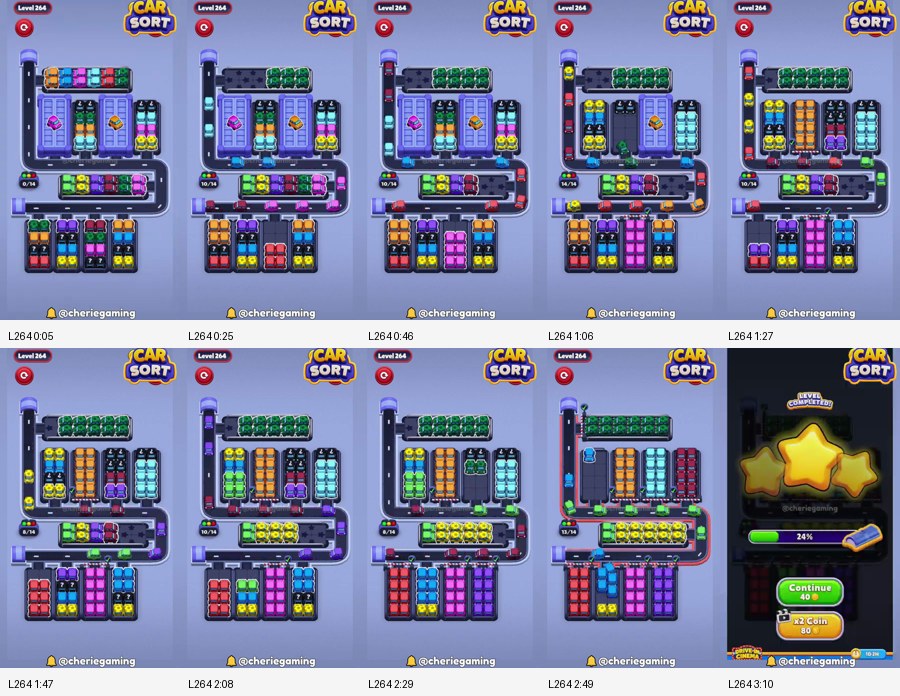
The layered board
The upper station contains pink, orange, cyan, yellow, dark, green, and other mixed cars. The long top row is almost entirely green but initially restricted. The center strip contains yellow, green, red, purple, and dark cars. The lower columns later reveal red, blue, pink, cyan, green, and yellow.
The road runs down the left side, across the center, curls around the right edge, and returns under the station. The upper and lower groups therefore share the right corners. A partial color parked there can isolate an entire layer.
The counter holds fourteen cars. Several station releases are long, so reserve space before activating them and avoid holding unrelated pairs.
Suggested route priority
Use:
green station markers → cyan → yellow → orange → pink → red → blue → long top green → purple → remaining dark cars
Small green matches near the station advance the opening. Cyan and yellow clear compact upper bays. Orange and pink remove the major station blockers.
Red and blue connect the center strip to the lower columns. The long top green row should wait until the road can carry the complete release. Purple and dark cars finish after the layered entrances are open.
Opening the upper station
Begin with the station color that has enough visible matches to complete immediately, usually cyan or yellow after the first green marker advances. Do not activate all four purple bays together.
Clear cyan through the upper-right turn. Its tall side group is concentrated and can leave in one sequence. Keep the center strip quiet while cyan travels.
Yellow follows from an upper bay and the center strip. Move the visible central yellow cars first, then use the station pieces to finish the group. This prevents a lone yellow car from waiting at the upper corner.
Orange is a strong third station color. Its cars form a tall group after an early bay opens. Complete orange before moving pink from the adjacent bay.
Pink then clears the remaining upper-middle blocker. By the first checkpoint, cyan, yellow, orange, and pink should be organized, while the long top green row may still be locked.
The narrow center strip
The horizontal strip across the middle acts as a gate between upper and lower traffic. Its yellow, green, red, and dark cars should be removed in complete groups.
Red becomes useful after the station clears. Match the central red cars with the lower-left release, then complete the group through the lower-right turn.
Blue appears primarily in the lower supply columns and a station reveal. Wait until the red route empties, then move blue as one block.
If green cars appear in the center, use them only when they advance or match the long top group. Avoid leaving a small green pair active for many turns.
The center strip must be mostly empty before the long green release. It is the only destination area large enough to receive that sequence without blocking the road.
Releasing the long top green row
The top row is visually the largest single group and a tempting opener, but its screw condition and route make it a middle-to-late task. Earlier complete groups reduce its restriction and clear the upper road.
When the row becomes movable, reserve several counter spaces and send the green cars continuously. Do not interrupt the sequence with purple, red, or blue.
The long group travels along the upper edge and through the right turn. Keep both corners empty until the last green car reaches a garage.
After green clears, the board gains a large horizontal space at the top. Use it for complete late groups, not mixed leftovers.
Four lower supply columns
Open one lower column at a time. Red and blue are useful first because they match colors already exposed in the center. Pink or cyan can follow if an earlier group remains incomplete.
Yellow and green may recur behind the first lower cars. Treat them as new complete sets unless they are exact finishing pieces for an active group.
Never pull from two neighboring lower columns while both colors are incomplete. Their entrances share the same road and the cars will meet at the bottom-right corner.
As a cover changes, keep three spaces available. If its first car does not match the active color, leave it in place and finish the current group elsewhere.
Purple and dark cleanup
Purple appears behind station cars and in the lower progression. It is safest after the long green row and central strip are gone. Combine all visible purple sources on the open loop.
Dark cars remain hidden in upper and center rows. Once the brighter groups clear, they form coherent columns and can be finished one shade at a time.
The late replay shows uniform green at the top, clean orange and cyan columns in the station, yellow across the center, and red, blue, pink, and purple below. Exact slots can vary, but each layer should be orderly.
Recovery advice
If the upper-right turn is blocked, finish cyan, yellow, orange, pink, or green according to the waiting car. Do not open a lower column.
If the lower-right turn is jammed, stop station releases and finish red or blue from the lower source.
If the long green row was started too early, commit to completing green and ignore every new station marker until the road clears.
If the counter holds several station colors, choose the bay with a complete visible tower. Leave the other markers inactive.
If the center strip remains crowded, clear red or yellow before releasing the top row. Empty center space is the requirement for a safe green sequence.
For a restart, use four phases: cyan, yellow, orange, and pink organize the station; red and blue open the center and bottom; the long green row clears the top; purple and dark groups finish the empty layers.
The Level 264 solution depends on respecting the board's layers. Finish compact station colors, empty the center gate, and only then move the long screwed green row. Separate lower releases keep the shared right turns clear and make the final purple and dark cleanup routine.