Car Sort: Color Puzzle Level 267 Solution Walkthrough
Route Reference
Key opening, middle, and finish positions for this route.
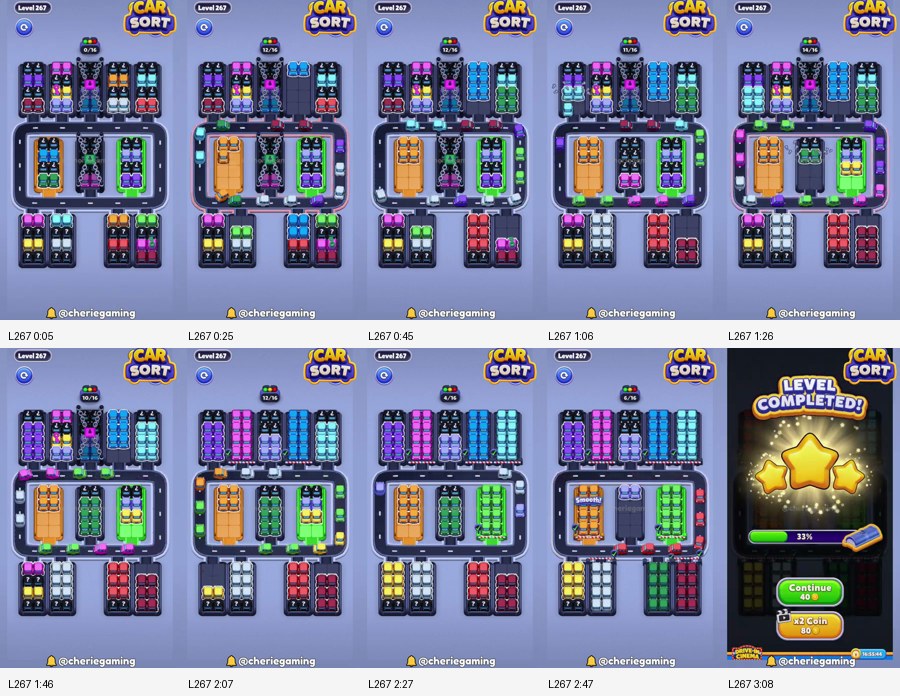
Reading the central block
The inner rectangle contains three tall bays. Orange dominates the left. The middle begins behind a dark chain with pink and green cars. The right contains purple, green, and later yellow. These bays occupy most of the available interior, leaving only a thin perimeter for movement.
Five columns stand above the road, carrying purple, pink, pale violet, blue, cyan, green, white, red, yellow, and dark cars. Four more groups sit below, including yellow, white, red, dark red, green, and covered colors.
The counter holds sixteen cars. That is enough for one tall column and a small unfinished pair, but not for activating every chained bay at once.
Recommended route order
A stable priority is:
orange → pink → purple → cyan → white → red → green → yellow → blue → pale violet and dark cleanup
Orange creates the first large interior opening. Pink and purple then release pressure from the chained center. Cyan and white clear concentrated outer towers.
Red connects the bottom columns to the center. Green and yellow become the main late central groups. Blue, pale violet, and dark shades are safest after the road is mostly empty.
Clearing the orange bay
Start with the orange cars in the left central bay. Their route is direct, and completing orange converts the largest interior obstacle into useful space. Do not pull pink or purple from an upper column while orange is using the loop.
If an outer orange car is exposed, take it only when it completes the central group. Avoid opening a new column merely to collect another orange pair.
After orange clears, preserve the empty bay. It should receive one complete group later rather than several mixed cars.
The first checkpoint is a clean left interior, an open lower-left corner, and enough counter room for the first chained release.
Pink and purple release
Pink is visible in the middle bay and in upper or lower supply columns. Complete the exposed outer pink pieces first if they directly advance the chain, then clear the full central group.
Purple follows from the right bay and upper-left progression. Wait until pink has left the road. Both colors use the upper and lower turns around the central rectangle, and mixing them creates a queue.
When a chain counter changes, reserve several spaces. The released bay may expose a second color behind the first. Move that new color only if its partners are already visible.
By the end of this phase, the center should show open space on the left and clean or nearly complete pink and purple groups. Green may be visible but should not yet dominate the road.
Cyan and white outer towers
Cyan forms a strong upper-right column. Once the top edge is free, send the entire cyan group in one direction around the loop.
White appears in another upper column and a lower source. Complete white after cyan so both do not compete for the same right-hand corner.
These two colors are valuable because they empty complete outer towers without depending on further chain releases. Their removal also exposes red, blue, or green cars behind them.
If the game reveals a familiar color as a second group, finish the visible tower as a separate task. Do not keep a single car circulating in anticipation of a much later match.
Red as the lower bridge
Red is concentrated in the lower-right columns and appears in an upper progression. Wait until the bottom road is clear, then combine the sources.
Dark red may look similar to red. Keep the shades separate and watch which garage accepts each car. Mixing them consumes counter spaces without advancing either group.
Completing red opens the lower route to the green and yellow central bays. Do not begin both of those colors at once.
The replay's developed state shows red and dark red as clean lower towers while cyan and white stand organized above. That separation is a useful checkpoint.
Green and yellow center finish
Green is distributed across the middle and right central bays plus an outer column. Clear one complete green group through the space created by orange and red.
Yellow follows from the right bay and lower-left supply. Its cars should move only after green has vacated the inner road. Yellow often becomes the last major central group.
Both colors are long sequences. Keep at least three counter slots free before their chain or screw conditions finish. Do not interrupt a released column with blue or pale violet.
When green and yellow are complete, the interior rectangle should be largely empty and the remaining outer colors can travel without obstruction.
Late blue, pale violet, and dark cars
Blue appears in upper columns and behind earlier central blockers. Complete it using the open top edge.
Pale violet is similarly concentrated in a remaining upper tower. Let it follow blue rather than travel in the opposite direction.
Dark cars are scattered behind bright tower fronts and chains. Save them for the final pass, when their matching rows are fully visible.
The successful final arrangement has uniform outer columns and clean green and yellow interior bays. Exact destination slots can vary; uniform colors and an empty loop are the important evidence.
Recovery advice
If the loop is blocked beside the orange bay, finish orange or the color parked at that corner before opening a chain.
If pink and purple are both active, complete the color whose central bay has fewer cars remaining. Stop all outer towers.
If the lower edge is crowded with red and yellow, finish red first from its concentrated supply columns.
If a release exposes an unusable green car, leave it inside the bay and complete cyan or white from a visible outer tower.
If the counter contains several similar shades, identify which garage accepts each and finish the group with the most exposed matches.
For a restart, use four milestones: orange opens the interior; pink and purple release the center; cyan, white, and red clear the outside connections; green and yellow finish the bays before blue, pale violet, and dark cleanup.
The Level 267 solution is a prepared-release sequence. Clear the orange space first, never activate two chained colors together, and use compact outer towers while waiting for the center. Once green and yellow can move as complete groups, the remaining columns become a simple one-color cleanup.