Car Sort: Color Puzzle Level 302 Solution Walkthrough
Route Reference
Key opening, middle, and finish positions for this route.
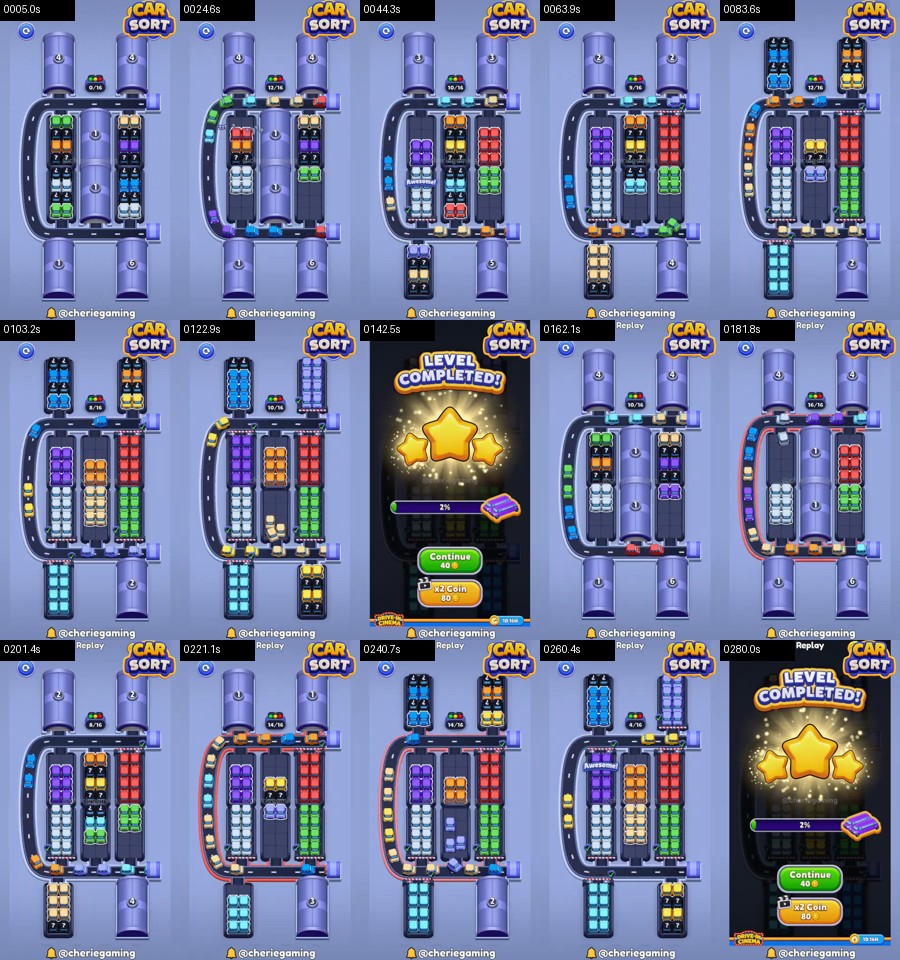
Reduce the side channels
Begin with the exposed red group on the right and the short green group beneath it. Finish red first, then green. On the left, clear the accessible purple batch followed by white. These four groups create turning space around the top and bottom ends of the central cylinder.
The route continues:
red → green → purple → white → yellow/blue upper stacks → orange → pale cyan → beige lower garage → final violet
Yellow and blue appear above once the first side groups have reduced the garage counts. Use the upper road for one full column at a time. Orange follows on the right; pale cyan uses the newly open lower-left connection.
The beige group released from a lower cylinder should be saved until the central route is clear. It is a long column and needs the bottom bend without blue or cyan traffic. Violet is the final tall group after the numbered covers have stepped down.
The replay's important checkpoint is not a particular number but the shape of the board: four uniform side columns with open road at both ends of the central cylinder. If your layout still has mixed short groups there, finish those before opening another garage.
If cars stop above the cylinder, complete the active yellow, blue, orange, or violet tower. If they stop below it, finish cyan, white, or beige. A garage number that does not change usually means a matching batch is incomplete somewhere on its side of the board.
Work around the cylinder, never through it
The center garage divides the board into two narrow channels. Until its dependencies are reduced, a car on the left cannot rely on crossing directly to the right. Each side therefore needs its own opening space. Red and green thin the right channel; purple and white do the same on the left.
Finish those four short groups before releasing either upper 4-cylinder. They create open turning pockets at both ends of the center block. If yellow or blue enters while a short red, green, purple, or white batch remains, the tall column can fill an entire side with nowhere to turn.
The first strong checkpoint is a board with clear road above and below the central cylinder and four tidy side columns. Exact counts may differ by one transition, but the road shape must be open at both ends. That shape allows the upper stacks to drain without needing a cross-board shortcut.
Build two independent side routes
- Clear red from the exposed right stack. Red opens the upper-right corner.
- Finish the short green group underneath it. Green frees the lower-right turn.
- Move purple on the left and let it clear the opposite upper corner.
- Complete white below purple. The lower-left road should now be usable.
- Drain yellow from the first upper stack. Keep blue waiting until yellow has left the top of the cylinder.
- Clear blue from the neighboring upper group. The two large top counts should now be visibly reduced.
- Send orange down the right channel. Orange inherits the space created by red and green.
- Move pale cyan through the lower-left connection after blue has parked.
- Release the long beige group from the bottom cylinder only when the lower bend is empty.
- Finish violet from the final tall garage, then collect any short matching remnant.
The side order can be remembered as short right, short left, tall top, then long lower cleanup. The colors still need to remain separate within those phases. Yellow and blue share the top turn, while cyan and beige share the bottom bend.
Watch the two ends, not only the counters
Above the central cylinder, the road should clear after every yellow, blue, orange, or violet batch. Below it, white, cyan, and beige should never overlap. A count can fall while a final car is still traveling, so wait for the physical lane to empty before moving to the next color.
After yellow and blue, the upper stacks should be visibly shorter and the side channels should remain organized. After orange and cyan, the lower garages become practical. Beige is the late-board checkpoint: if beige can make the bottom turn without meeting another color, the final violet batch is safe.
Repairing a one-sided traffic jam
When the right channel stalls, finish red or green in the opening, orange in the middle, or the active upper color near the end. Do not release cyan from the opposite side in an attempt to create movement; it still has to use the shared bottom turn.
When the left channel stalls, complete purple or white first. Later, finish cyan before beige. A prematurely released beige column should wait below its cylinder while cyan clears; adding violet from above would block both ends at once.
If a top garage remains at 4, return to the four short side groups. One of them is incomplete. If the count has reduced but the cover stays closed, finish the current yellow or blue batch. During final cleanup, a blocked violet tower almost always means beige or orange still owns one end of the cylinder.
The route succeeds when each side remains locally clean until both ends connect. Trying to make every color circle the full rectangle too early ignores the center obstruction and turns a manageable two-lane puzzle into one long queue.
Level 302 works by opening both ends of the central cylinder. Clear the short red, green, purple, and white groups, then drain the upper yellow/blue towers and finish orange, cyan, beige, and violet through the released lower garages.