Car Sort: Color Puzzle Level 333 Solution Walkthrough
Route Reference
Key opening, middle, and finish positions for this route.
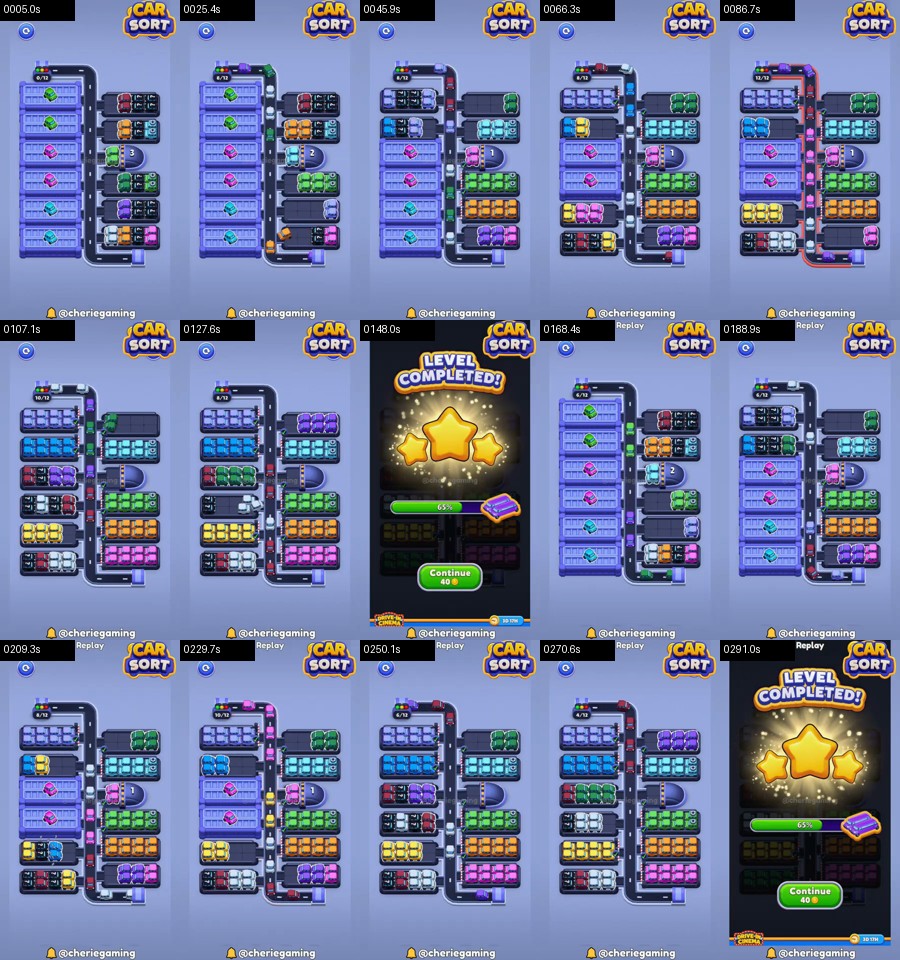
Work down the exposed right shelves
Start with red and orange from the two upper shelves. Pale cyan is the next broad row, followed by green. These batches run straight to the outside road and reduce the central gate without requiring space from the covered left bank.
Use this route reference:
red → orange → pale cyan → green → purple → yellow → white/black lower shelf → left-bank releases → repeated cyan, green, orange, and pink rows
Purple should move after green opens the middle connection. Yellow follows from the lower shelf and clears the turn beside the numbered gate. Do not tap a newly uncovered bay on the left while purple or yellow is still travelling.
Opening shelf checkpoints
Read the right side as three zones. Red and orange occupy the upper approach, cyan and green control the wide middle shelves, and purple with yellow guard the gate turn. Finish one zone before descending to the next. After the upper pair, the top road should be empty. After cyan and green, the middle connection should be visible. Purple and yellow then remove the last cars directly beside the round gate.
The left bank can flash a newly available face during this sequence. Treat that as information, not an immediate move. A left-side batch should enter only when the corresponding right-side zone has stopped using the connecting road.
Open the numbered middle gate
The bottom-right shelves contain white, dark, and mixed small groups. Finish the exposed complete color rather than alternating between them. Every completed batch lowers the round counter and removes another cover from the left bank.
Once the counter reaches its next checkpoint, use the released left bay immediately. The left side is a vertical sequence: a new bay becomes useful only after the one above it has stopped feeding the road. Clear its visible color, return to the right shelf that has just been exposed, and repeat.
Watch the empty shelf spaces rather than the number of cars still visible. After the orange and cyan rows leave, the top-right area should form a continuous channel. After purple and yellow finish, the same should be true beside the round gate. If either channel still contains a parked car, complete that color before accepting the next left-bank release.
Alternate sides only at a clean gate
When a left bay opens, clear its complete visible face and then inspect the gate. If the connection is empty, return to the newly exposed right row. If a marker remains beside the circle, finish the left batch before switching. This side-to-side rhythm is the core of the replay: right shelf, left bay, right shelf again, never two partial groups meeting at the center.
The lower white and dark faces need special care because they are small and easy to split. Finish whichever face is fully exposed. Their removal often triggers a larger colored row, so preserve the empty gate space for that new group.
Finish the paired shelf waves
The late board forms recognizable horizontal rows: pale cyan near the top, green through the center, orange below, purple at the lower edge, and pink as a final broad band. Clear these rows from top to bottom unless the active counter highlights a different exposed color.
The left covers remain the best progress indicator. If several are still shut, a matching right-side row has not been completed. If the outer road jams near the top, finish the red, orange, or cyan group already in motion. A blockage by the central gate usually means purple, yellow, or the white/dark lower shelf was opened out of order.
Late-row timing
Pale cyan should cross the top channel before green fills the center. Orange belongs below green, while purple and pink use the lower gate turn. Clear each broad row completely enough to leave a dark shelf behind it. If a left bay reveals the same color, finish the nearer right row first and then use the empty shelf as room for the left group.
Pink is the best final batch because it appears as a solid late band and has no deeper traffic competing for the gate. If orange or purple still occupies the road, postpone pink until that color reaches its garage.
Recovering a blocked handshake
If two colors meet beside the round gate, finish the one whose source face is already fully exposed. Do not open another left cover to search for space. A car trapped above the gate points to red, orange, cyan, or green; a car below it points to purple, yellow, white, dark, or pink.
Restart only if the connecting cell and both adjacent road corners contain different incomplete colors with no exposed matches. Most errors can be repaired by completing one side, waiting for the road marker to disappear, and resuming from the last counter change.
Level 333 is solved as a handshake between the two sides. The right shelves pay down the gate, each counter change opens a left bay, and that bay exposes the next right-side row. Keeping each exchange to one color prevents the narrow middle connection from becoming permanent parking.
Before the last pink batch, verify that the left bank shows no unopened face and that the round gate has finished its final animation. The top channel and the lower turn should both be empty. If one shelf remains colored, clear that row first. Pink is intended to travel alone through the completed connection, providing a simple visual confirmation that every earlier exchange has been resolved.