Car Sort: Color Puzzle Level 351 Solution Walkthrough
Route Reference
Key opening, middle, and finish positions for this route.
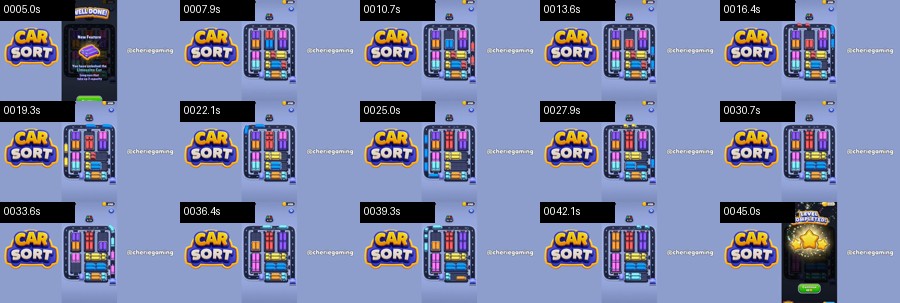
Read the compact grid
The opening layout shows tall pink and purple groups around the sides, with red, orange, blue, pale cyan, green, and yellow packed into the center and lower rows. Because the replay is short, use the visible grouping and road state as the route reference rather than trying to imitate an exact tapping rhythm.
The safest broad order is:
outer pink/purple columns → exposed red and orange center groups → blue and pale-cyan rows → green and yellow lower groups → remaining vertical columns → final single-color cleanup
The important rule is to complete a full visible group. The board has very little spare road, so one car from several colors is more dangerous than an imperfect choice between two complete columns.
Open one outer edge
Start with the complete outer column that already touches the road, normally pink or purple. Let the full group leave before opening the opposite side. This creates a vertical dark strip that acts as the board's only reliable buffer.
Once that strip is open, clear the neighboring outer color. If pink started, purple can follow; if the replay state exposes purple first, reverse those two while keeping the same principle. Do not alternate them in the road.
The first checkpoint is one empty outer lane and no mixed markers along the top edge. If both sides remain partially occupied, complete the side whose cars are closer to their matching garage.
Reduce the center colors
Red and orange become easier to reach after the outer edge opens. Clear the complete red group, then orange, or reverse them only when orange is the sole full face touching the road. These warm-color groups occupy the middle connection and must leave before the blue-cyan phase.
Blue follows through the dark space left by red and orange. Pale cyan should be kept separate even though the two hues are visually close. Watch the garage color and the road marker rather than relying only on shade. Finish blue, wait for its marker to disappear, and then clear cyan.
Use the lower horizontal connection
Green and yellow are concentrated around the lower section. Green should move while the vertical buffer is still open. Yellow follows after green has cleared the lower turn. If orange remains near that connection, finish orange before starting either lower color.
The short replay shows the board shrinking rapidly once the center is open. That is expected: the remaining columns no longer compete for the same narrow entry. Continue with one complete visible color at a time rather than trying to preserve the original order after every column changes.
Four visual checkpoints for the fast replay
Use the board shape to stay oriented. After the outer opening, one side should be a continuous dark strip. After red and orange, the center should no longer show a warm-color block across the connection. After blue and cyan, the upper and middle roads should be quiet. After green and yellow, only isolated vertical columns should remain.
These checkpoints are more dependable than the exact timing of the taps because the replay moves quickly. If your board has not reached the expected shape, finish the currently exposed group before following the next color. A newly visible column can wait safely; a partial group already in the road cannot.
Finish the remaining vertical columns
Pink or purple may remain in a deeper column after the first outer pass. Clear the complete returning group through the established buffer. Red, blue, or cyan can also appear in the final center cells; choose the group whose entire face is visible and whose garage route is unobstructed.
Before the last batch, the board should show several dark vertical strips and only one solid color cluster. If two colors remain, finish the one already touching the road. The final group should not need to circle or wait.
Recovery advice for the short route
If the road fills with two colors, stop tapping and complete the color closest to its garage. A jam near the top points to an unfinished outer pink, purple, red, or orange group. A blockage near the bottom points to blue, cyan, green, or yellow.
Do not open a hidden or deeper column to search for a match. Use only a complete face already visible in the same area as the stranded car. The compact board often recovers as soon as one full group disappears and restores the vertical buffer.
Restart only when different partial colors occupy both the top and bottom connections and neither has an exposed matching group. Most mistakes involving one early car remain recoverable.
Choosing between two complete columns
Sometimes two solid columns are visible together. Prefer the one whose entrance is next to the empty outer strip. It can leave without crossing the other column's future route. After it clears, the second group inherits the same buffer.
If both entrances appear equally open, follow the color already represented by a road marker. Completing an active batch is safer than starting a fresh one. Avoid using a single car from a third column to change the order; the compact grid has no spare cell for that experiment.
Before the final tap, check that the horizontal lower connection is dark and that only one vertical face remains colored. Let that face clear completely. The completion state should follow without another color appearing from behind it in the visible short route.
Level 351 is a short precision level rather than a long unlock puzzle. Open one outer lane, remove red and orange from the center, separate blue from pale cyan, clear green and yellow below, and finish the remaining vertical groups through the same preserved buffer.