Car Sort: Color Puzzle Level 360 Solution Walkthrough
Route Reference
Key opening, middle, and finish positions for this route.
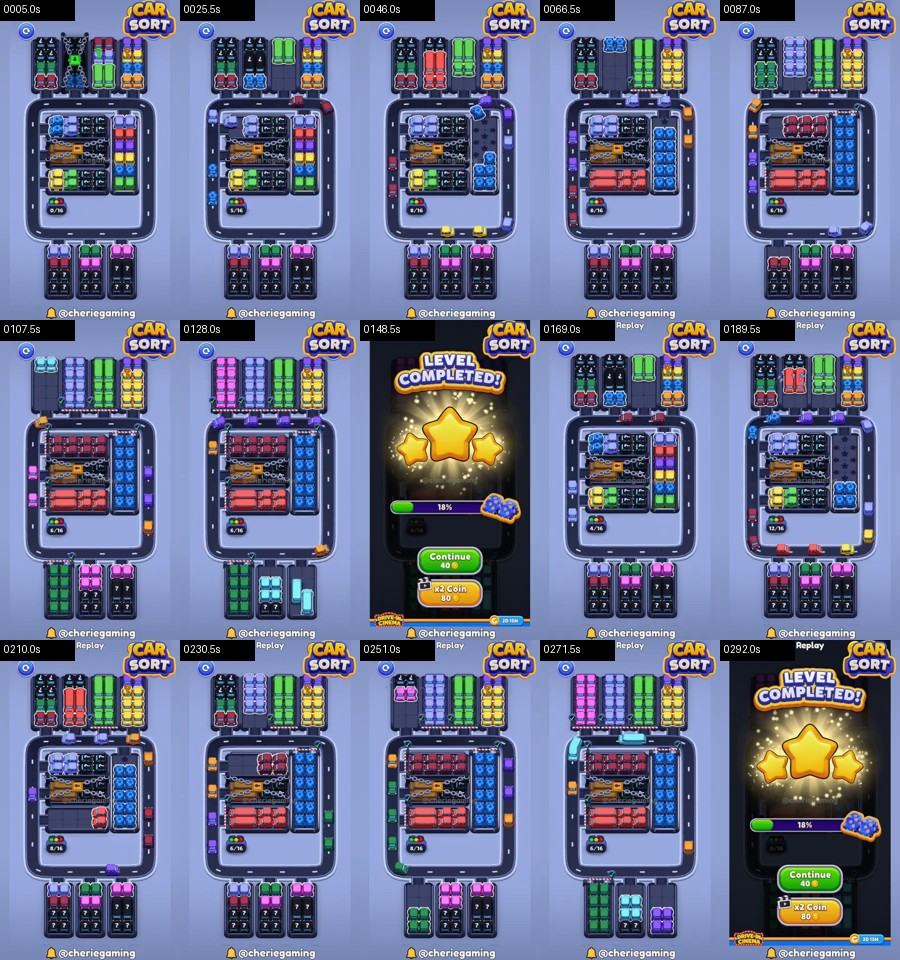
Map the outer columns and inner lock
The opening top bank includes green, blue, red, orange, cyan, purple, and yellow. Bottom garages show pink, green, purple, cyan, red, and white. Inside the loop, broad red and blue rows cross beneath dark chained cells. Because every region connects to the same rectangle, the outer road must be empty at each lock change.
Use this route reference:
top green-blue → red and orange → cyan-purple pair → first inner red row → blue center band → bottom pink-green → purple and cyan → second inner release → returning orange-red → white-yellow cleanup
Repeated red and blue rows are separate waves. Finish the row attached to the active panel before tapping a newly revealed copy elsewhere.
Clear the top bank in compact pairs
Start with green and blue from the side nearest the open corner. Clear green completely, wait for its marker to leave the top road, then take blue. Red and orange form the next pair. Red should go first if it occupies the inner position, because orange needs the same corner to turn.
Cyan and purple finish the first top wave. Yellow is visible but belongs later; starting it now occupies a long outer edge that the inner red group will soon need. The upper checkpoint should show several dark vertical towers and an empty horizontal road above the central block.
If a chain animation occurs before purple has stopped, do not follow it immediately. The new panel changes visibility faster than the roadway clears. Let the current batch arrive, then inspect the full inner face.
Open the first chained center
The first useful inner group is a broad red row. Clear it from end to end. Blue follows across the neighboring band and creates a dark horizontal channel. A smaller green or cyan face may appear between them; take it only when it is complete and directly connected to the road.
This center release is the critical point of Level 360. The empty red-blue bands become storage space for cars arriving from the bottom columns. If either band remains mixed, the lower wave will run out of room before its counters finish.
At the first midpoint, the inner chained cells should be reduced, the top road should be empty, and the bottom pink or green column should be fully exposed. Do not descend on the strength of a single visible car; wait for a solid face.
Use the bottom bank to expose the second wave
Pink is the cleanest first lower column. It leaves from an open corner and clears access for green. Purple and cyan come next, each as a complete vertical batch. Their empty bays provide enough room for the remaining inner cover to open.
Red appears again lower down, but it is not automatically next. If the second center panel exposes orange first, complete orange before returning to red. The road position decides: choose the full face already touching the dark inner channel.
White and yellow are late colors. Save both until the center has stopped feeding red, blue, or orange traffic. White often occupies a short lower face; clearing it first leaves the longest outer edge available for the final yellow column.
Four checkpoints around the rectangle
After green-blue-red-orange, inspect the top-left corner. After cyan-purple and the inner red-blue bands, inspect both upper corners. After pink-green-purple-cyan, inspect the lower corners. Before white-yellow, confirm all four edges are empty.
These checks prevent a subtle failure in which a car is still crossing the far side of the rectangle while the next color starts near the opposite corner. Since the road is long, the previous marker can be easy to overlook. Waiting for the full perimeter to clear is safer than watching only the active garage.
Recovery from a split wave
A jam across the top edge points to an incomplete green, blue, red, orange, cyan, or purple upper column. Finish its visible face. A marker stopped inside the central block belongs to the first red-blue release or the second orange-red wave. Cars trapped on the lower edge identify pink, green, purple, cyan, white, or yellow.
When two colors share the rectangle, stop creating new traffic. Complete the color with a visible full face nearest its destination. Its empty bay usually allows the second group to move. Never start the same color from another shelf merely because it matches visually; that shelf may serve the later lock cycle.
If a chain remains closed, look immediately beside it for an unfinished complete row. The chain is evidence of a missing local batch, not a reason to clear a distant tower. Restart only when both sides of the relevant row are hidden and the outer road is occupied by incompatible partial groups.
The final state should contain dark inner bands, open chained cells, and one solid bottom or top cleanup column. Send white before yellow when both remain. Allow the last marker to finish the full rectangle, then wait for the completion screen rather than tapping a newly empty garage.
Level 360 is solved by treating the rectangle as shared infrastructure. The top pairs open the first lock, the red-blue center creates buffer space, the bottom pairs release the second lock, and the late orange-red-white-yellow groups finish on an empty perimeter.
The last safe moment to change sides is after the second red face disappears. Confirm both lower corners are clear before white and yellow; those cleanup groups travel farther than their small visible faces suggest.