Car Sort: Color Puzzle Level 362 Solution Walkthrough
Route Reference
Key opening, middle, and finish positions for this route.
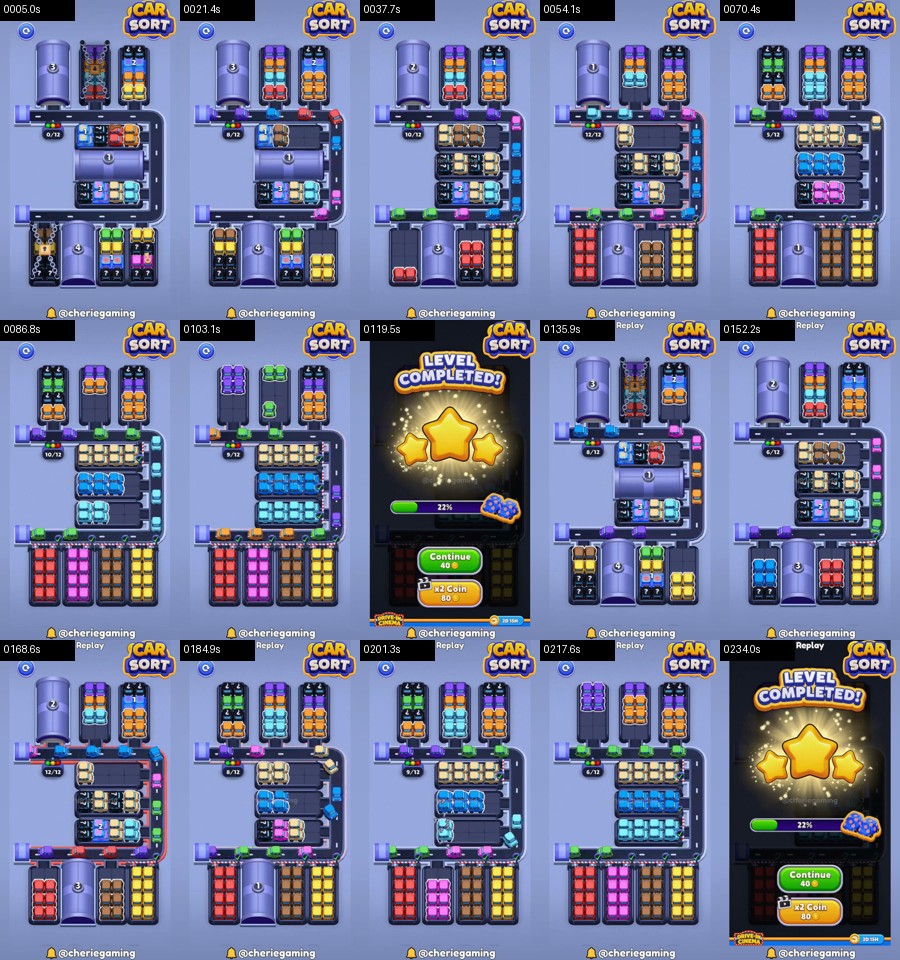
Understand the stepped road
Green, orange, blue, purple, and yellow occupy the upper towers. The bridge area contains pale cyan, brown, white, red, and several chained faces. Below it, red, blue, pink, green, cyan, orange, and yellow stand in narrow columns. Cars cannot pass freely at the step corners, making complete batches essential.
Use this order as the route reference:
upper green → orange-blue pair → purple upper tower → first cyan bridge → brown and white center → red bridge row → lower red-blue → pink-green → second cyan/orange release → yellow cleanup
Do not descend merely because a lower column is visible. Finish the numbered bridge face currently connected to the upper road first.
Open the three upper towers
Start with green from the isolated top face. Orange and blue follow, one complete tower at a time. Purple then clears the remaining obstruction beside the first step. Yellow stays parked because its route crosses the bridge that cyan needs next.
After purple, wait for the top corner to become empty. The correct opening state has dark slots in the three towers and one complete pale cyan face along the bridge. If an orange or blue marker remains on the horizontal road, finish that group before touching cyan.
Cross the numbered bridge
Clear cyan continuously. Brown appears behind its panel and should follow, then white. Red owns the deeper bridge row; it needs the dark spaces left by the first three colors, so do not start it early.
Each counter change exposes a small part of the lower bank. Ignore partial lower faces until red has left the bridge. The central checkpoint is a dark stepped connector, reduced diamond covers, and a full red or blue lower column touching the road.
Release the lower bank left to right
Red and blue form the first lower pair. Clear the inside column first, because it owns the tight lower turn. Pink follows, then green. These four groups turn the crowded lower entrance into a broad dark shelf.
Cyan and orange are the second release wave. Complete whichever face is fully exposed by the last cover, wait for its marker to clear the step, and then take the other. Yellow is safest last; by then both the bridge and lower turn are empty.
Check the road after red-blue and again after pink-green. A marker lingering on the central step means the earlier batch has not finished, even if the next numbered garage has changed.
Recovery at each elevation
A blockage above the bridge belongs to green, orange, blue, or purple. A car stopped on the numbered bridge identifies cyan, brown, white, or red. A jam below belongs to the active lower column. Complete the visible face at the same elevation instead of opening a matching color elsewhere.
If yellow was started early, stop tapping it and finish the center color already on the bridge. The empty center bay may let yellow retreat into a usable route. If two partial groups occupy both step corners and neither face remains visible, restarting is cleaner.
Before the final group, confirm the upper towers are dark, every diamond cover is open, and the bridge contains no marker. Send the remaining solid yellow, cyan, or orange column in one batch.
Level 362 succeeds through controlled descent. The upper towers open the first step, cyan-brown-white-red pay down the bridge, and the lower columns then clear in pairs. Treating each elevation as a separate checkpoint prevents the stepped road from becoming a meeting point for incompatible colors.
A practical replay check
If your board no longer resembles the route, compare the number of dark shelves at each height. Four empty upper faces means the opening is complete. Four dark center bands means the bridge is paid down. Only then should most of the remaining color sit below the road. This spatial check is more dependable than trying to remember the exact number of taps, especially when a counter changes while a car is still moving.
During cleanup, favor the lower column whose top car already faces the open turn. Its entire group will follow the same path. A column buried behind another color is not truly ready, even when its garage icon is visible. Finishing the nearer face preserves the empty bridge for the last long yellow run.
Distinguish the two bridge halves
The upper half of the bridge is governed by cyan, brown, and white; the lower half is governed by red and the first lower pair. If a car stops before the central step, the missing face is in the upper trio. If it reaches the step but cannot descend, red or the inside lower column is incomplete. This division narrows recovery to the correct shelf instead of inviting random taps.
When brown and white are exposed together, clear the smaller face nearest the upper step first. Its cars take the shorter corner and leave a dark pocket beside the numbered bridge. The farther face can then cross without meeting a tail marker. Do not start red until both small-color counters have settled and the pocket remains empty.
The lower red-blue pair deserves a full pause because it changes the direction of traffic. Upper groups arrive from above, while the later pink-green columns climb from below. Confirm that red and blue have both disappeared from the step before reversing the flow. Once that checkpoint is clean, the remaining lower sequence can proceed nearest-first.
If the final yellow column appears split by a covered cell, it is not ready. Complete the orange or cyan release beside the cover, wait for the panel, and look again. A valid cleanup face is solid from its mouth to its last visible car and connects to an entirely dark bridge.