Car Sort: Color Puzzle Level 384 Solution Walkthrough
Route Reference
Key opening, middle, and finish positions for this route.
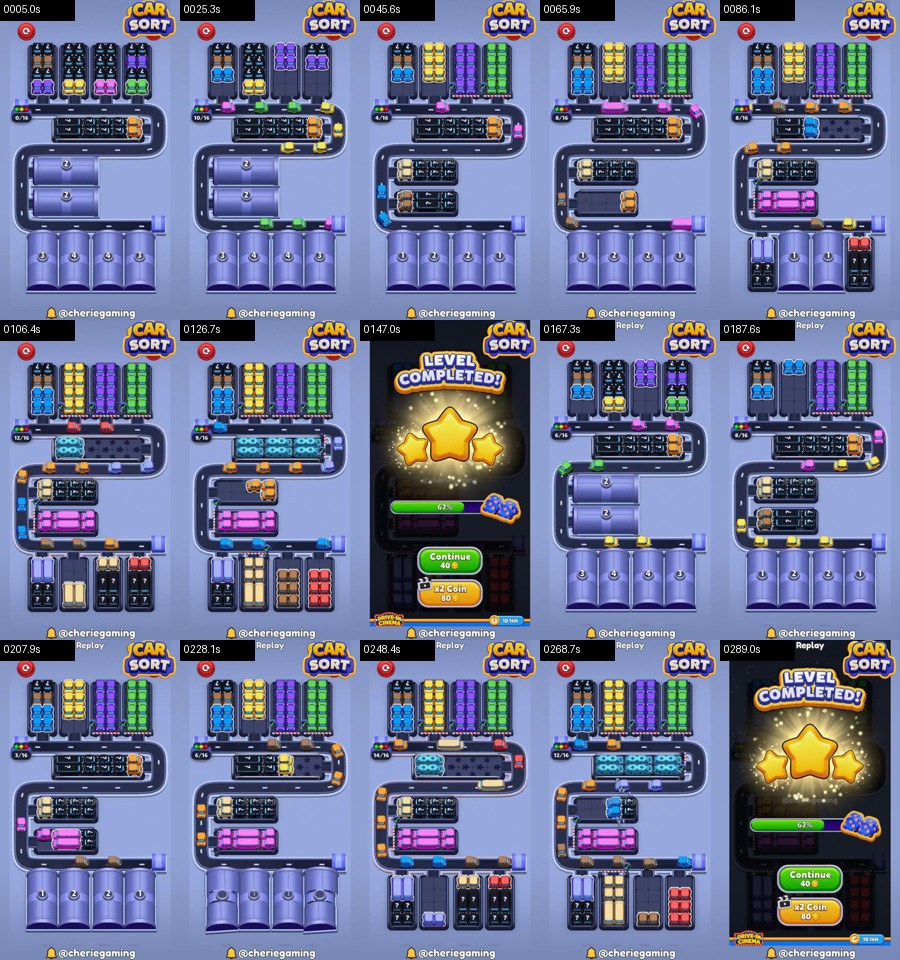
Read the rack, curve, and covers
Purple and dark cars occupy the upper-left rack, with cyan, yellow, green, blue, pink, and orange towers across the top. The road bends right, crosses a middle shelf, and turns back toward the row of covered columns. Yellow and orange are frequent checkpoint colors, while blue, purple, cream, white, and red appear in deeper layers.
Use this practical route:
upper purple/dark face → cyan and blue towers → yellow-green pair → first orange road batch → exposed lower blue/white → second purple face → yellow middle shelf → red and cream columns → returning cyan/green → orange-pink cleanup
The covers do not all open together. Always clear the complete face revealed by the most recent counter before tapping a different covered column.
Empty the upper rack
Start with the complete purple or dark face nearest the left entrance. Cyan follows once the first bend is empty. Clear blue before yellow if blue sits on the inside of the curve; blue creates the turning space the larger yellow and green towers need.
Move yellow as one batch, then green. Orange may become visible on the middle road during this sequence, but wait until the last green marker leaves the upper bend. Orange is the handoff between the open rack and the covered lower columns.
At the first checkpoint, the upper-left rack should be dark, several top towers should be empty, and one lower cover should expose a solid blue or white face.
Pay down the bottom columns
Clear the newly exposed blue column completely. White follows if it is adjacent to the same open lower bend. These short vertical groups reduce the covers without crowding the S-curve. A purple face then appears higher in the structure and can be cleared through the empty road.
Do not open two bottom columns together. Their cars join at a single corner and a mixed queue will prevent the next counter from completing. After every column, wait until its colored markers vanish and confirm that the counter has settled on a new face.
Control the yellow middle shelf
A broad yellow group occupies the middle shelf after the first lower release. Yellow needs the entire S-curve, so clear any purple remainder first. Then drain yellow continuously. Its empty shelf becomes the buffer for red and cream from the deeper bottom covers.
Take red before cream when red touches the inner turn. Cream follows through the newly empty middle section. If white reappears, complete the face already connected to the road rather than combining it with an earlier white column.
The middle checkpoint shows a dark S-shaped shelf, at least two open lower columns, and no colored marker between the rack and the covers. This is the safe moment to return to cyan and green.
Release the second top wave
Cyan and green reappear in deeper top layers. Cyan normally owns the left approach and should go first; green follows from the right tower. Blue or purple may sit between them. Clear the fully exposed face nearest the empty bend and keep the opposite tower closed until the road resets.
Orange and pink form the late handoff. Orange is often the broader road-facing group, so finish it before pink. Their removal opens the last covered columns and leaves only small yellow, white, red, or blue cleanup faces below.
Never interpret a newly exposed bright color as permission to switch immediately. The previous batch may still be travelling around the upper curve. Use the road itself as the signal: change groups only when both bends are dark.
Final columns and recovery
Work the last bottom columns from the open corner toward the outside. Finish a whole yellow, white, blue, or red face, pause for its cover, and then move the next solid group. If the final top tower still contains color, clear it before the outermost lower column because it controls the long approach.
A jam above the S-curve belongs to the upper purple, cyan, blue, yellow, green, or orange phase. A car stopped at the lower turn belongs to the active covered column. Complete the source on the same side; do not release a matching color from another depth.
If a cover refuses to change, inspect the middle shelf. A single car may remain behind the apparent dark gap. Finish its color, let it reach the garage, and only then tap the revealed column. Restart only when partial batches occupy both curve entrances and their sources have become inaccessible.
Before the last group, verify that the upper rack is dark, the full S-curve is empty, and four of the five lower columns are cleared. The remaining face should be solid and directly connected to the road. Its cars should travel without stopping and the completion state should follow the final counter change.
Level 384 is a repeated top-to-bottom exchange. The upper rack creates access, orange hands the route to the lower covers, blue and white open the middle, yellow releases red and cream, and the returning cyan-green wave exposes the final columns. Protect the two bends at every exchange and the hidden layers stay manageable.
One useful timing habit is to watch the empty portion of the S rather than the counter number. After a top batch, the upper curve should be dark from the rack to the middle shelf. After a bottom column, the lower curve should be dark from the cover to the shelf. Only move across that boundary when the whole relevant curve is clear.