Car Sort: Color Puzzle Level 398 Solution Walkthrough
Route Reference
Key opening, middle, and finish positions for this route.
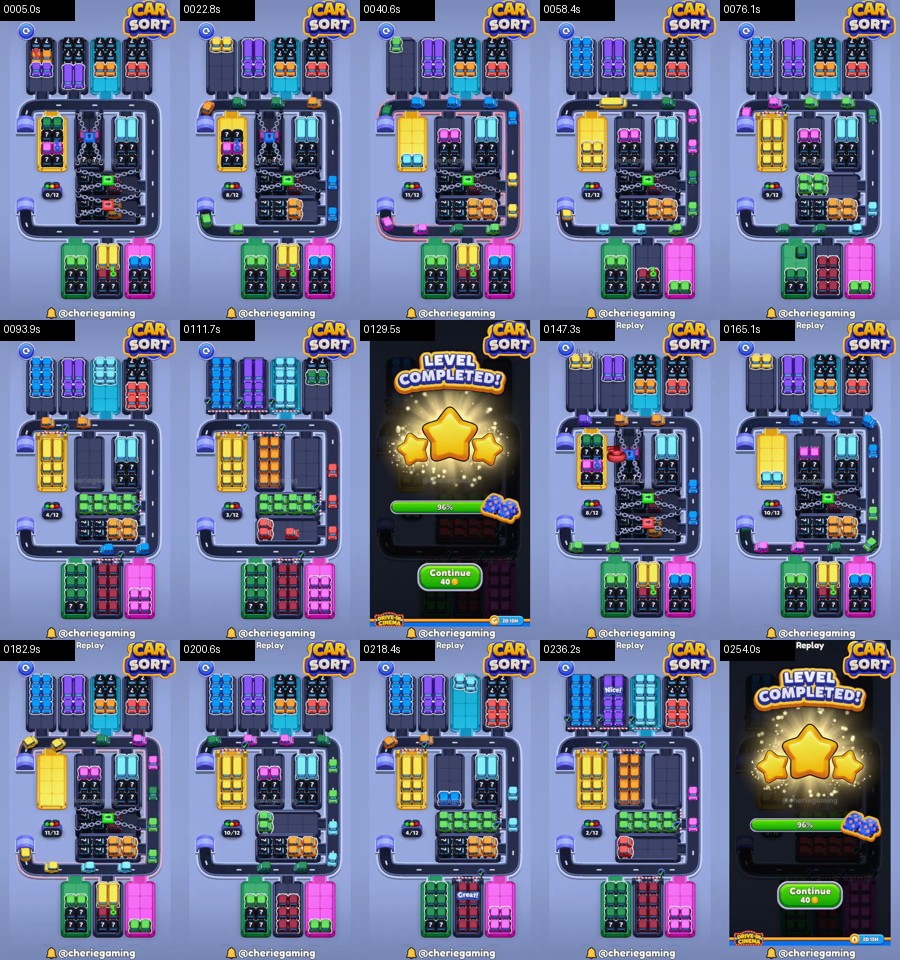
Read the inner lock before the towers
The opening center shows a small yellow face beside narrow cyan markers. Above it are blue, purple, red, and green towers; below are pink, orange, cyan, and white. The center occupies the only crossroad between the four sides, so a complete inner face always takes priority.
Route reference:
inner yellow → upper blue/purple → center cyan → lower pink/green → orange inner face → upper red-blue → white lower pair → second yellow lock → purple-cyan return → green-pink cleanup
Treat every inner counter change as a road reset. Clear the newly complete center face before another outer tower.
Empty the first lock
Start with yellow inside the rectangle. Once it leaves, clear blue from the upper side, then purple. Let both groups finish the top corners before returning to cyan in the center.
Cyan is a short but important handoff. Drain it continuously. Its empty bay opens the lower entrances and exposes pink or green as complete faces.
At the opening checkpoint, the central lane is dark, the top pair is reduced, and one lower column reaches an empty corner.
Release pink and green below
Clear pink first when it owns the lower-left entrance, then green from the opposite side. If their positions differ, use the connected face first but keep the colors separate. Both travel around the same bottom edge.
Orange appears in the center after this pair. Clear it immediately. Starting an upper red tower while orange remains will block the inner vertical lane.
Second upper and lower exchanges
Red and blue form the deeper upper wave. Red should go first if it touches the inside corner, followed by blue. Their removal releases white along the lower side. Drain white before any repeated purple or cyan face.
A second yellow lock becomes visible next. Clear the complete yellow face, wait for its markers to disappear, and inspect the rectangle. Both central approaches should be dark before purple and cyan return.
Finish purple as one upper face, then cyan from the lower or center side. These repeated colors use new counters and must not be mixed with any leftover opening group.
Final green-pink pass
Green and pink normally remain as the last large columns. Clear the one attached to the open bottom corner. Allow a full road reset, then drain the other. Orange, white, red, or blue may appear as a short final face behind the center lock.
The correct late state shows an empty vertical strip through the center and dark tower slots on three sides. One solid face should be the only remaining color.
Recovery around the rectangle
A jam above the lock belongs to blue, purple, red, or the returning blue layer. A center blockage points to yellow, cyan, orange, or the second yellow lock. A queue below belongs to pink, green, white, returning cyan, or the final green-pink pass.
Complete the source associated with the occupied edge. Do not release a matching color from a different tower. If an inner counter stalls, inspect the complete center face for a remaining car.
If two colors occupy adjacent corners, stop the later source and finish the earlier one. Restart only when both corresponding faces are covered and neither can advance. Most mistakes recover after the center is emptied.
Use checkpoint shapes rather than counter values. After yellow-blue-purple-cyan, the upper half of the central strip should be dark. After pink-green-orange, both bottom corners should be empty. After red-blue-white-yellow, the full rectangle should be clear for purple and cyan.
Time the lock-to-tower handoff
The first inner lock creates access to the lower columns; the second lock opens the returning tower layer. When either counter changes, let the face settle and inspect the nearest two corners. A newly available color should wait if an earlier marker still occupies its route.
Purple and cyan use opposite sides of the rectangle during the late handoff. Complete the side already carrying traffic, then move to the other. Green and pink can only begin after both colors have stopped using the center.
If a tower face and inner face share a color, take the inner face first. It sits closer to the lock and its empty cells become turning space for the tower column.
Before the last group, verify every inner lock face is dark and no marker remains on the rectangle. Drain the final solid tower without changing color. Level 398 succeeds through center-first timing: yellow opens the top, cyan opens the bottom, orange returns access upward, white exposes the second yellow lock, and the returning purple-cyan pair prepares green-pink cleanup.
The final board should have four quiet corners and one complete vertical face. If two faces remain, clear the one beside the already empty edge. Allow its garage animation to finish before releasing the outside cleanup column.
A late pause near the center usually means a white or yellow lock delivery was missed. Return to that visible inner group, complete it, and recheck all four corners before continuing.
Use the two lock spaces as a final route gauge. Both should be uniformly dark, with no marker entering from an upper tower or lower column. The final green or pink face should then have a clear side edge and two open corners. Send that group alone, wait for its last car to cross the center, and avoid tapping a deeper face during the garage animation.
Check the opposite edge after the first cleanup column parks. If it remains quiet, the remaining tower has inherited all four corners and can finish without another lock exchange.