Car Sort: Color Puzzle Level 407 Solution Walkthrough
Route Reference
Key opening, middle, and finish positions for this route.
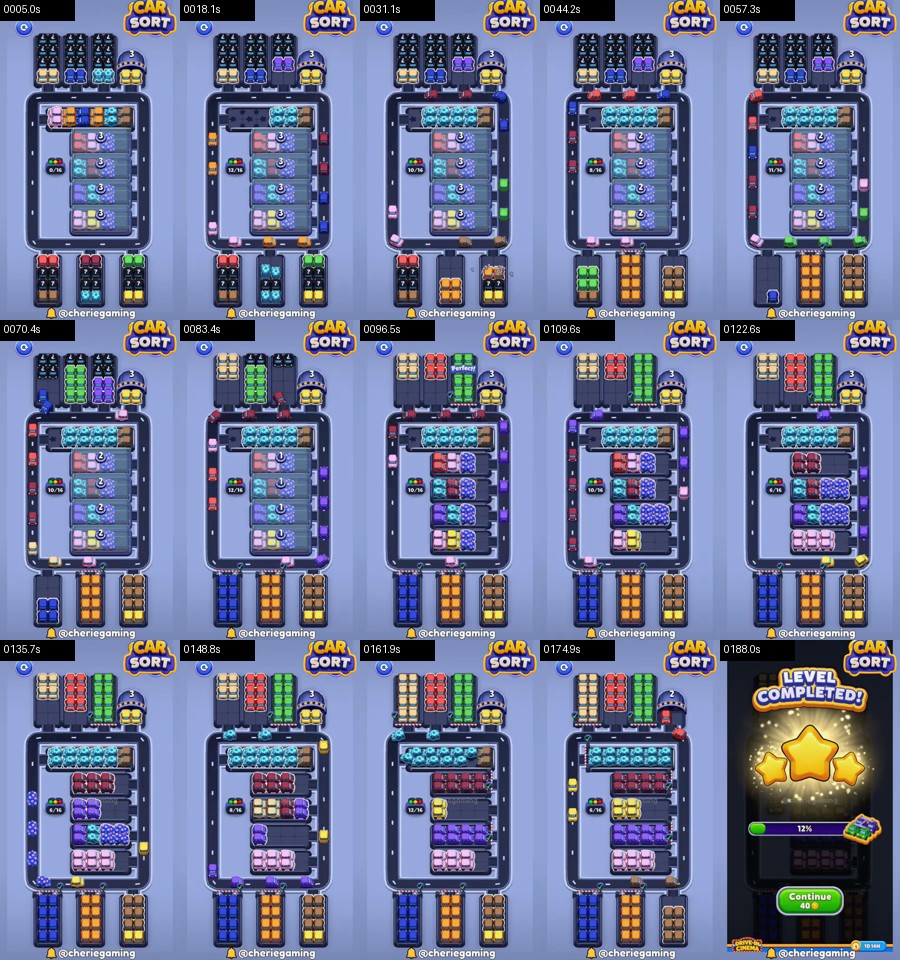
Read the five covered shelves
The central stack contains cyan, pink, red, purple, yellow, blue, and cream cars, but only its upper face is immediately useful. The loop has long left and right straights with tight top corners. That shape gives a complete batch room to circulate, yet it punishes two unfinished colors because neither can pass the other at a corner.
The safest route reference is:
cream and blue outside pairs → cyan upper shelf → pink center shelf → green top and lower groups → purple shelf → red shelf → yellow and cream release → returning blue/orange/brown rows → final pink and purple cleanup
Treat each numbered cover as a checkpoint. A cover dropping from 3 to 2 does not mean the newly visible color should move immediately. First wait until the batch that caused the change has left the loop. The correct state is always an empty bend plus one solid exposed garage face.
Build the opening from the outer garages
Begin with the complete cream group at the upper left, then use the blue group beside it. These colors enter close to the top edge and clear without crossing traffic from the lower entrance. Cyan becomes the first useful central color once that space is available. Send the full cyan row and allow every cyan road marker to disappear before touching pink.
Pink occupies a broad face near the top of the covered stack. Clearing it reduces the upper counter and creates the first dark horizontal bay. Keep that bay empty; it is the buffer that prevents later green traffic from becoming trapped behind a partial purple row.
The upper-right yellow group still looks easy during this phase, but it belongs to a later handoff. Releasing it while pink is circling fills the top-right corner and can leave a single yellow car waiting opposite the central exit. Finish cyan and pink first.
Use green to open the middle band
Green appears in a tall outside group and then returns inside the stack. Clear the exposed outside green as one batch. When the route settles, the matching green face in the middle can follow. This double green phase removes enough traffic to reveal a purple band and lowers another numbered cover.
Purple should leave from the highest complete face, not from a small lower garage. The central purple row needs the entire right straight to merge. If a purple marker remains at the lower-right corner, stop tapping and let it complete the loop. Mixing blue or orange into that corner is the most common cause of a false jam.
After purple, move the complete red row. Red occupies the middle of the stack and its departure exposes a lighter cream-and-yellow layer. This is the level's main release point: the board changes from a covered tower into several clean horizontal shelves. The loop should now show large dark areas on the left side and only one active color on the road.
Separate the lower garages from the tower
The three garages beneath the road supply blue, orange, and brown. Do not open all three together. Start with blue when its central partner is visible, follow with orange, and reserve brown until the upper-right bend is clear. Brown is a long group and needs an uninterrupted pass along the bottom and right edges.
Yellow and cream can be cleared between those lower waves. Choose whichever has a complete exposed face next to the central exit. A full yellow block is safer than a partial cream block even if cream appears closer, because the yellow group clears a numbered shelf and leaves useful space behind it.
At the middle checkpoint, the five central covers should be open or nearly open, the top garages should show mostly completed green, cream, and red stacks, and the lower orange-brown pair should remain organized rather than mixed. If the board does not resemble that state, finish the color already touching the road before advancing.
Finish the returning rows shelf by shelf
Later in the replay, red returns as a solid central row, followed by yellow and purple. Clear red first because it sits closest to the road. Yellow follows through the empty top bend. Purple then gets a clean run from the lower half of the tower.
Pink is the final broad shelf. It spans the bottom of the central stack and should not be disturbed while purple still occupies the road. Once purple disappears, pink can travel as one uninterrupted batch. Any remaining blue, orange, or brown outside group can then be completed from the nearest entrance.
The last two frames of the playable board should show an open central tower with dark shelves, the square road nearly empty, and no covered counter still carrying a number. Let the final markers reach their garage before expecting the completion panel.
Recovery advice for a blocked loop
If traffic stops on the top edge, look for an unfinished cream, blue, cyan, or yellow face in the upper garages. Complete that exact color; do not start a new lower batch. A blockage on the right straight usually belongs to pink, green, purple, or red from the central tower. Return to the exposed matching row and finish it.
When a numbered cover refuses to decrease, one source group from the previous shelf is incomplete. Scan the garage face directly above the cover rather than tapping every visible color. The counter is tied to progress in its own band, and outside cars cannot substitute for the missing central batch.
If two colors are already mixed around opposite corners, wait for the moving cars to settle. Sometimes the first group still has an open destination and clears on its own. Restart only when both colors remain stationary and their matching garages are hidden. On a retry, keep the first dark central bay empty until the green phase is over.
A lone lower car is usually evidence that orange or brown was opened too early. Complete its outside column only after the road has cleared; never add yellow as a rescue color. The lower entrance has less recovery space than the upper one.
Level 407 is solved by respecting the central counters rather than racing through every exposed garage. Cream, blue, cyan, and pink establish the opening; green, purple, and red unlock the five-shelf tower; then yellow, orange, brown, and the returning rows use the space created by those releases. Keep each batch complete, check the corners at every cover change, and the final pink shelf has a completely open route to the finish.