Car Sort: Color Puzzle Level 408 Solution Walkthrough
Route Reference
Key opening, middle, and finish positions for this route.
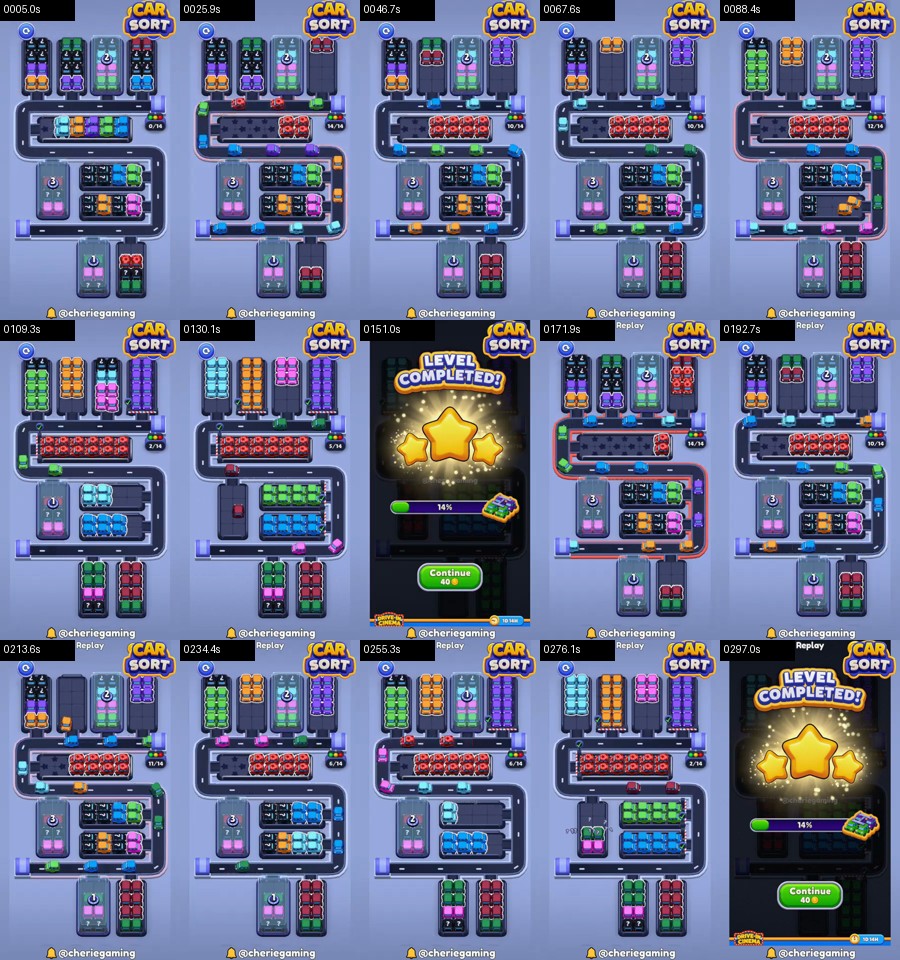
Understand the two-road handoff
The upper rectangle is the opening workspace. Its long red row controls access to the central connector, so the first objective is to empty complete top garages without crowding that row. The lower rectangle should remain quiet until the upper counter has fallen and the numbered purple lift begins to open.
Use this practical route:
dark blue and orange top groups → green top stack → red upper row → cyan and purple upper releases → pink lower shelf → blue lower shelf → numbered lift colors → green and burgundy bottom garages → replay cleanup in cyan, orange, pink, and purple
The route is organized by circuit, not merely by color. Clear the upper road to a full stop before moving a lower group through the connector. A car still turning at the right edge means the previous phase is not finished.
Empty the top feeders around the red bar
Start with the exposed dark-blue group at the upper left, then clear orange beside it. These small batches use the top-left merge and remove the first pressure from the long red bar. Green follows from the next complete top stack. Avoid the pale cyan and purple groups for the moment; both need the connector to remain free.
Now release the long red row. Red occupies almost the full upper shelf, but after blue, orange, and green leave, it has a clean clockwise route. Send the entire row continuously. Stopping halfway leaves red parked along the lower edge of the upper rectangle and prevents the first lift change.
Once red is gone, clear cyan if its top face is complete, followed by purple. The visible upper checkpoint is an empty red shelf, a mostly dark top garage bank, and an unobstructed vertical connector on the right. Do not judge readiness by the counter alone; moving red cars may remain after its face turns dark.
Open the lower rectangle in controlled pairs
Pink is the first useful lower color. It occupies the right side of the lower shelf and can exit once the connector is empty. Clear the complete pink face, wait, then send blue from the shelf below it. Blue uses the same lower-right bend, so these groups must not overlap.
The purple numbered lift on the lower left changes as complete lower batches arrive. When it drops, newly exposed cyan or green may look immediately playable. Keep the lift space empty until the blue markers have vanished. That dark lift bay is the only buffer between the two lower rows.
Green then becomes safe from the lower garage. Burgundy follows from the neighboring bottom stack. Burgundy is longer and should be completed in one pass. If a burgundy car pauses below the connector, the matching bottom garage is not finished; do not try to dislodge it with orange.
Read the replay checkpoints
The replay makes four useful checkpoints visible. First, the upper red row is reduced while the lower circuit remains nearly unchanged. Second, the top garages show complete cyan, orange, pink, and purple stacks while the red shelf is dark. Third, the lower shelves settle into solid green and blue faces. Finally, only a few tall top columns remain, with the connector completely open.
At each checkpoint, change circuit only after the road counter stops changing. The most reliable order is upper group, empty connector, lower group, empty connector. This rhythm is slower than tapping every available face, but it prevents mixed traffic from occupying both rectangles.
When cyan returns late, take it from the highest complete garage. Orange follows if it owns the top entry. Pink and purple form the final tall stacks; clear whichever is directly adjacent to an empty merge, then finish the other.
Resolve the final green-blue block
Near the end, the lower rectangle displays broad green and blue rows. Green should leave first when it fills the upper lower-shelf, because that creates a dark lane above blue. Blue then travels without competing for the right bend. A small cyan face may sit beside them; reserve it until the broad rows are finished.
The upper red bar can briefly reappear as the board exposes a deeper layer. If it does, clear red before returning to lower blue. The connector belongs to the upper circuit whenever a full red row touches it.
Completion follows a simple visual state: the long upper shelf is dark, both lower shelves are dark, the purple lift is fully open, and only one outside garage contains cars. Send that last solid color and wait for its markers to leave both road rectangles.
Recovery when the circuits become mixed
If cars are stranded along the top rectangle, finish the matching top garage—usually red, cyan, orange, or purple. Do not tap a bottom source, because lower traffic must cross the same connector. If the blockage sits inside the lower rectangle, complete pink, blue, green, or burgundy from the currently exposed lower face.
A lift that remains numbered indicates an unfinished lower shelf, not a missing top color. Inspect the two compact rows to the right of the lift and complete the one already touching the road. When both are covered, finish the outside lower garage whose color matches the stationary car.
If you opened green and burgundy together, allow green to finish first. Burgundy can wait inside its garage; adding more burgundy while green still occupies the connector converts a recoverable pause into a full lock. Restart only if each circuit holds a different stationary color and neither matching face remains accessible.
For a clean retry, preserve three rules: empty the long red bar before opening the lower circuit, keep the lift bay dark as buffer space, and never switch circuits while a road marker is visible at the connector. Level 408 then becomes a sequence of complete loops rather than a tangle of simultaneous traffic. The upper blue-orange-green opening releases red, the lower pink-blue pair opens the lift, and the remaining green, burgundy, cyan, and purple groups can finish on an increasingly empty board.