Car Sort: Color Puzzle Level 208 Solution Walkthrough
Route Reference
Key opening, middle, and finish positions for this route.
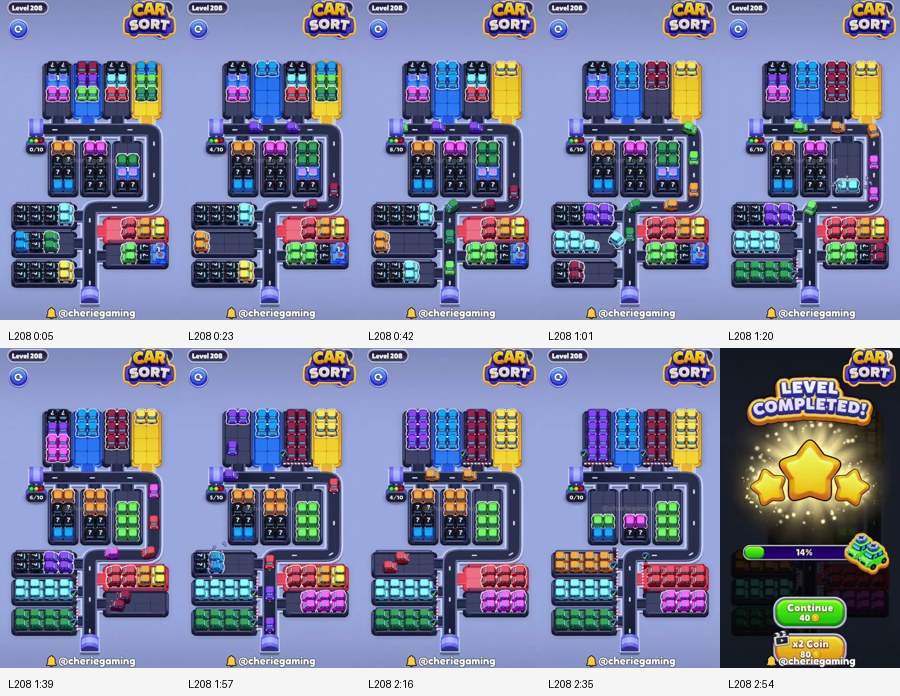
Map The Split Yard Before Releasing Cars
Car Sort: Color Puzzle Level 208 spreads its traffic across three separate-looking areas that are connected by one narrow road. Four tall garage columns line the top: purple on the far left, then cyan/blue, red, and yellow on the far right. The central yard contains three covered counters and two short exposed pairs near the upper entrance. Below that, three horizontal shelves sit on the left while a smaller red-and-green parking pocket occupies the lower right. Although each area appears to have its own space, every group eventually depends on the right-side vertical connector and the short bends around the center counters.
The opening should therefore be read from the road inward. The small orange and pink pairs near the top of the center yard can reach the road without forcing a deep shelf to open. The lower-right red and yellow cars are also visible, but they should not all enter immediately because their exit joins the same right-hand connector. On the lower left, the black covers hide cyan, green, yellow, and later purple rows. Those shelves are the deepest part of the puzzle and are safest when treated as late checkpoints.
A concise route reference for Level 208 is:
upper orange pair -> upper pink pair -> exposed top-garage batches -> right-pocket red/yellow -> center counters one at a time -> lower-left cyan -> purple shelf -> green shelf -> orange and pink cleanup
The color shown by a newly opened counter can change which matching garage is immediately available, so use the order as an area plan. Complete the active color before advancing another counter. The board is in a safe state whenever the right vertical connector contains only one color and at least one horizontal stretch of road is empty.
The ten route checkpoints show why this separation matters. Early frames concentrate activity in the top garages and center yard. The first lower-left rows remain covered while the blue and yellow top columns fill. During the middle, the left shelves reveal pale cyan and purple groups, but the board does not release every lower row together. Near the finish, the central counters are almost exhausted and the lower shelves have reorganized into clean orange, cyan, green, red, and pink bands. That staged reveal is the heart of the solution.
Top Garages And The Central Counter Block
Begin with the two exposed pairs above the covered counters. Orange is a useful first batch because it sits beside the left bend of the central road and can leave without crossing lower traffic. Let both orange cars clear the bend before touching pink. Pink then uses the space orange created and removes the second small obstruction at the top of the counter block.
Watch the top four garage columns while these cars move. The cyan/blue and yellow columns become established early in the route, and they act as clear progress markers. Do not interpret an available garage as permission to send every visible matching car from the bottom, though. The correct early cars are those already bordering the center road. Pulling cyan from the lowest left shelf while orange or pink is still turning through the center creates a queue at the only vertical connector.
After the exposed pairs are gone, work with the three covered counters in a controlled rhythm:
- Open only the counter whose exit faces an empty road segment. The left counter should not feed cars while another color is sitting across its mouth.
- Finish the revealed color before reducing the next counter. A counter changing from four remaining cars to a new hidden layer is a checkpoint, not a reason to keep tapping blindly.
- Use the matching top garage as confirmation. When that garage column visibly fills and the right connector clears, the next center group is safe.
- Leave one center lane unused. The gap beside the counters is the buffer that allows cars from the lower-right pocket to join later.
The early blue/cyan and yellow progress is especially helpful. If yellow cars are still waiting on the right bend, do not release red behind them. If cyan is travelling up the left side of the central yard, do not open a purple lower shelf merely because purple has appeared. Finish the moving batch, wait for the road animation to settle, and then continue.
If the center jams, look for a car stranded on the short horizontal road just above the counters. That car tells you which color is unfinished. Complete its matching exposed group rather than opening a different counter. Once it reaches the top garage, the central yard normally regains enough space to proceed without a restart.
Lower Shelves: Cyan First, Then Purple And Green
The three lower-left shelves begin as dark stacks with only small color clues at their ends. They are not independent garages; they are queues that all share the same exit. The route reference shows pale cyan becoming a major visible row before the darker purple and green layers are fully released. This makes cyan the most reliable transition from the center phase into the lower phase.
Wait until the central counters are reduced and the upper road is no longer carrying mixed colors. Then clear the pale-cyan row as one group. Cyan needs the connector for several cars in succession, so interrupting it with red from the lower-right pocket can leave both groups facing the same turn. When the cyan shelf is empty, the purple row has room to advance. Keep purple together until its top-left garage path is clear.
Green is a later lower-shelf batch. Green appears in both the left shelves and the lower-right pocket, which makes it tempting to tap from both places at once. Only combine those groups when the road already contains green and both entrances can feed the same uninterrupted route. If red or yellow is still active on the right, clear that right-pocket color first and leave the lower-left green row parked.
Use the shelf faces as checkpoints rather than relying on the counters alone:
- after cyan, one long pale row should disappear from the lower left;
- after purple, the upper of the remaining dark shelves should be visibly reduced;
- before green, the right vertical connector should be empty or already carrying green;
- before cleanup, the left yard should show clean single-color bands rather than several partly opened covers.
The route becomes unstable when all three shelves are opened together. In that state, exposed cars may look playable, but none has a full path. Recover by finishing the color already nearest the connector. Do not tap the deepest row. Once the nearest batch reaches its garage, work from the uppermost exposed shelf downward until the lower-left yard again has one active color.
Right Pocket And The Late Orange-Pink Cleanup
The lower-right pocket holds compact red, yellow, green, and later pink groups. Its short local road gives a false sense of safety: cars can leave their parking rows, but they still have to turn into the shared vertical connector. This pocket should be used between center batches or after the lower-left road is empty, never while a large shelf color is crossing.
Red and yellow are the first practical pocket colors because their top garages are clearly positioned and easy to monitor. Send whichever one has the clean connector, complete it, then take the other. Green should wait until the matching lower-left traffic can be handled as one phase or until that left group is already gone. Pink is a late cleanup color; the final checkpoints show a long pink row becoming prominent only after the central and lower-left structure has opened.
Near the finish, orange forms a clean horizontal band along the lower-left side, cyan and green occupy the rows beneath or beside it, and red/pink remain on the right. At this stage the puzzle no longer depends on uncovering the correct counter. It depends on keeping the two entrances from feeding different colors simultaneously. Clear one horizontal band, wait for the connector to empty, and then cross to the other yard.
If your final board has orange waiting on the left and pink waiting on the right, choose the color whose first car is already closest to the connector. Finish that entire group. The empty road it leaves becomes the buffer for the opposite side. Alternating orange and pink taps is the common late mistake because both batches then occupy the central turn and neither garage receives a complete set quickly.
Level 208 works as a sequence of yard releases: the exposed upper pairs open the center, the counters fill the first top garages, cyan starts the lower-left phase, purple and green empty the deeper shelves, and the right pocket supplies the final red, yellow, orange, and pink cleanup. Keep one yard inactive while another is moving and the narrow shared connector remains useful from the opening layout through the completion screen.