Car Sort: Color Puzzle Level 210 Solution Walkthrough
Route Reference
Key opening, middle, and finish positions for this route.
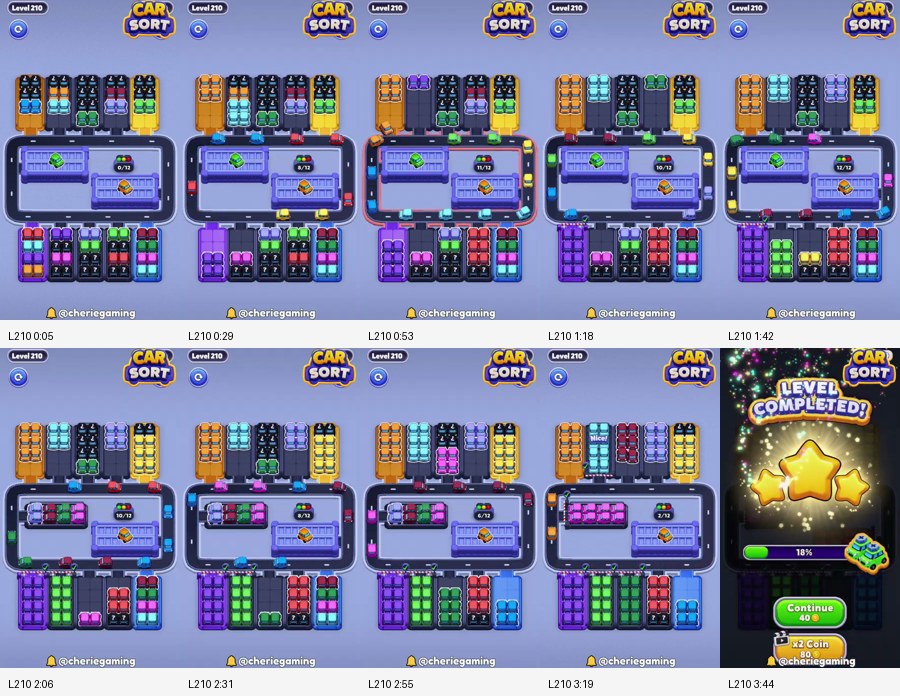
Protect The Rectangle Around The Two Covered Bays
Car Sort: Color Puzzle Level 210 places two long covered bays inside a rectangular road. Five tall parking columns stand above the rectangle and five more stand below it. The upper columns begin with visible orange, cyan, dark, pale-purple, green, and yellow groups, while the lower bank contains purple, pink, green, red, cyan, and several numbered covers. Every column enters the same outside loop, and the two center bays can release cars directly into that loop as their counters fall.
The board has more road than some nearby levels, but almost all of it is perimeter space. A car that stops on the top edge blocks several upper columns; a car held on the bottom edge blocks several lower columns. The long sides are useful only when the active batch keeps moving. For that reason, Level 210 should be solved in phases: establish the upper garage routes, reduce the center counters, then work through the lower columns after the rectangle has become an open circulation lane.
A practical route reference is:
upper orange -> upper cyan -> yellow outside column -> green and pale-purple upper blockers -> first center-bay layers -> pink center row -> lower purple -> lower green -> lower red/cyan -> final covered-column cleanup
The exact order of two adjacent late colors can change with the exposed counter layer, but the area order should remain stable. Do not pull from the lower numbered columns while the upper road still carries traffic, and do not reduce both center bays at the same time unless they reveal the same active color.
The route checkpoints show a clean progression. At the opening, the center bays are mostly covered and both upper and lower banks contain mixed visible ends. In the early middle, orange and cyan have established clear upper columns while cars circulate around the rectangle. Later, the center reveals pale purple, cyan, and pink rows and the lower bank becomes a set of full single-color columns. Immediately before completion, pink is the obvious center batch and the loop has enough empty space for the final lower cars.
Build The Upper Routes From The Outside In
Begin with the far-left orange upper column. Orange has a direct entrance to the left side of the rectangle and does not require another column to move first. Send the exposed orange cars as one batch and wait until the left vertical road is clear. The adjacent cyan column is next because it uses the same newly opened side without competing with cars from the right half.
Yellow on the far right is another useful early column, but switch sides only after cyan has completed its trip. The top edge is the shared danger zone. If cyan remains there while yellow enters from the right, the two batches meet near the upper corners and the central bays lose their exit space.
Work the remaining upper blockers after both outside approaches are established:
- Complete orange on the far left. This opens the left vertical side of the loop.
- Move cyan through the same side. Cyan turns the temporary opening into a reliable route toward its garage.
- Clear yellow from the far-right column. Use the opposite side only after the top edge is empty.
- Release the exposed green and pale-purple groups. These inner columns are safer once both outside columns have shortened.
- Leave dark covered cars parked until their color is exposed by a clear matching route. Do not tap a black-backed column simply because its front car becomes available.
The upper bank is ready to hand control to the center when the orange, cyan, and yellow columns look like clean completed stacks or empty mouths, and no car is waiting across the top edge. If an upper car stalls, finish that same color from its visible column. Opening the center bay to make room is the wrong recovery because the new center car enters the same blocked perimeter.
Reduce One Center Counter At A Time
The two pale-purple structures inside the rectangle are long counters with separate exits. The left bay faces the upper-left portion of the loop, while the right bay feeds the lower-right side. Opening both simultaneously can place two colors on opposite corners and remove the loop's only buffer.
Choose the bay whose exit faces the emptier road. Reveal one layer, identify its color, and complete that layer before touching the other counter. Early layers include pale purple and cyan; later checkpoints show pink becoming a long, important center row. Each cleared layer creates open floor inside the rectangle, but that floor does not create a second road. Cars still have to leave through one of the perimeter entrances.
Use the counter labels as stopping points. When a counter drops, wait for the released cars to reach their garage. If the next layer changes color, leave it in place until the loop is clear. A common mistake is to keep tapping because the numerical counter is nearly finished. That exposes a new color behind the old one and turns a nearly solved bay into a mixed queue.
Pink is the final major center checkpoint. The late route reference shows a row of pink cars travelling along the upper part of the rectangle while most other center space is empty. Keep pink together. Do not interrupt it with green or red from the lower bank, even if those columns are fully exposed. Once pink reaches its garage, the center no longer feeds new traffic and the lower cleanup becomes much safer.
If the two bays are active with different colors, recover by finishing the one whose leading car is farther along the loop. Stop tapping the other bay. After the first color clears a corner, complete its remaining layer, then return to the parked color. This restores an empty half of the rectangle instead of adding a third batch.
Read The Lower Columns As A Left-To-Right Cleanup Bank
The lower columns are visible throughout the level, but they are mostly reserve traffic. Purple and green form the clearest early lower batches; red and cyan become practical after the center has reduced. Several columns also contain counters, so the front color may hide a different group underneath.
Start the lower phase with purple on the far left when the left side of the rectangle is empty. Purple can travel directly and opens the mouth of the adjacent green column. Green follows as a complete column, not as scattered taps from multiple stacks. If green is also exposed in an upper or center group, combine it only when the road already carries green and no other color is waiting at a corner.
Red and cyan occupy the right half of the lower bank. Use them after the center pink row has cleared. Red should finish before cyan if red cars already sit nearer the bottom-right corner; otherwise, take the color with the open garage path. The important rule is that the lower horizontal road must carry one color at a time.
Numbered lower columns require the same discipline as the center bays:
- reveal one layer;
- finish its color;
- wait for the corner to empty;
- inspect the next layer before tapping again;
- move to another column only when the newly revealed color lacks a safe route.
Near the finish, the board shows strong vertical bands instead of the mixed opening stacks. That is your signal to clear full columns. Purple and green leave from the left, red and cyan use the right, and yellow or pale-purple leftovers can use whichever side is already open. Avoid alternating columns simply to make every counter decrease; the counters do not matter if their cars cannot cross the rectangle.
Recovery Checkpoints For A Crowded Loop
If the top edge is blocked, stop all upper-column taps and finish the color already closest to a top garage. If the bottom edge is blocked, stop opening numbered lower columns and complete the active lower batch. If both edges are occupied, choose the color whose car has already rounded a vertical side; that group is closer to completion and will release more road sooner.
Do not use a center bay as emergency storage. Every center release consumes perimeter space immediately. Also avoid starting lower cyan while center pink is still moving: both groups often want the same right-hand turn, and their mixed queue is difficult to unwind.
Three visible checkpoints confirm that the solution remains aligned:
- After the upper phase, the outside orange, cyan, and yellow columns are reduced and the top road is clear.
- After the center phase, both pale-purple bays are nearly empty and pink is the last substantial row inside the rectangle.
- Before final cleanup, the lower bank consists of clean vertical color columns and the loop contains at most one active batch.
Level 210 becomes manageable when the rectangular road is treated as a conveyor rather than parking space. The upper columns establish its two sides, the center bays spend that space one layer at a time, and the lower columns wait until the center stops producing traffic. Following those phases keeps every color moving directly toward a garage and prevents the large-looking loop from filling with cars that have nowhere to turn.