Car Sort: Color Puzzle Level 225 Solution Walkthrough
Route Reference
Key opening, middle, and finish positions for this route.
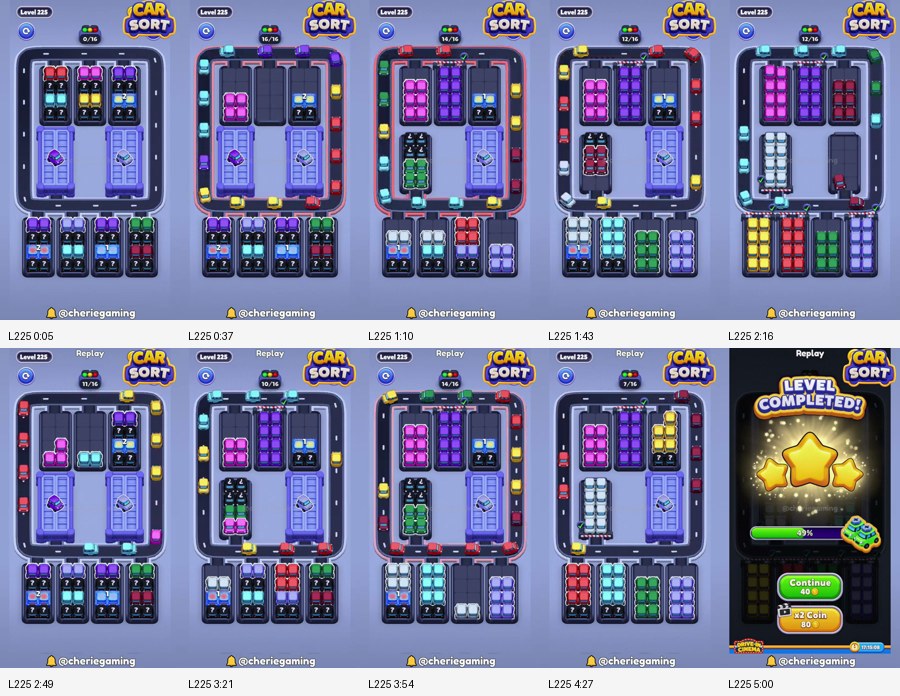
Three Tall Bays Inside A Square Road
Car Sort: Color Puzzle Level 225 places three vertical parking bays inside a square road. Five numbered banks line the bottom outside edge. The center bays begin with pink, purple, green, red, white, and covered blue/yellow layers, while the lower banks hide white, cyan, red, green, pale purple, yellow, and additional counters.
Unlike a shelf puzzle, Level 225 has open vertical space inside the loop from the beginning. That space is not another road. Every car still exits through the square perimeter, and the bottom banks join at the same lower corners. The correct route empties the center bays first, then hands the loop to the five lower reserves.
Recommended route:
center pink -> center purple -> center green/red -> center white -> covered blue/yellow bay -> bottom white -> bottom cyan -> bottom red -> bottom green -> bottom pale purple -> yellow cleanup
The replay shows the same area progression. Use it as a board-state guide rather than expecting identical counter numbers after every tap.
Open With Pink And Purple
Pink forms the clearest left-center column. Send it as one batch and let the left side of the square empty. Purple follows from the middle bay. These two colors create the first large gaps inside the yard.
Do not start green or red while purple still occupies the top edge. The center entrances are close together, and two colors can lock both upper corners.
Opening checks:
- pink clears the left bay;
- purple reaches its garage;
- at least one center column becomes visibly empty;
- lower counters remain untouched.
If pink stalls, finish pink from the same bay. Opening a bottom bank only sends another car to the lower road.
Clear The Remaining Center Layers
Green and red occupy deeper central layers. Move whichever full color has the open corner, finish it, and then take the other. White becomes a strong left-side column later and should travel alone.
The covered right bay reveals blue, yellow, or another layer as its counter falls. Handle it one layer at a time. If a layer changes color, stop and wait for the road to clear before continuing.
Center rhythm:
- complete one visible full column;
- wait for the perimeter to empty;
- reduce one covered layer;
- finish the revealed color;
- leave the next different layer parked;
- open bottom banks only after the center stops feeding cars.
The replay's middle checkpoint shows pink and purple still prominent while green/red and a numbered bay occupy the right. Late replay frames show a clean white column and an almost empty right bay. That empty-center state is the handoff to bottom cleanup.
Why White Must Finish Before The Lower Banks
White appears both in the center and the leftmost bottom reserve. Combining them too early is risky because they enter the loop from opposite sides. Clear the center white column first. It opens the left road and removes a long batch from inside the square.
Only after the center white cars reach their garage should the lower white layer open. Then it can travel along an empty bottom edge. If another lower color is already active, leave white parked until that batch clears.
This separation prevents a common jam where matching white cars face one another across a blocked corner instead of forming one moving stream.
Release The Five Bottom Banks In Complete Layers
The bottom banks resolve into white, cyan, red, green, pale-purple, and yellow columns. Start on the side with the empty corner. White or cyan is usually first, followed by red, green, and pale purple. Yellow is a late cleanup color.
For every counter:
- expose one layer;
- identify the matching garage route;
- finish that color completely;
- wait until the lower edge is empty;
- inspect the next layer before tapping again.
Do not open all five banks to see their colors. The square can circulate one batch, but it cannot store five fronts.
Replay Recovery And Final Checks
If the top edge contains two center colors, stop all bottom taps and finish the leading center batch. If the lower edge blocks, stop the center covers and complete the active reserve color.
For a mixed loop:
- identify the car farthest around the square;
- complete that color from its current bay or bank;
- finish the second road color;
- wait for both corners to clear;
- resume from the unfinished center bay or next lower layer.
The replay provides three reliable states: pink/purple open the center, white and the numbered right bay mark the late center, and full white/cyan/red/green/pale-purple columns appear below for cleanup.
Avoid starting the long yellow column while pale purple remains on the road. Yellow needs repeated access to the lower-right corner. Finish pale purple, let the loop reset, and then send yellow uninterrupted.
Use Empty Center Bays As Progress Markers
An empty bay is valuable because it proves a whole internal feed has stopped. After pink, the left bay should show a clear vertical strip. After purple, the middle should no longer place cars onto the top road. After white and the right counter, the square should circulate without any surprise center release.
Do not refill an empty bay by opening an unrelated cover. The visual gap is a checkpoint, not spare parking. If a supposedly finished bay still shows one car, complete that color before activating a lower bank. That remaining car can enter during cleanup and block a full reserve column.
Before the bottom phase, confirm all three center mouths are either empty or display a parked color whose counter you intentionally postponed. This makes the source of every new road car predictable.
Level 225 is controlled by the center-to-bottom handoff. Pink and purple create space, green/red/white empty the deeper bays, the right counter reveals one layer at a time, and the five bottom banks wait for a quiet square. Preserve that handoff and the final cyan, green, purple, and yellow batches move directly to their garages.