Car Sort: Color Puzzle Level 226 Solution Walkthrough
Route Reference
Key opening, middle, and finish positions for this route.
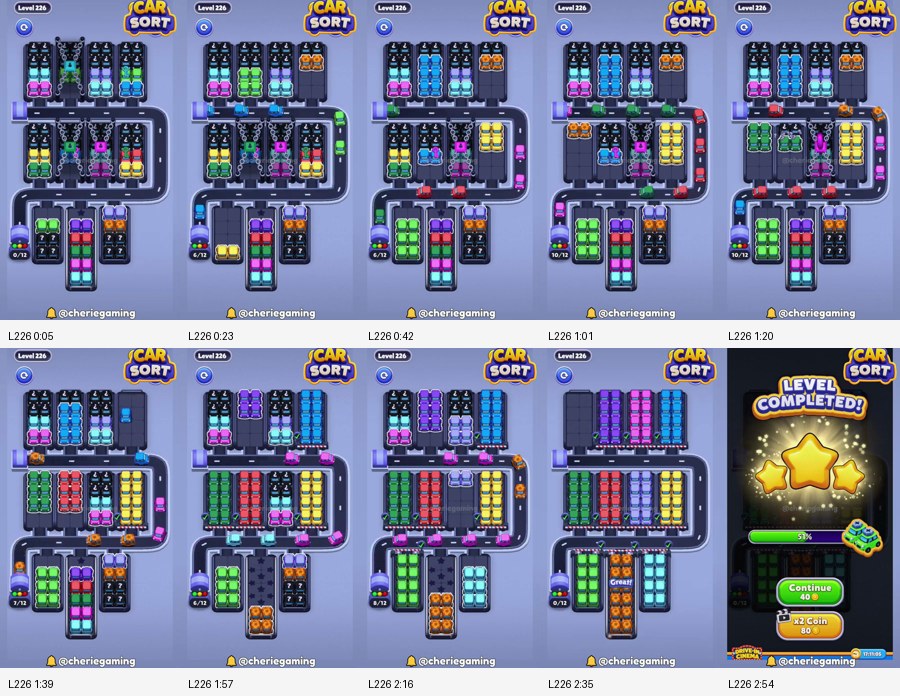
Two Tiered Yards Along An S-Curve
Car Sort: Color Puzzle Level 226 divides its parking into a top bank, a chained middle bank, and three lower reserves. A road runs beneath the top columns, bends around the middle yard, then drops toward the bottom. The opening exposes pink, cyan, green, yellow, blue, and orange, but chains and counters hide many deeper layers.
The top bank eventually forms pink, purple, pale-purple, and blue columns. The middle resolves into green, red, dark, and yellow bands. The bottom holds green, pink/cyan, orange, and numbered layers. Because every tier uses the same S-curve, the route must clear one tier before the next begins.
Recommended route:
top pink -> top cyan/blue -> top green -> top orange -> middle yellow -> middle green -> middle red -> chained purple/pink -> lower green -> lower cyan/pink -> lower orange -> final top purple/blue
When a chain or counter reveals a different color, stop and complete the active road batch before continuing.
Shorten The Top Bank From The Open Side
Begin with pink on the left top column. It can enter the upper road without crossing another batch. Cyan or blue follows from the next column, then green. Orange on the right should wait until the upper bend is clear.
Do not release a middle chained car while a top batch remains on the S-curve. It enters directly below and can trap the top car at the first turn.
Opening checks:
- pink clears the left entrance;
- cyan/blue reaches its garage;
- green leaves a visible gap in the top bank;
- orange clears the right bend alone.
If a top car stalls, finish that tower. Bottom or middle traffic cannot create another exit.
Break Middle Chains Only After A Road Reset
The middle bank begins with yellow and green fronts beside several chains. Clear the exposed yellow batch first if its garage path is open. Green follows through the same section after yellow clears.
Red becomes a long middle column later and should move as one uninterrupted batch. Purple or pink appears when a chain opens. Treat that revealed layer as a new phase, not part of the previous color.
Safe chain rhythm:
- clear an exposed middle color;
- wait for the S-curve to empty;
- break one chain;
- identify the new front color;
- finish it if the route is clear;
- leave the next different layer parked.
The route checkpoints show the middle changing from mixed chained stacks into clean green, red, dark, and yellow columns. That state is the signal to clear full bands rather than opening more chains.
Use The Rainbow Counter As A Stop Signal
A small rainbow-style counter near the lower-left side tracks another reserve group. Its changing value is tempting to reduce early, but its cars join the lowest bend of the same S-road.
Open it only between middle batches. Complete the visible color and stop when the counter changes. If green is already moving from the middle, a matching green layer can join only when the intervening road is clear. Otherwise, leave it parked.
The counter should be nearly exhausted before the final lower orange column begins. If it still holds an active car, finish that color first so orange has a clean bend.
Hand The Road To The Lower Reserves
The bottom group contains green on the left, a tall mixed cyan/pink column in the center, and a numbered orange/right reserve. These are late traffic.
Clear green first after the middle bank stops feeding the road. Cyan or pink follows from the center column as a complete visible band. Orange is a late cleanup batch and should use the entire lower bend alone.
For a numbered lower layer, reveal one color, complete it, wait for the road to empty, then inspect the next layer. Do not reduce multiple counters together.
Late checkpoints show top purple/blue, middle green/red/yellow, and lower green/orange/cyan as clean columns. Choose the full column nearest an open entrance and finish it.
Recovery And Final S-Curve Checkpoints
If the upper bend blocks, stop middle and lower taps and finish the active top color. If the lower bend blocks, finish the active middle or reserve batch before returning upward.
For mixed traffic:
- stop all chains and counters;
- identify the leading car on the S-curve;
- complete its color;
- finish the second road color;
- resume at the highest unfinished tier.
Avoid starting top blue cleanup while lower orange is still travelling. Both need the right-hand bend and can lock one another despite belonging to distant tiers.
Three board checks confirm progress: the top bank shortens before most chains, the middle resolves into full green/red/yellow bands, and lower counters activate only after the central turn is clear.
Check The Two S-Curve Handoffs
There are two places where a completed batch can still appear active: the turn below the top bank and the turn beside the lower reserves. Watch both before changing tiers. A car that has left its column but not rounded the next bend still owns the road.
After a top batch, wait until the first turn is empty before breaking a middle chain. After a middle batch, wait until the lower turn is empty before opening the rainbow counter or bottom column. These checks prevent distant groups from meeting in the center.
If the upper turn clears but the lower one remains occupied, continue the current middle/lower color rather than returning to the top. If the lower clears first, finish the top color before releasing anything new. The tier with the occupied handoff always has priority, regardless of which counter looks closest to completion.
Level 226 is a tier-handoff puzzle. Top pink/cyan/green opens the S-road, middle chains reveal controlled batches, the rainbow counter is handled between them, and bottom green/cyan/orange waits for cleanup. Keep each tier's traffic separate and the final purple, blue, red, and orange columns reach their garages without a shared-road jam.