Car Sort: Color Puzzle Level 265 Solution Walkthrough
Route Reference
Key opening, middle, and finish positions for this route.
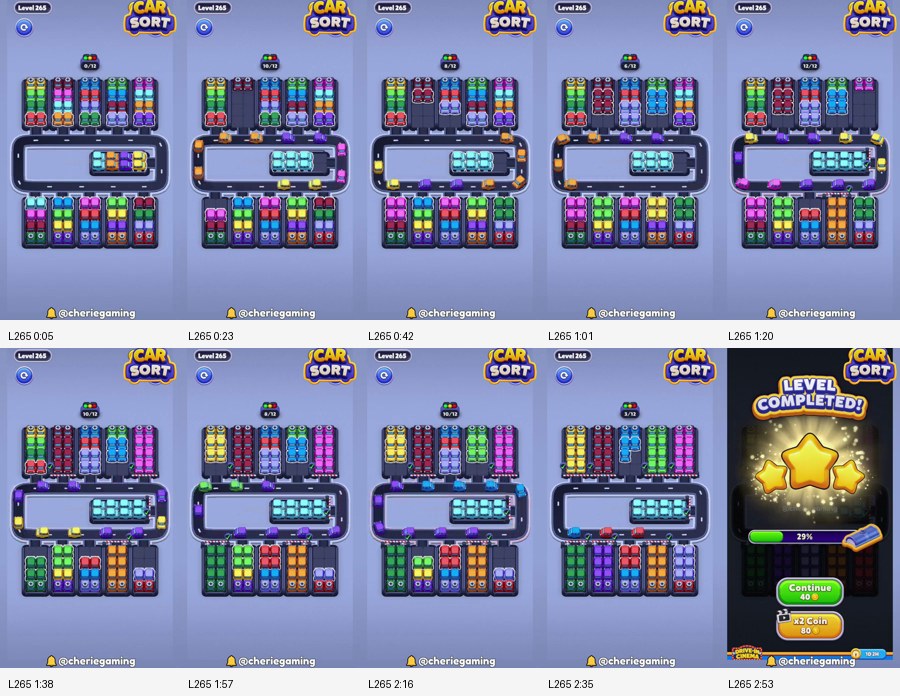
Reading the ring of columns
The upper columns contain yellow, green, red, blue, orange, pink, cyan, purple, and pale violet. The lower columns add dark green, lime, red, orange, blue, and dark red. Most stacks contain several colors arranged vertically, so clearing the visible front group reveals a different task behind it.
The central rectangle has a clockwise and counterclockwise path, but the top and bottom corners are narrow. Cars entering from adjacent columns should not approach the same corner in opposite directions.
The counter holds twelve cars. A full tower sequence fits comfortably, while three partial colors can consume the entire capacity.
Recommended route sequence
A stable priority is:
cyan center → yellow → red → pale violet → bright blue → green → pink → orange → dark green → remaining purple and dark colors
The initial cyan group inside the road is the natural opener. Yellow and red then consolidate the most exposed upper and lower stacks. Pale violet clears a central upper column.
Bright blue and green create space across both sides. Pink and orange emerge from deeper tower sections. Dark green, purple, and dark red become concentrated near the end.
Clearing the central cyan group
Begin with the cyan cars already inside the rectangular road. Complete that group before opening multiple outside columns. Its removal gives the loop a clean internal destination and exposes the colored roadside spaces.
If a matching cyan car sits at the front of an upper column, use it only as the final piece. Do not pull other colors from that column until cyan is complete.
After cyan leaves, inspect all twelve tower fronts. Choose the color with a full visible group, not simply the nearest car.
The first checkpoint is an empty center and a loop with no stationary car at either short end.
Yellow and red towers
Yellow is usually the best first exterior target. Its pieces appear across the upper-left and lower-middle fronts, and completing it reveals strong red or green sections.
Send yellow traffic in one direction around the loop. Do not let a red car enter from the opposite side while yellow is still turning at the corner.
Red follows because several columns expose red after yellow moves. Consolidate the upper and lower red sources into one group. If dark red also appears, keep it separate; the visual similarity can hide a counter mistake.
The yellow and red clears should produce several partially empty columns and make pale violet visible in the upper middle.
Pale violet, blue, and green
Pale violet is concentrated in one or two upper towers. Complete it through the top side of the rectangle. Its removal frees a useful entrance for bright blue.
Bright blue appears in both upper and lower stacks. Clear the source closest to a corner first, then merge the opposite-side pieces while the loop remains one-way.
Green follows through the space blue creates. There may be both bright green and dark green groups; finish the bright group before collecting dark green.
At the middle checkpoint, the upper towers should show clean yellow, red, pale violet, blue, green, or pink columns. The lower towers should be less mixed and the road should remain open.
Pink and orange second layer
Pink is exposed after blue or green clears an upper stack. Complete the full pink group before taking orange from a neighboring tower.
Orange has sources on both top and bottom. Wait until the loop is empty, then send all orange cars in the same direction. Parking orange at both corners makes the rectangular road appear full even with counter slots available.
The road counter may rise and fall during this phase. Every complete pink or orange group should reduce active traffic before a deeper tower color is exposed.
If a tower reveals cyan again, determine whether it belongs to a second complete group. Do not keep a lone cyan car on the road because the opening cyan set has already finished.
Late dark green, purple, and dark red
Dark green appears mainly in the lower-left progression and becomes uniform once bright green leaves. Complete it next.
Purple and dark red remain behind several upper and lower colors. With fewer active entrances, they can merge safely across the loop. Handle one shade at a time.
The successful late state shows six clean upper towers and six clean lower towers. Their exact left-to-right order is not essential. What matters is that every tower contains a single color and the central road is empty.
Corner management
Before moving a top-column car, check the upper-left and upper-right turns. Before moving a lower-column car, check the bottom turns.
Choose one direction for each complete group. Reversing direction midway can cause the group's own cars to meet.
Never use the inner cyan garage as mixed overflow. It should receive one complete color only, leaving the road free for the next tower.
When a new front color appears, finish the current color before taking it unless it is an exact matching piece.
Recovery advice
If a corner is blocked, complete the color already waiting there. Do not activate the adjacent tower.
If the counter holds three or four pairs, find the pair whose remaining cars are visible at tower fronts. Prioritize that group and ignore deeper colors.
If dark red was mixed with bright red, finish the group with the larger visible tower first. Keep the other shade parked.
If top and bottom traffic meet, stop one side entirely and complete the group with fewer cars remaining.
If the board diverges from the replay, compare phases: center cyan first; yellow and red open the stacks; pale violet, blue, and green clear the middle; pink and orange expose the final dark colors.
Level 265 is solved by treating twelve entrances as a single queue. Complete the center cyan group, choose one visible tower color, and keep its traffic moving in one direction until finished. The columns then reveal their deeper layers without overwhelming the compact rectangular road.