Car Sort: Color Puzzle Level 285 Solution Walkthrough
Route Reference
Key opening, middle, and finish positions for this route.
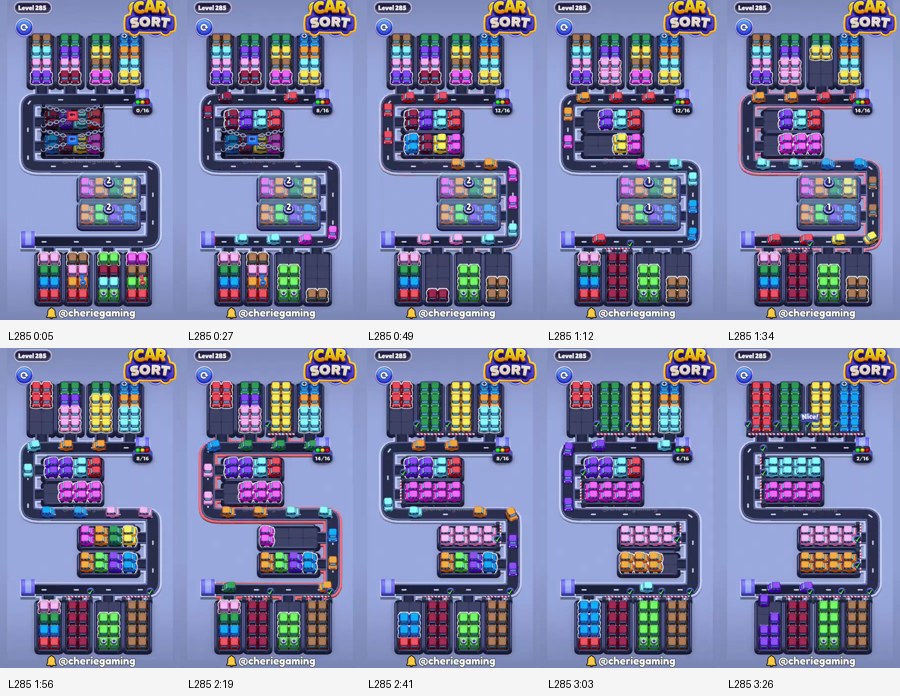
Reading the two-room layout
The top room begins with black lanes, pink shelves, red inserts, cyan pieces, and yellow stacked above. The lower room is smaller, with numbered blocks and mixed short rows that later turn into pink, orange, and pale columns. The bottom reserve banks already show green, red, and brown potential homes.
Only one road connects the rooms. That road bends twice and does not tolerate mixed waiting traffic well. So the right question is not "what color is visible?" but "which room should own the road right now?"
The replay answers that very clearly: the upper chamber owns the early game, and the lower room owns the late transition.
Recommended route order
Use:
pink → cyan → red → yellow → green → purple → pale pink → orange → brown cleanup
Pink is the first major unlock inside the upper room. Cyan follows because it clears space without asking the lower room for help yet. Red is the first true bridge color between upper and lower spaces. Yellow continues the top-room simplification. Green, purple, and pale pink become cleaner once the lower room has taken over.
Pink first in the upper chamber
Start by reducing the visible pink shelves in the upper room. The replay does not immediately chase the bottom reserves, even though they are visible, because the upper chamber is still producing too many blockers.
Pink is the correct opener because it shortens the upper room horizontally. Once that shelf is lighter, cyan can pass through the chamber without stopping in a mixed queue. If pink is left half-done while cyan begins, the narrow connector between rooms becomes the storage line for both colors.
The first checkpoint is an upper chamber with less pink pressure and a road between rooms that still belongs to one color at a time.
Cyan opens the connector
Cyan is the first clean vertical handoff out of the chamber. Use the exposed cyan shelf in the upper area, then bring the matching support through the connector while the lower room is still mostly passive.
The important detail from the deeper frames is that cyan does not just clear a color. It creates the first moment where the connector road looks like a route instead of a waiting strip. That is your sign that red can soon become active.
Red bridges the two rooms
Red is the first color that really uses both spaces together. Some red sits in the upper room, and the lower reserves later receive the completed batch naturally. Because of that, red should begin only after pink and cyan have already simplified the chamber.
This is also the point where many failed routes drift off. If you open yellow and green too early, red loses the bridge lane it needs. In the clean replay, red gets an obvious uninterrupted window and the lower room only starts helping after the upper room has already paid for that space.
Yellow closes the upper phase
Yellow is still part of the upper-chamber job. It strips away another layer of clutter and leaves the chamber flatter than it looked at the start. Around the middle of the video, the board shifts from "crowded top room" to "transfer board with one smaller active room." Yellow is the last major step in that shift.
If your upper chamber still looks layered when you are thinking about green or purple, you are early. Yellow should have already simplified it.
Lower-room transition
Now the smaller lower room starts to matter. Green comes through as the first calmer batch, and purple follows once the connector is no longer full of leftover upper-room traffic. The replay around the two-minute mark shows purple and pink-style lower groups becoming neat horizontal rows rather than emergency parking.
Pale pink and orange are especially important here. They look minor in the opening, but in the late game they are the proof that the lower room has taken over cleanly. Use them one at a time and let each row empty completely.
Brown and final cleanup
Brown and the final dark shades belong at the end because their pieces are spread between the bottom-right reserve and lower leftovers. They do not improve the route if opened early. Once green, purple, orange, and pale pink have already settled, brown becomes a simple fill-in job.
The finished replay shape is very orderly: bright uniform columns on the top and bottom, a calm lower room, and no reason to revisit the original dense upper chamber.
Recovery advice
If the road between rooms is blocked, finish the color already using that road before touching a fresh shelf in either room.
If the upper chamber is still crowded, return to pink, cyan, red, or yellow. Do not ask the lower room to solve a problem the upper room created.
If the lower room is mixed, finish the longest row already there instead of opening another bottom reserve. The small room should convert one batch at a time.
The safest way back to the replay is to restore this order: pink pressure reduced, cyan connector stable, red bridge completed, yellow flattening the chamber. Once those pieces are true again, the lower-room finish becomes much easier.
Level 285 is a two-room handoff puzzle. The upper chamber must pay for the space first through pink, cyan, red, and yellow. Only after that should the lower room step in and convert the remaining colors into neat horizontal and vertical finishes.