Car Sort: Color Puzzle Level 286 Solution Walkthrough
Route Reference
Key opening, middle, and finish positions for this route.
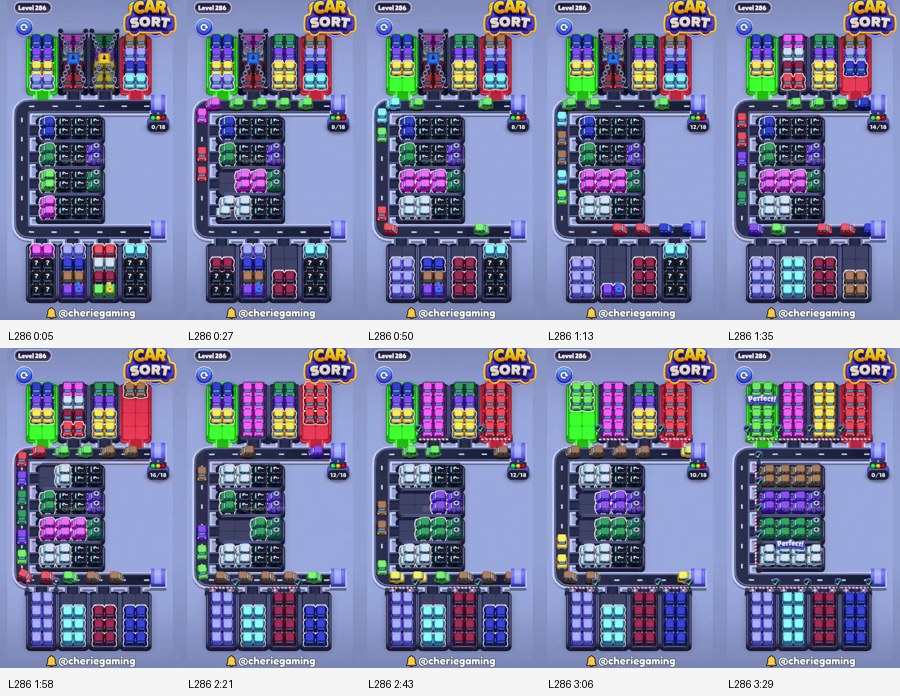
Reading the layered center
The center is not one color block. It is several short shelves stacked vertically: green and blue near the upper-left of the stack, pink and white across the middle, purple and dark green lower down, and black lanes tying everything together. The top towers are brighter and easier to see, but they depend on those middle lanes opening first.
The lower reserve banks already show pale violet, cyan, red, and blue homes. They are useful later, but they are not early parking. If they start filling with mixed leftovers before the center is simplified, the bottom edge becomes as crowded as the top.
The counter begins at eighteen, so there is plenty of nominal capacity. The real limit is road access, not slots.
Recommended route order
Use:
green → pink → white → blue → red → yellow → cyan → purple → dark cleanup
Green starts in the center and touches the upper-left supply later. Pink and white are the widest middle blockers. Blue secures the right half of the center. Red becomes the first tower color worth spending. Yellow and cyan follow from the upper supply once the center no longer steals every move. Purple and the dark colors belong to the late open-board phase.
Green opening from the middle
Begin with the visible green in the center stack. The point is not only to complete green. It is to make the upper-left side of the rectangle usable for later traffic. When green is gone, the first vertical lane through the middle starts to look trustworthy.
Do not wake a tall upper yellow or cyan group during this opening. The replay keeps the top towers waiting because the center still owns the board here. If your top edge is already filling while the center still has layered pink and white, you are ahead of the route in the wrong way.
The first checkpoint is a clearer left side of the center and an upper road that is still mostly unused.
Pink and white flatten the stack
Pink is the next major middle release. It forms a broad shelf that sits exactly where later red and yellow traffic would like to pass. Finish pink first, then turn immediately to white while the same center corridor is still available.
White matters because it removes another thick middle band and gives the lower-left approach a purpose beyond emergency parking. In the deeper frames, the replay spends a long stretch turning the middle from a pile of colored inserts into shorter darker lanes. Pink and white are the reason that transformation happens.
If pink is half-finished while blue starts, the central rectangle becomes a mixed stop line. Avoid that.
Blue secures the right side
Blue is the first middle color that truly claims the right half of the board. It uses the lower-right side and the center lanes that pink and white just opened.
This is the best moment to check whether the route is healthy. If blue can travel without waiting behind old white or pink cars, the board is on track. If not, finish the leftover middle color first. Blue should inherit an open lane, not create one from scratch.
At the middle checkpoint, green, pink, and white should be largely settled, and blue should be converting the center from a layered obstacle into a set of simple dark lanes.
Red and yellow begin the tower phase
Only now do the upper towers deserve real attention. Red is the first big tower color in the replay, followed by yellow. The order matters because red uses the newly opened top and right edges more directly, while yellow benefits from the extra space red leaves behind.
Treat each one as a full column phase. Do not interrupt red with a half-exposed purple from the center or a bottom reserve distraction. The clean replay shows red finishing with very little interference, and that calm is exactly what makes the later upper colors easy.
Cyan and purple transition
Cyan follows yellow from the bright upper supply. It is long, visible, and surprisingly clean once the center is no longer active. Purple arrives from the middle leftovers and upper support after cyan has already reduced the upper traffic.
This is where the level changes personality. In the opening, the center feels like the whole puzzle. By this point, the center is mostly solved and the upper towers are simply cashing out. If your center still contains mixed white, pink, and green when you begin cyan, pause and tidy it first.
Dark cleanup and final shape
The remaining dark shades sit behind the bright top columns and in the lower center leftovers. They are poor opening targets because they are too scattered, but they are almost effortless after the bright towers have cleared.
The replay finish shows a very orderly board: tall bright columns above, clean pale and dark columns below, and the original center stack reduced to a quiet endgame rather than a live obstacle. That is the finish shape you want even if your exact garage assignments differ.
Recovery advice
If the top edge is blocked, do not blame the top edge first. Look at the center. Usually the real problem is that green, pink, white, or blue was left unfinished.
If the bottom edge is blocked, finish the active center-facing color before waking a lower reserve or another top tower.
If red and yellow are both visible and you are unsure which one should move, choose the one that already owns the road. This board punishes switching owners more than it punishes slightly different garage order.
The best restart checkpoint is: green opened the middle, pink and white flattened it, blue stabilized the right side. Once those three conditions are true, the red-yellow-cyan tower phase becomes much easier to rebuild.
Level 286 is a center-first puzzle disguised as a tower puzzle. Flatten the middle through green, pink, white, and blue, then spend the new space on red, yellow, cyan, and purple from above. That order turns a crowded layered stack into a straightforward open-board cleanup.