Car Sort: Color Puzzle Level 365 Solution Walkthrough
Route Reference
Key opening, middle, and finish positions for this route.
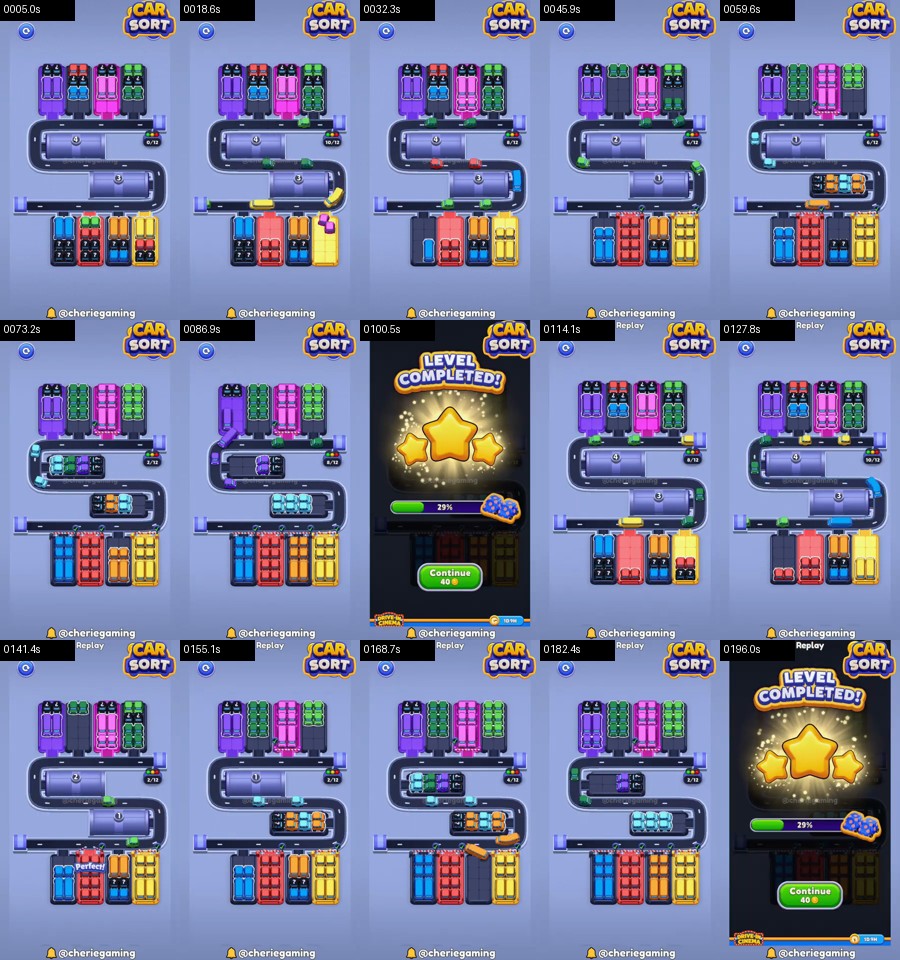
Recognize the shared T junction
The top row exposes purple, pink, green, cyan, blue, and red. Inside the horizontal chamber are pale cyan, orange, yellow, and numbered panels. The lower bank includes red, blue, orange, cyan, green, and yellow. Every car must cross the central T, so mixed batches are especially dangerous.
Use this route reference:
top purple → pink → green → cyan-blue pair → center orange → pale cyan chamber → yellow release → lower red-blue → orange-cyan → green-yellow cleanup
The center stem should be empty before each change from top to chamber or chamber to bottom.
Clear the crossbar from outside inward
Begin with purple from the exposed left end, then pink. Green follows and opens more of the upper shelf. Cyan and blue make the final upper pair; clear each completely. If red is visible at the far end, leave it until the inner orange face has opened.
The opening checkpoint is a dark top crossbar and an empty T junction. A marker still moving horizontally means the upper phase is not complete. Do not tap the bright lower yellow columns yet.
Empty the short central chamber
Orange is the first safe inner group. Its removal exposes pale cyan. Clear cyan fully, then yellow if the corresponding face is complete. These groups turn the central chamber into buffer space for cars climbing from below.
A numbered panel can change while cyan is still crossing the junction. Wait until the stem is empty. The chamber phase ends when orange, cyan, and yellow leave a dark horizontal pocket and a complete lower red or blue column faces the stem.
Bring the lower columns through the stem
Red and blue are the first lower pair. Clear the inside column first, then the neighboring one. Orange and cyan follow; their garages use the newly opened chamber as turning space.
Green and yellow make the cleanup pair. Green should leave before yellow when it sits closer to the T. Preserve the full vertical stem for yellow's final long run. If a small red remainder appears, finish it before beginning yellow.
Check the junction after every pair. The T has no alternate route, so one stranded marker can stop all three approaches.
Recovery around the crossbar
A horizontal jam belongs to purple, pink, green, cyan, blue, red, or the active chamber color. Complete that visible face. A blockage on the stem identifies the current lower column. Do not activate a second lower color until the first has reached its garage.
If top and bottom traffic meet at the T, finish the group with the exposed complete face closest to the junction. Its empty shelf will create room for the other group to pass. Starting a third color makes recovery unlikely.
When a panel remains closed, inspect the orange-cyan-yellow chamber rather than distant towers. One local batch is incomplete. Restart only if the missing cars are covered and both the crossbar and stem are occupied.
Before the last yellow or green group, confirm the entire crossbar is dark, the chamber is open, and the stem contains no marker. Send the final column without switching colors.
Level 365 is solved by respecting the T as a single-lane intersection. The upper crossbar clears outside-in, the orange-cyan-yellow chamber creates a turning pocket, and the lower pairs then climb through a quiet stem.
Choosing between two ready columns
Late in the replay, several lower faces can look complete at once. Use position as the tie-breaker. The column whose top car is already aligned with the stem should go first. Its cars make the shortest turn and leave a dark bay beside the next column. A farther column may be the same color as an open garage, but it must cross the mouth of the nearer one and is more likely to stall.
At the final checkpoint, count zones rather than counters: the crossbar should be empty, the chamber should be dark, and the bottom should contain one isolated color. If a second color remains inside the chamber, complete it before the last column. This simple three-zone test prevents a premature finish attempt.
Why orange owns the middle handoff
Orange sits where the crossbar meets the vertical stem, so its batch determines when traffic can reverse from horizontal to vertical. Clear it only after the crown has stopped, but finish it before allowing the lower red-blue pair to climb. A half-cleared orange face occupies the junction even when no orange marker is immediately visible.
Pale cyan and yellow should be considered chamber colors, not lower-bank colors. Their empty cells form the turning pocket used by the first red column. If either remains mixed, finish it locally. Activating a similarly colored column below sends cars into a pocket that has not yet been created.
When red and blue begin the lower phase, watch the mouth of the stem. The first column should vanish completely before the second enters. Their destination panels may sit on opposite sides, but both batches pass through the same central square and cannot safely overlap.
If an error leaves a car on the crossbar and another in the stem, prioritize the crossbar group. It is closer to the open upper bays and usually needs fewer cars to finish. Once it clears horizontally, the vertical group gains the full junction and can resume without a restart.
The final yellow run should look different from every earlier phase: the crown and chamber are entirely dark, and cars move only upward from one lower column. Any horizontal movement at that point signals an unfinished chamber face. Stop yellow, complete that face, and re-check the T before continuing.