Car Sort: Color Puzzle Level 366 Solution Walkthrough
Route Reference
Key opening, middle, and finish positions for this route.
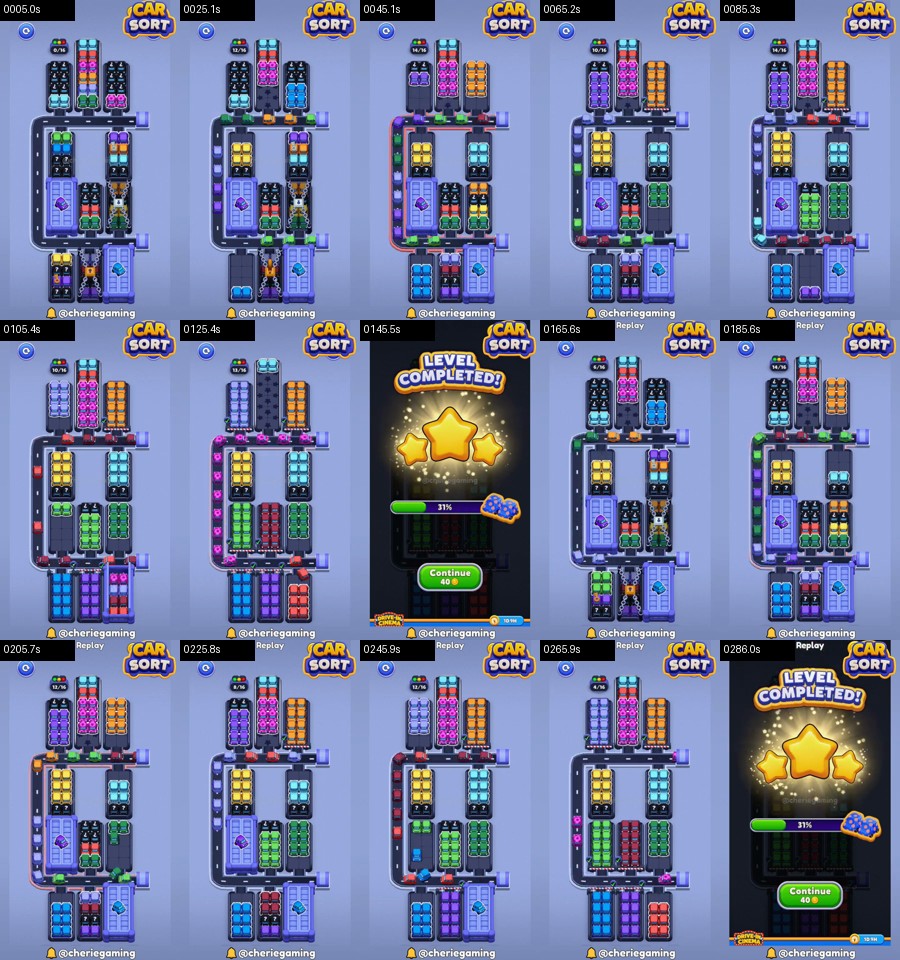
Read the board as a central tower
Upper garages show blue, orange, purple, cyan, and red. The inner tower holds green, yellow, pink, white, blue, and repeated red bands. Bottom columns add purple, green, cyan, orange, pink, and yellow. The two side roads reconnect at narrow top and bottom bends, leaving no passing lane when both contain traffic.
Use this route reference:
top blue-orange → purple-cyan → first green inner column → yellow and pink center → white release → red-blue middle → bottom purple-green → cyan-orange → second red/pink wave → yellow cleanup
Complete the face attached to the active numbered panel; do not merge repeated colors from different depths.
Open the top bends
Start with blue and orange, one tower at a time. Purple follows, then cyan. Red can wait if the first green inner column is already fully exposed. The purpose is to empty both top bends and create a dark cap over the center.
Before entering the tower, verify no marker remains on either side road. A top car can take several seconds to reach its garage after the counter changes.
Peel the first inner layers
Green is the first complete vertical face. Clear it, then yellow. Pink follows from the adjacent shelf. White appears deeper and should leave only after pink has opened a full dark column.
Red and blue form the middle handoff. Clear the face nearest the currently empty side road, wait, then clear the other. Their removal opens the bottom bend and exposes the lower garages.
The midpoint should show dark strips through the upper half of the tower and one or two solid lower columns. If colors remain scattered above, finish the incomplete green, yellow, pink, white, red, or blue face before descending.
Release the bottom in two waves
Purple and green are the first lower pair. Keep each batch on a single side road until complete. Cyan and orange follow, widening the lower entrance. A second red or pink face can then emerge from the center; clear it before the final yellow column.
Yellow is safest last because its tall lower group needs a side road from bottom to top. If both roads are dark, choose either; if one still contains a marker, wait rather than forcing yellow onto the other side.
Side-road recovery
A jam high on the board belongs to an unfinished top tower. A marker stopped halfway identifies the active inner layer. Trouble at the lower bend belongs to purple, green, cyan, orange, red, pink, or yellow below.
When two colors occupy opposite roads, finish the group whose full face remains visible. Do not alternate between them. One completed group turns its side into a recovery lane for the other.
If a numbered panel does not open, inspect the layer directly above or beside it. The missing batch is local. Activating a same-colored bottom column will not satisfy that panel and can block both roads.
Before completion, verify that every inner panel is dark, both top bends are clear, and only one solid lower face remains. Send that final group continuously.
Level 366 is a layered descent through a central tower. The upper pairs clear the bends, green-yellow-pink-white open the core, red-blue connect the lower half, and the bottom pairs finish using one side road at a time.
Preserve the empty side as insurance
It is tempting to use both side roads simultaneously because they look independent. They reconnect at both ends, however, and two batches can still meet at a bend. Keep the unused side empty until the active garage accepts its final car. That empty route is what lets a stranded marker continue if it pauses beside an inner shelf.
During the second wave, compare the height of the remaining faces. Clear the highest complete inner face before the lowest outer column. This top-down choice stops a late center car from trying to cross a stream already climbing from below. Once the tower is dark above the midpoint, the remaining lower columns can be cleared nearest-first without reopening the center.
Track the inner layers by height
Green should leave a dark vertical strip near the upper center. Yellow and pink widen that strip across the next shelf depth. White then creates a smaller but important pocket beside the side road. If these dark spaces do not appear in descending order, one layer is incomplete and the next counter should be ignored.
Red and blue are the boundary between center traffic and lower traffic. Their cars travel far enough to use both the middle road and a lower bend. Clear red, check the side it used, clear blue, and check again. Only after both checks should purple or green start from below.
When the second red or pink wave appears, compare it with the earlier center shelf. The late face sits lower and connects directly to the recently emptied bottom bays. Complete that local face; do not search upward for a same-colored remainder unless a marker is visibly stranded there.
If yellow is the sole remaining column but one side road still contains color, trace that marker upward. It usually belongs to cyan or orange from the prior pair. Finish the matching lower face and wait until the side is dark. Yellow's long route is safe only when the board has returned to one-direction traffic.
The final visual state has a dark central tower, open numbered panels, empty side roads, and one lower garage face. Meeting all four conditions is more reliable than counting how many colors have been cleared, particularly on a board with repeated red, blue, and green layers.