Car Sort: Color Puzzle Level 367 Solution Walkthrough
Route Reference
Key opening, middle, and finish positions for this route.
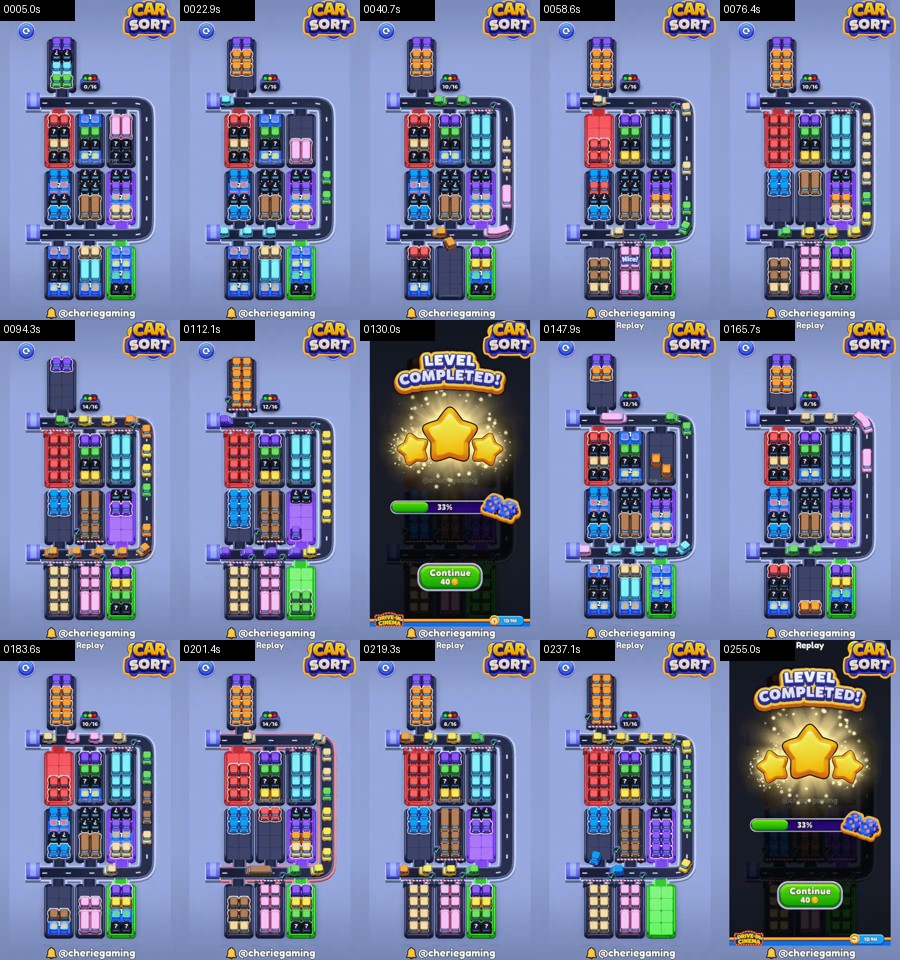
Locate the single feeder
The top tower shows orange, blue, green, and dark covered cells. Inside the rectangle, red and cyan occupy the upper rows, purple and yellow fill the middle, and green-blue bands sit lower. Bottom garages repeat pink, orange, white, cyan, and red. Since the top has only one entrance, a premature lower group can block it completely.
Use this route reference:
top orange → blue feeder → green upper release → red inner row → cyan center → purple-yellow bands → green-blue lower center → bottom pink-orange → white-cyan → red-yellow cleanup
Repeated orange and blue groups belong to different shelf cycles. Follow the currently exposed full face.
Drain the upper feeder
Clear orange first, then blue. Green follows after the top bend is empty. If another orange face appears behind the cover, leave it until the first inner red row has cleared.
The correct opening shows a dark top stalk and an unobstructed upper curve. Do not start the bottom pink columns while a feeder marker remains; both groups need the same loop corner.
Peel the center rectangle
Red is the first broad inner row. Cyan follows and opens the middle. Purple should leave before yellow when it occupies the inside edge. Clear both completely, then take the lower green and blue bands.
Each finished band creates a horizontal dark bay. Preserve these bays instead of inserting a partial bottom group. They provide the turning room needed for deeper center cars.
At the midpoint, the upper feeder is dark, the center has several empty rows, and a complete pink or orange bottom column touches the loop. Mixed center rows mean the peeling sequence is unfinished.
Clear the bottom fan
Pink and orange form the first lower pair. White and cyan follow. Clear the column nearest the open loop first and wait for every marker to disappear before selecting its neighbor.
Red and yellow are late groups. If a returning blue or green face remains inside, complete it before red-yellow. The final yellow column needs the entire lower curve and should not be split.
Recover by tracing the feeder
A jam at the top belongs to orange, blue, or green. Side-loop trouble points to red, cyan, purple, yellow, green, or blue inside. A lower blockage identifies the active bottom column. Complete the face in that same zone.
Do not activate a same-colored copy at another depth. It can target a different garage face and consume the empty loop. If two colors are already moving, finish the one with the shorter visible remainder.
Before completion, verify the feeder and center are dark and the bottom contains one solid face. The last group should circle the loop without stopping.
Level 367 is controlled by the single upper stalk. Orange-blue-green open it, the central bands are peeled from top to bottom, and the lower fan clears only after the loop becomes a wide empty route.
Useful checkpoints for the long middle
After red and cyan, the upper half of the rectangle should be dark. After purple and yellow, the center of the loop should look open from side to side. After green and blue, no colored row should touch the inner road. These three visual checkpoints catch an incomplete band before lower traffic hides it.
If one car remains in a row, continue the same color rather than moving to the next listed batch. The route order describes complete groups, not isolated taps. A single missed center car is enough to stop a later bottom column at the side bend.
During cleanup, use the dark center as a buffer but do not refill it with mixed colors. Finish white or cyan fully, verify the loop, then take red. Yellow goes last only when its entire column is exposed and both corners are clear. That final-state test is safer than relying on the apparent counter order.
Follow the feeder counter, not repeated colors
The top stalk can reveal another orange or blue face after the first center row changes. That returning face belongs to the next counter cycle. Leave it until the active red or cyan row has fully cleared the loop. Starting the feeder again too soon puts a downward stream against center traffic moving sideways.
At the purple-yellow handoff, compare the two sides of the inner rectangle. The side used by purple should be dark before yellow starts. Yellow normally has a wider face and needs both an empty side road and one empty center bay. If it pauses, finish the last purple car rather than adding yellow taps.
The lower green-blue bands are the final test before bottom traffic. Each should disappear into a clean horizontal stripe. A single remaining green or blue car can be difficult to notice against the lower fan, so scan the inner edge of the loop before choosing pink or orange.
If white and cyan become available together near cleanup, take the face closest to the lower bend. Clear it fully and preserve its garage bay. The second color can then use that bay when rounding the loop, while red and yellow remain parked for the final direct runs.
The intended finish has no movement from the feeder and no horizontal movement across the center. Only one stream should rise from the lower fan. If cars still enter from two directions, return to the zone that opened earlier and complete its visible face before continuing.
Before releasing that stream, confirm the top stalk shows a fully dark bay. A colored feeder face means the loop can still receive opposing traffic and the lower cleanup should wait.