Car Sort: Color Puzzle Level 368 Solution Walkthrough
Route Reference
Key opening, middle, and finish positions for this route.
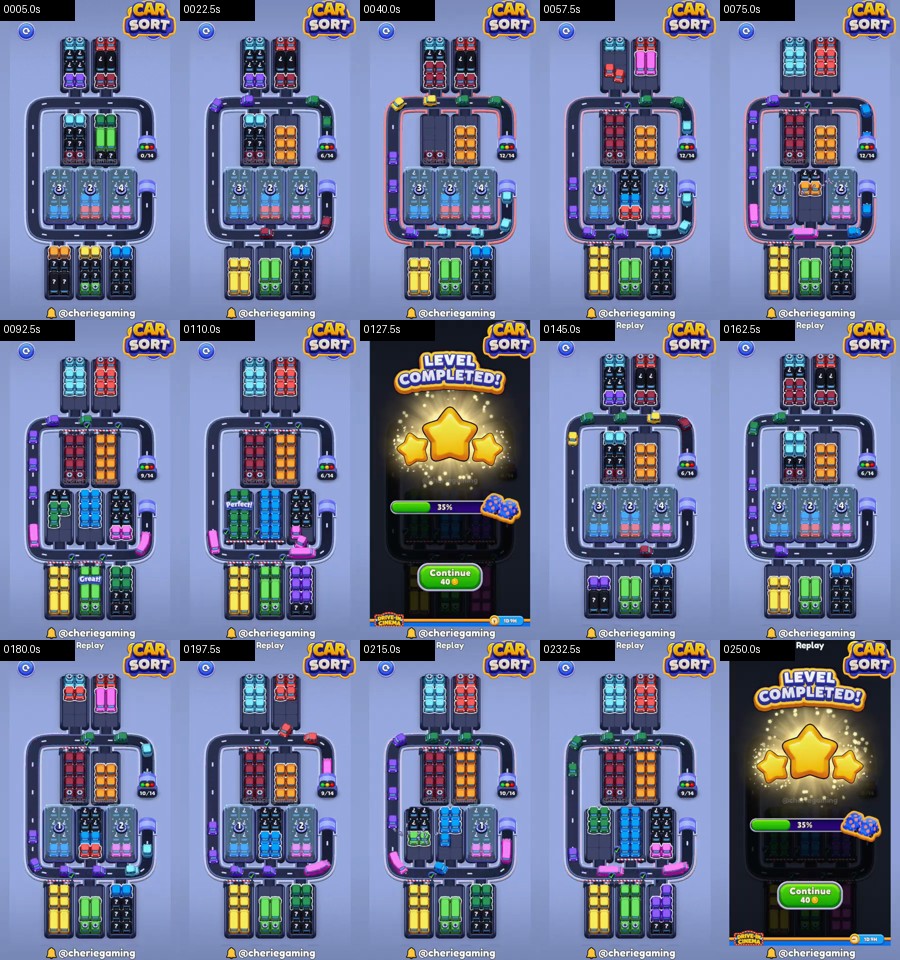
Read the four-sided frame
Orange, purple, cyan, and blue appear above. Red, yellow, green, pink, white, and blue fill the center. Bottom towers repeat purple, orange, cyan, red, green, and yellow. Side garages create several short entrances, but all cars eventually share the outer frame.
Use this route reference:
top orange-purple → cyan-blue → upper red center → yellow-green → pink and white → first bottom purple-orange → cyan-red → second green-blue release → yellow-pink cleanup
Complete one side of a pair before changing sides. Opposing cars cannot pass at the lower bends.
Open the top and upper center
Clear orange, then purple. Cyan and blue follow after the top edge empties. Red is the first inner row and should leave through the side already cleared by the upper groups.
Yellow and green form the next central pair. Finish yellow if it owns the inside lane, then green. Do not touch the bottom purple tower while the center still feeds cars onto the frame.
The opening checkpoint is a dark top edge, an empty upper half of the loop, and a complete pink or white center face.
Create a vertical channel
Clear pink and white separately. Their removal opens a dark vertical strip through the middle and reveals lower covered rows. A blue or cyan face may appear early; wait until the current marker has finished the side road.
The central channel is valuable buffer space. Do not fill it with two partial colors. A single complete group can turn through it; mixed traffic will block both exits.
Pay off the bottom towers
Purple and orange are the safest first lower pair. Clear the inside tower, check the corner, then take the outer one. Cyan and red follow. Green or blue may return from a released center row and should be cleared before yellow-pink cleanup.
Yellow usually has the taller final column. Clear pink first if both are exposed, leaving the full frame for yellow. A remaining white or cyan face must be completed before this final run.
Corner checks and recovery
Inspect the top corners after orange-purple-cyan-blue, the side edges after red-yellow-green-pink-white, and the bottom corners after every lower pair. A colored marker at any checkpoint means the current batch is incomplete.
A top jam belongs to an upper tower; a side jam belongs to an inner row; a lower jam belongs to a bottom column. Finish the local full face rather than opening the opposite side.
If two colors meet, stop tapping. Complete the group with fewer visible cars remaining. Its empty garage bay normally restores one full side of the frame. Restart only if both remaining faces are covered.
Before the last group, make sure the center channel and all four corners are dark. Send the remaining yellow, pink, or green column continuously.
Level 368 becomes predictable when the four-sided frame is treated as one road. Upper pairs clear the first half, central rows create a vertical buffer, and bottom pairs finish only after every preceding marker has left the corners.
Distinguish exposure from readiness
A numbered cover often reveals the top car of the next column while the previous color is still crossing the frame. That is exposure, not readiness. A ready group has a complete visible face, an empty corner on its side, and no marker from the prior batch. Require all three conditions before tapping.
If your replay diverges near the middle, examine the dark channel. It should widen after pink and white and remain empty through the first bottom pair. If it contains red or cyan, finish that color before continuing. The channel is the board's only spare capacity during the late release.
For the final two columns, choose the shorter route first. A face beside the open lower corner can clear without crossing the whole frame; its empty bay then gives the far column an unobstructed final path. This position-based choice resolves ambiguity when both counters look available.
Manage the central stack after white
White marks the point where the route changes from inner peeling to lower release. Its face is smaller than the neighboring pink and red rows, so the counter may change quickly. Still wait for the white marker to clear a side edge; the first purple or orange bottom car needs that same corner.
When red returns behind a lower cover, determine whether it is attached to the center or the bottom bank. A horizontal red face should clear before another vertical column. A vertical red face belongs with the later lower pair. Position, rather than color alone, preserves the intended sequence.
The first bottom purple-orange pair should leave a dark pocket along the lower edge. Use that pocket as the checkpoint before cyan-red. If it remains occupied, complete the closer column. Moving to cyan while orange still turns can fill both bottom corners.
During a recovery, watch which side road the stranded marker faces. Continue the shelf on that same side until the marker reaches an open bay. Crossing to the opposite side introduces head-on traffic, even though the rectangular frame appears to offer two routes.
Before cleanup, the central stack should read as vertical dark gaps from the former green row down to the released cover. If one gap contains blue, red, or pink, finish that group. The final yellow-pink run succeeds only when those inner gaps stay empty.
At completion, no marker should circle behind the remaining column. Wait for a fully still frame, then release the last solid face through the nearest empty corner.