Car Sort: Color Puzzle Level 370 Solution Walkthrough
Route Reference
Key opening, middle, and finish positions for this route.
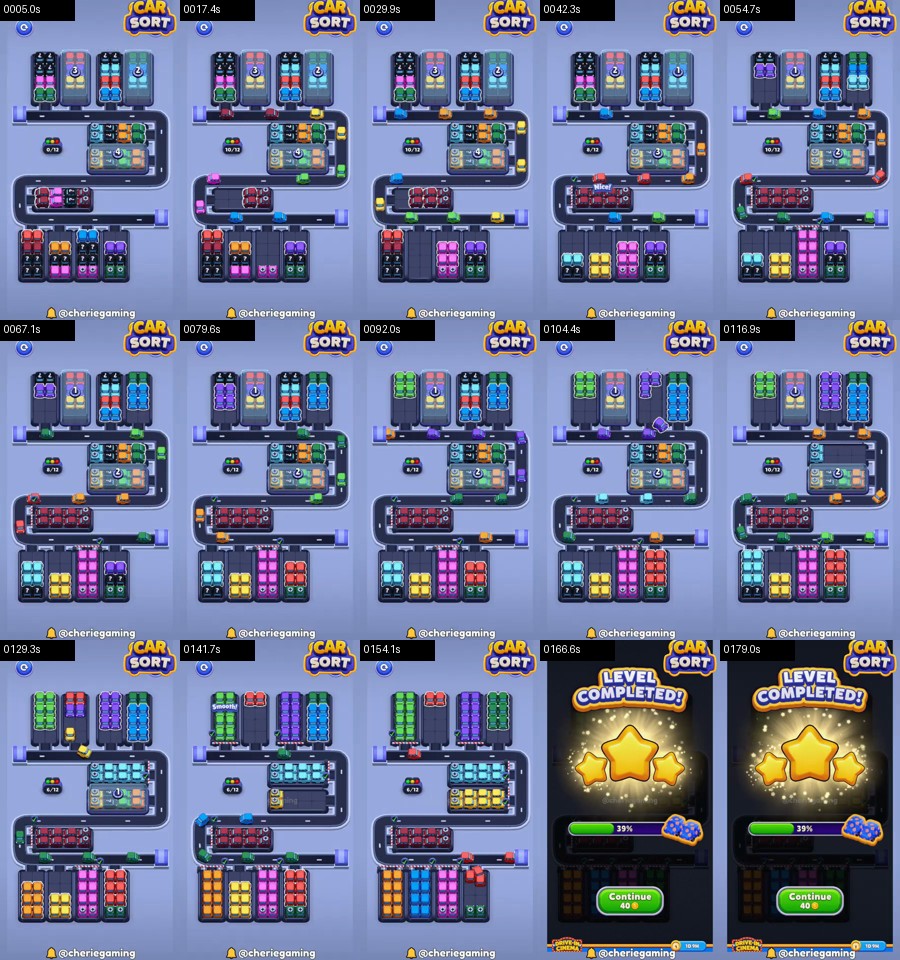
Follow the zigzag from the upper mouth
Upper garages show purple, cyan, blue, red, green, and orange. The central band contains red, pink, yellow, cyan, and covered rows. Bottom columns add green, blue, purple, orange, yellow, and white. Each bend is a single-car bottleneck.
Use this route reference:
upper purple-cyan → blue-red → green-orange → first red center row → pink-yellow band → cyan release → bottom green-blue → purple-orange → white-red → yellow cleanup
At every direction change, finish the active color before selecting a face beyond the next bend.
Clear the upper staircase
Start with purple and cyan. Blue and red follow, then green and orange. Work down the stepped shelf rather than jumping to a matching color below.
After each pair, inspect the next corner. The upper phase ends when all visible top shelves are dark and a complete red center row faces an empty bend. A lower green column may already be visible but is not ready.
Open the long middle band
Red clears first. Pink and yellow follow as separate horizontal batches. Cyan is the release color at the far end of the band; it needs all the dark space created by the previous rows.
Do not react immediately when a covered row opens. Let the current marker clear the next corner. The correct midpoint has a largely dark horizontal middle and an unobstructed zigzag from the top mouth to the lower bend.
Descend through the bottom pairs
Green and blue are the first lower columns. Purple and orange follow. White should leave before the returning red face if it occupies the inside corner; otherwise finish red first. Yellow is the final long column.
Keep each pair local. Switching from a left column to a far-right column forces cars through multiple bends and can meet the tail of the previous batch.
Diagnose a blocked corner
The height of the jam tells you the missing batch. High trouble belongs to purple, cyan, blue, red, green, or orange above. A middle jam points to red, pink, yellow, or cyan. A lower jam belongs to the active bottom column.
Complete the face immediately before the blocked bend. Do not open a same-colored group farther down the zigzag. If two colors occupy adjacent bends, finish the one with the shorter visible remainder.
Before the last yellow group, trace the road visually from bottom to top. Every corner should be dark and no center face should remain mixed. Send yellow in one batch.
Level 370 is a shelf-by-shelf descent. The upper staircase opens the route, the red-pink-yellow-cyan middle band straightens it, and the lower columns then clear in nearby pairs.
A bend-by-bend checkpoint method
Rather than watching every garage counter, check the road at three landmarks: the top elbow after green-orange, the middle reversal after pink-yellow, and the lower elbow after each bottom pair. A clear landmark proves the previous batch has completed its entire path.
If a counter changes but a landmark still holds a colored marker, wait. The next face may be exposed, yet its first car would enter the same corner. This is particularly important before cyan in the middle and before the final yellow column.
During recovery, never tap behind the blocked corner. Work backward one shelf and finish the color that owns the marker. Once it disappears, the dark horizontal bay behind it becomes buffer. This local repair is more reliable than restarting the whole level or trying to balance traffic across the zigzag.
Read the direction of each shelf
The upper purple-cyan pair approaches the first elbow from one direction, while blue-red enters after the road reverses. Green-orange completes that staircase from the opposite side. Finish each pair before the reversal; otherwise their tails can occupy adjacent corners with no straight section between them.
In the middle, red creates the first long dark shelf. Pink uses that shelf as a passing pocket, and yellow expands it toward the next bend. Cyan should not start until the entire band behind it is dark. This sequence is the board's main space-building mechanism.
When lower green and blue become visible, inspect whether their column mouths point toward the same elbow. Clear the inside one first. The outside column may look more open, but its cars must cross the mouth of the inner column and can trap the last marker there.
White is a short cleanup group that often appears beside the returning red face. If white already touches the empty shelf, clear it first. If red occupies the inside bend, finish red instead. The road geometry, not a rigid color preference, decides this small late swap.
Before yellow, every zigzag segment should appear dark in a continuous chain. Trace it from the bottom mouth through the center reversal to the top. A colored break identifies the exact shelf that still needs completion and prevents a blind final attempt.
If the final column stalls after one bend, stop tapping and revisit the preceding horizontal shelf. One car from orange, purple, white, or red may still own that segment. Finishing it reopens the route without disturbing the rest of the solved board.
The completion layout should show empty shelves stepping down in the same shape as the road. When those dark bars form one continuous staircase, the remaining yellow face is safe. If a bar still contains color, treat it as an unfinished checkpoint rather than part of cleanup.
Let the final yellow marker disappear from the upper elbow before making any extra tap.
Also inspect the center reversal after that marker passes. A uniformly dark elbow confirms the yellow garage accepted the whole batch and no hidden shelf car remains.